Should Menopause Hormone Therapy Prevent Heart Disease?
Hormone therapy can treat menopause symptoms, but it isn’t a proven way to prevent heart attacks or other cardiovascular events.
Menopausal hormone therapy is used mainly to relieve symptoms such as hot flashes and, in some cases, to help prevent bone loss. It should not be started to prevent heart disease: trials have not shown that it prevents coronary events, and some regimens increased risks such as stroke or blood clots. Heart prevention calls for its own risk assessment and plan. 3 5 6
Symptom relief and heart prevention are different goals
Hormone therapy can be highly effective for bothersome hot flashes and other vasomotor symptoms. The North American Menopause Society also identifies prevention of bone loss as a potential benefit. Those are separate reasons to consider treatment, not evidence that hormone therapy prevents heart attacks, strokes, or other cardiovascular disease. 5
A change in a cholesterol result or another risk marker, by itself, would not prove that a treatment prevents a heart attack. The meaningful question is whether people taking it have fewer clinical events. In trials, hormone therapy has not established that benefit. 3 6
What the heart-outcome trials found
A 2026 Cochrane review summarized randomized trials comparing hormone therapy with placebo. In the Women’s Health Initiative trial of 16,608 postmenopausal women with a uterus, combined conjugated equine estrogen and medroxyprogesterone acetate probably made little to no difference to coronary events over an average of 5.6 years: the relative risk was 1.17 (95% confidence interval 0.95 to 1.44). The review found that this regimen may increase stroke and blood-clot risk. 6
In a separate Women’s Health Initiative trial of 10,739 postmenopausal women who had undergone hysterectomy, estrogen-only therapy also probably made little to no difference to coronary events over an average of seven years (relative risk 0.94, 95% confidence interval 0.78 to 1.13). It probably increased stroke risk. These results concern the specific oral regimens studied; they don’t mean every hormone therapy formulation has identical effects or predict an individual woman’s risk. 6
The evidence is also weighted toward older postmenopausal women: in the Cochrane review, only about 30% of participants were ages 50 to 59 at the start of the studies. A separate trial in women with established coronary heart disease found no cardiovascular benefit from combined estrogen and progestin therapy. 3 6
Age and timing shape the treatment discussion
Age and time since menopause matter when weighing hormone therapy’s benefits and risks. The 2022 Menopause Society position statement says the benefit-risk balance is generally more favorable for healthy women younger than 60 or within 10 years of menopause who are treating bothersome symptoms or seeking to prevent bone loss. Starting later or at an older age brings greater absolute risks of coronary heart disease, stroke, blood clots, and dementia. That timing distinction helps guide symptom treatment; it does not turn hormone therapy into heart prevention. 5
So if you’re considering hormone therapy, the useful question is whether its expected benefits for your symptoms or bones fit your health history and preferences. The answer can depend on the type of therapy, whether a progestogen is included, route, timing, and other factors. It shouldn’t be chosen as a substitute for proven cardiovascular risk assessment and prevention. 5
Make a separate plan for heart health
Heart risk is shaped by factors including age, family history, blood pressure, cholesterol and triglycerides, and diabetes. Some can be changed or managed. For a practical conversation, ask what your blood pressure and cholesterol results mean for you, whether diabetes or family history affects your risk, and which prevention steps are appropriate in your situation. 1 4
A heart-prevention plan may involve addressing blood pressure and cholesterol, alongside other relevant health and lifestyle factors. Medicines may be part of prevention when indicated; for example, cholesterol-lowering medicines can reduce cardiovascular risk. The right plan depends on your overall risk, not on whether you use menopause hormone therapy. 1 2
You can discuss symptom treatment and heart prevention in the same visit, but keep the goals distinct: one plan addresses menopause symptoms or bone health, and the other addresses your cardiovascular risk.
Two goals, two decisions
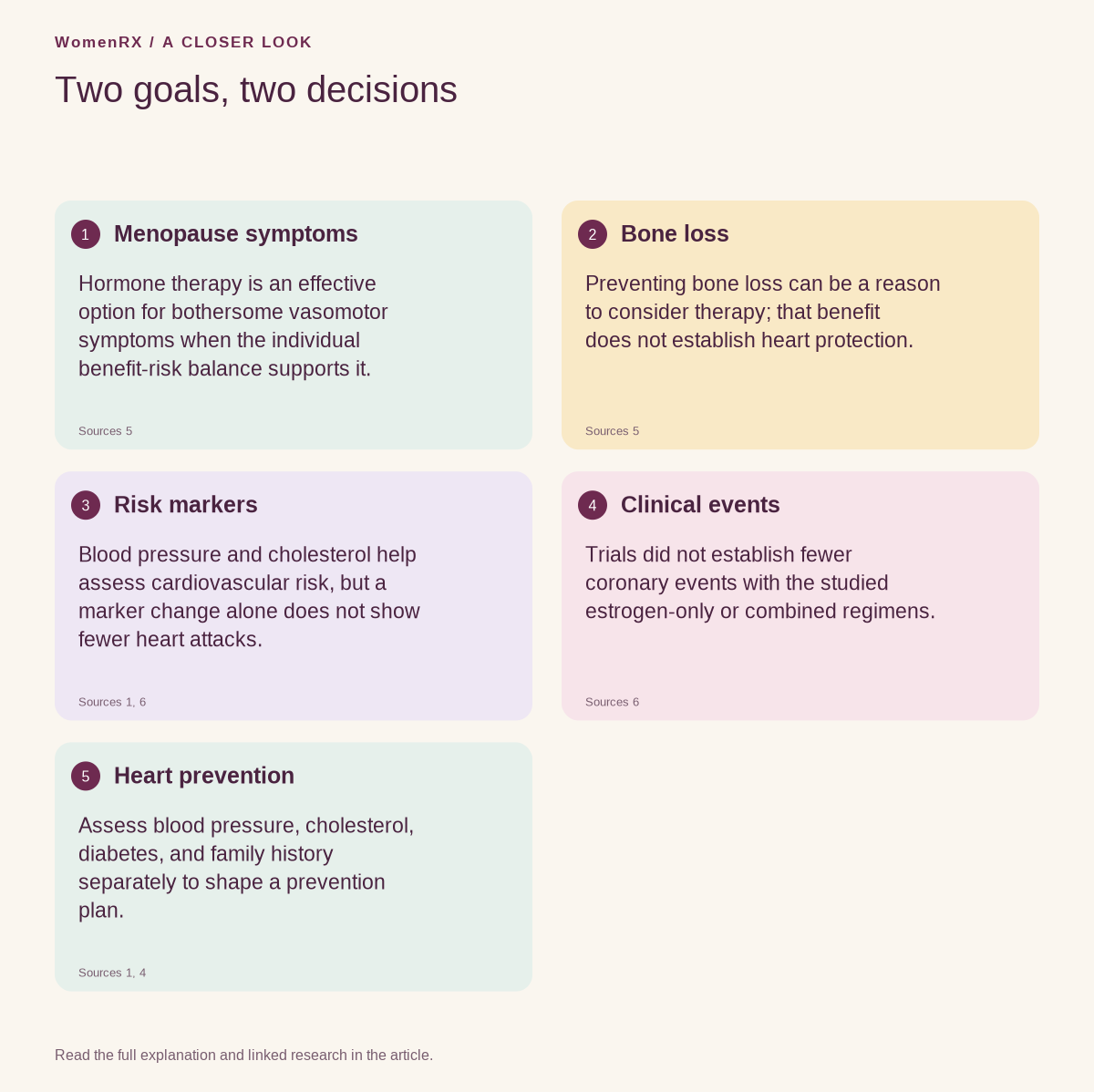
Menopause symptoms: Hormone therapy is an effective option for bothersome vasomotor symptoms when the individual benefit-risk balance supports it.5
Bone loss: Preventing bone loss can be a reason to consider therapy; that benefit does not establish heart protection.5
Risk markers: Blood pressure and cholesterol help assess cardiovascular risk, but a marker change alone does not show fewer heart attacks.16
Clinical events: Trials did not establish fewer coronary events with the studied estrogen-only or combined regimens.6
Heart prevention: Assess blood pressure, cholesterol, diabetes, and family history separately to shape a prevention plan.14
Read the figure as text
Hormone therapy and cardiovascular prevention address different goals. A lab result is not the same as a clinical outcome such as a heart attack.- Menopause symptoms: Hormone therapy is an effective option for bothersome vasomotor symptoms when the individual benefit-risk balance supports it.5
- Bone loss: Preventing bone loss can be a reason to consider therapy; that benefit does not establish heart protection.5
- Risk markers: Blood pressure and cholesterol help assess cardiovascular risk, but a marker change alone does not show fewer heart attacks.16
- Clinical events: Trials did not establish fewer coronary events with the studied estrogen-only or combined regimens.6
- Heart prevention: Assess blood pressure, cholesterol, diabetes, and family history separately to shape a prevention plan.14
More questions, answered
Does starting hormone therapy soon after menopause protect my heart?
Starting earlier can make the benefit-risk balance more favorable when hormone therapy is being considered for symptoms or bone loss in an otherwise appropriate candidate. It is not a recommendation to use it for heart-disease prevention. 5
Are estrogen-only and combined hormone therapy the same for heart risk?
No. The trials summarized in the Cochrane review studied different groups and regimens, and their risk profiles differed. Neither trial established that its regimen prevents coronary events. 6
Sources you can check
- Heart Disease Prevention | MedlinePlusAccessed 2026-09-25Return to first citation
- Cardiovascular disease - NHSAccessed 2026-09-25Return to first citation
- PREMPHASE (CONJUGATED ESTROGENS AND MEDROXYPROGESTERONE ACETATE) KIT PREMPRO (CONJUGATED ESTROGENS AND MEDROXYPROGESTERONE ACETATE) TABLET, SUGAR COATED [WYETH PHARMACEUTICALS LLC, A SUBSIDIARY OF PFIZER INC.] | US prescribing information and patient instructionsAccessed 2026-09-25Return to first citation
- Heart Disease in Women | MedlinePlusAccessed 2026-09-25Return to first citation
- The 2022 hormone therapy position statement of The North American Menopause Society.“The 2022 Hormone Therapy Position Statement of The North American Menopause Society” Advisory Panel. · Menopause (New York, N.Y.) · 2022Return to first citation
- Long-term hormone therapy for perimenopausal and postmenopausal women.Bofill Rodriguez M, Yong LN, Mirkov S, Bekos C, Lethaby A, Farquhar C. · The Cochrane database of systematic reviews · 2026Return to first citation