Starting Menopause Hormone Therapy After 60
Age 60 isn’t an automatic cutoff, but a first start later in life calls for a closer look at timing, symptoms, and personal health risks.
For a first start after age 60 or more than 10 years after menopause, the benefit-risk balance generally appears less favorable than for starting earlier. That isn’t an automatic prohibition: the decision depends on what symptoms you’re treating, your health history, and the treatment being considered. Continuing therapy begun earlier is a different question and calls for its own review. 2
A first start and ongoing treatment are different decisions
If you’re over 60 and haven’t used menopause hormone therapy before, age is part of the decision, not the whole answer. The North American Menopause Society says the benefit-risk balance appears less favorable when treatment is first started after age 60 or more than 10 years after menopause. The reason is that the absolute risks of coronary heart disease, stroke, blood clots, and dementia are greater in these groups. This guidance does not make age 60 an automatic cutoff. 2
Continuing treatment you began earlier is a separate question. Longer use may be considered for a documented reason, such as persistent hot flashes, with shared decision-making and periodic reassessment. The guidance on a later first start shouldn’t be turned into an automatic instruction to stop an existing treatment. 2
Start with the reason you want treatment
Systemic hormone therapy is the most effective treatment for hot flashes and night sweats, and hormone therapy can help prevent bone loss. Those are different goals from preventing heart disease or dementia. In particular, US prescribing information says estrogen-plus-progestin therapy should not be used to prevent cardiovascular disease or dementia. That statement is specific to estrogen-plus-progestin therapy, not a claim that every hormone regimen has identical effects. 2 1
Bone health deserves its own discussion. Hormone therapy can prevent bone loss, but that benefit by itself does not settle whether a first start after 60 is a good choice for you. The timing-related balance still matters, as do your health history and the particular treatment under consideration. 2
If your main concern is vaginal or urinary discomfort rather than hot flashes, ask whether you need a whole-body treatment at all. For bothersome genitourinary symptoms that haven’t improved with over-the-counter options, the Menopause Society recommends considering low-dose vaginal estrogen or certain other treatments when there is no indication for systemic therapy. 2
The treatment and your health history both matter
Hormone therapy isn’t one interchangeable product. Risks can vary with the formulation, dose, route, duration, timing of initiation, and whether a progestogen is used. Cardiovascular disease and estrogen-dependent cancers are examples of conditions that may make someone a poor candidate for hormone therapy; they are reasons to assess your situation carefully, not a complete list of individual risks. 2 3
Research on one formulation shouldn’t be used as a personal risk estimate for every other one. For example, a review summarized a trial comparing continuous oral conjugated estrogen plus medroxyprogesterone with placebo in 16,608 postmenopausal women with a uterus. Over an average 5.6 years, that specific combined treatment probably increased breast cancer risk and may have increased stroke and blood-clot risks. The review reported different results for estrogen-only therapy in women who had undergone hysterectomy. These findings help explain why the exact regimen matters, but they don’t establish the risks of every formulation or predict an individual’s outcome. 4
What a useful decision looks like
A practical way to frame the discussion is to be specific about the problem you want treatment to solve. Are hot flashes disrupting sleep or daily life? Are symptoms mainly vaginal? Is bone loss part of the question? Then weigh the potential benefit for that concern against your health history and the timing of a first start. The goal is a decision about a real symptom or health concern, not an assumption that hormone therapy prevents future disease.
If systemic therapy isn’t a good fit for hot flashes, evidence-based nonhormonal options include cognitive behavioral therapy, clinical hypnosis, and some prescription treatments. The options supported by the Menopause Society include several different approaches, so the right discussion depends on your symptoms and preferences. 3
In short, starting after 60 can’t be answered with a universal yes or no. The balance is generally less favorable than with earlier initiation, while continuing an earlier treatment is a distinct decision that should be reassessed around its ongoing reason for use. 2
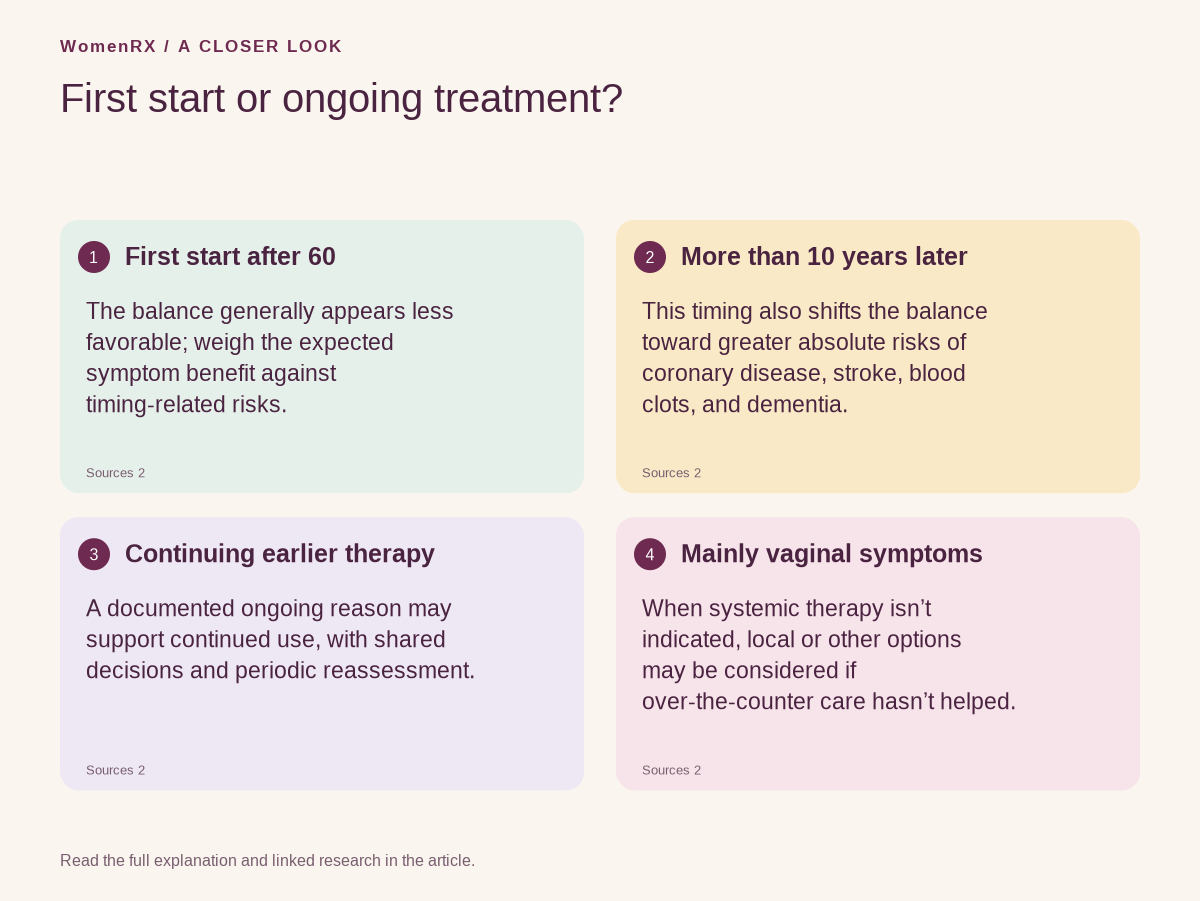
First start or ongoing treatment?
First start after 60: The balance generally appears less favorable; weigh the expected symptom benefit against timing-related risks.2
More than 10 years later: This timing also shifts the balance toward greater absolute risks of coronary disease, stroke, blood clots, and dementia.2
Continuing earlier therapy: A documented ongoing reason may support continued use, with shared decisions and periodic reassessment.2
Mainly vaginal symptoms: When systemic therapy isn’t indicated, local or other options may be considered if over-the-counter care hasn’t helped.2
Read the figure as text
The question changes depending on whether you’re considering a new start, reviewing an existing treatment, or treating mainly local symptoms.- First start after 60: The balance generally appears less favorable; weigh the expected symptom benefit against timing-related risks.2
- More than 10 years later: This timing also shifts the balance toward greater absolute risks of coronary disease, stroke, blood clots, and dementia.2
- Continuing earlier therapy: A documented ongoing reason may support continued use, with shared decisions and periodic reassessment.2
- Mainly vaginal symptoms: When systemic therapy isn’t indicated, local or other options may be considered if over-the-counter care hasn’t helped.2
More questions, answered
Does turning 60 mean I have to stop hormone therapy?
No. Guidance distinguishes a first start after 60 from continuing a treatment begun earlier. Continuing may be considered for a documented reason, such as persistent hot flashes, with periodic review of its benefits and risks. 2
What if my symptoms are mostly vaginal?
If over-the-counter options haven’t helped and you don’t have a reason to use systemic therapy, low-dose vaginal estrogen or certain other treatments may be considered for bothersome genitourinary symptoms. 2
Sources you can check
- PREMPHASE (CONJUGATED ESTROGENS AND MEDROXYPROGESTERONE ACETATE) KIT PREMPRO (CONJUGATED ESTROGENS AND MEDROXYPROGESTERONE ACETATE) TABLET, SUGAR COATED [WYETH PHARMACEUTICALS LLC, A SUBSIDIARY OF PFIZER INC.] | US prescribing information and patient instructionsAccessed 2026-09-25Return to first citation
- The 2022 hormone therapy position statement of The North American Menopause Society.“The 2022 Hormone Therapy Position Statement of The North American Menopause Society” Advisory Panel. · Menopause (New York, N.Y.) · 2022Return to first citation
- The 2023 nonhormone therapy position statement of The North American Menopause Society.Menopause (New York, N.Y.) · 2023Return to first citation
- Long-term hormone therapy for perimenopausal and postmenopausal women.Bofill Rodriguez M, Yong LN, Mirkov S, Bekos C, Lethaby A, Farquhar C. · The Cochrane database of systematic reviews · 2026Return to first citation