How to Weigh Menopause Hormone Therapy Benefits and Risks
Start with the symptom you want to treat, then compare the specific treatment with your timing, health history, and other options.
Menopause hormone therapy is the most effective treatment for bothersome hot flashes, but it doesn’t have one safety profile. The balance depends on your treatment goal, age and time since menopause, health history, whether you have a uterus, and the hormones and route being considered. If symptoms are mainly vaginal or urinary, a local treatment may make more sense than systemic therapy. 4
First, decide what benefit you’re weighing
If hot flashes or night sweats are disrupting your sleep or day, systemic hormone therapy offers the strongest symptom relief. It can also prevent bone loss and fractures. For someone younger than 60 or within 10 years of menopause onset, without contraindications, the benefit-risk balance is generally favorable when treating bothersome hot flashes or preventing bone loss. That’s a useful starting point, not a verdict about your individual health. 4
The calculation changes if you’re considering hormones without a symptom-treatment goal. Bone protection may be relevant, but hormone therapy shouldn’t be used to prevent heart disease or dementia. When the expected benefit is unclear, even a modest risk can be harder to justify. 124
Timing matters as well. For people starting after age 60 or more than 10 years after menopause onset, the benefit-risk balance appears less favorable because the absolute risks of coronary heart disease, stroke, blood clots in the veins, and dementia are greater. The question is not just whether you can take hormones, but what you expect them to do for you now. 4
Compare the actual treatment, not “HRT” as a category
Whether you have a uterus changes the regimen. Systemic estrogen alone increases the risk of cancer of the uterine lining in someone with a uterus. If estrogen is proposed and you have a uterus, ask how the plan addresses that risk. 17
The Women’s Health Initiative trials show why the distinction matters. In long-term follow-up, women with a uterus who had been assigned oral conjugated equine estrogens plus medroxyprogesterone acetate had more breast cancer diagnoses than those assigned placebo. In a separate trial of women with a prior hysterectomy, those assigned oral conjugated equine estrogens alone had fewer breast cancer diagnoses and deaths than those assigned placebo. Participants were postmenopausal and aged 50 to 79 at enrollment. These results describe specific medicines in different groups; they don’t prove that changing only the progestogen would produce the same difference, or predict the outcome of a patch or gel. 123
Route matters, particularly when discussing clots. The oral estrogen regimens studied in the WHI had increased blood-clot risks compared with placebo. A clinical review reports greater venous clot risk with oral formulations, while transdermal estradiol with micronized progesterone did not appear to increase that risk. That apparent route difference is worth discussing, but it isn’t a promise that a patch or gel eliminates clot risk or settles breast, uterine, and other risks. 126
Your history belongs in this comparison. For example, cardiovascular disease or an estrogen-dependent cancer may make systemic hormones a poor fit; a personal history relevant to breast cancer, stroke, or blood clots deserves attention before choosing a regimen. The aim is to compare the expected relief with the risks that matter to you, rather than apply the average trial result as your personal forecast. 45
Match an alternative to the symptom
If your main concern is vaginal dryness or other bothersome vaginal or urinary symptoms, you may not need systemic treatment. When over-the-counter measures haven’t helped and there’s no other reason for systemic therapy, low-dose vaginal estrogen or other treatments are options recommended by the North American Menopause Society. That’s a different decision from taking systemic hormones for hot flashes. 4
If hot flashes are the problem and you’d rather avoid systemic hormones, or they aren’t suitable for you, evidence-supported nonhormonal options include menopause-focused cognitive behavioral therapy, clinical hypnosis, and certain prescription medicines, including SSRIs or SNRIs, gabapentin, and fezolinetant. They aren’t all equivalent choices for every person, and hormone therapy remains the most effective treatment for hot flashes. 45
A useful decision starts with five specifics: What am I treating? When did menopause begin? Do I have a uterus? Which hormones and route are being proposed? What in my health history changes the comparison? Then ask what you could reasonably expect from an alternative aimed at the same symptom. If you choose treatment, revisit whether its benefits still match your symptoms and priorities over time. 45
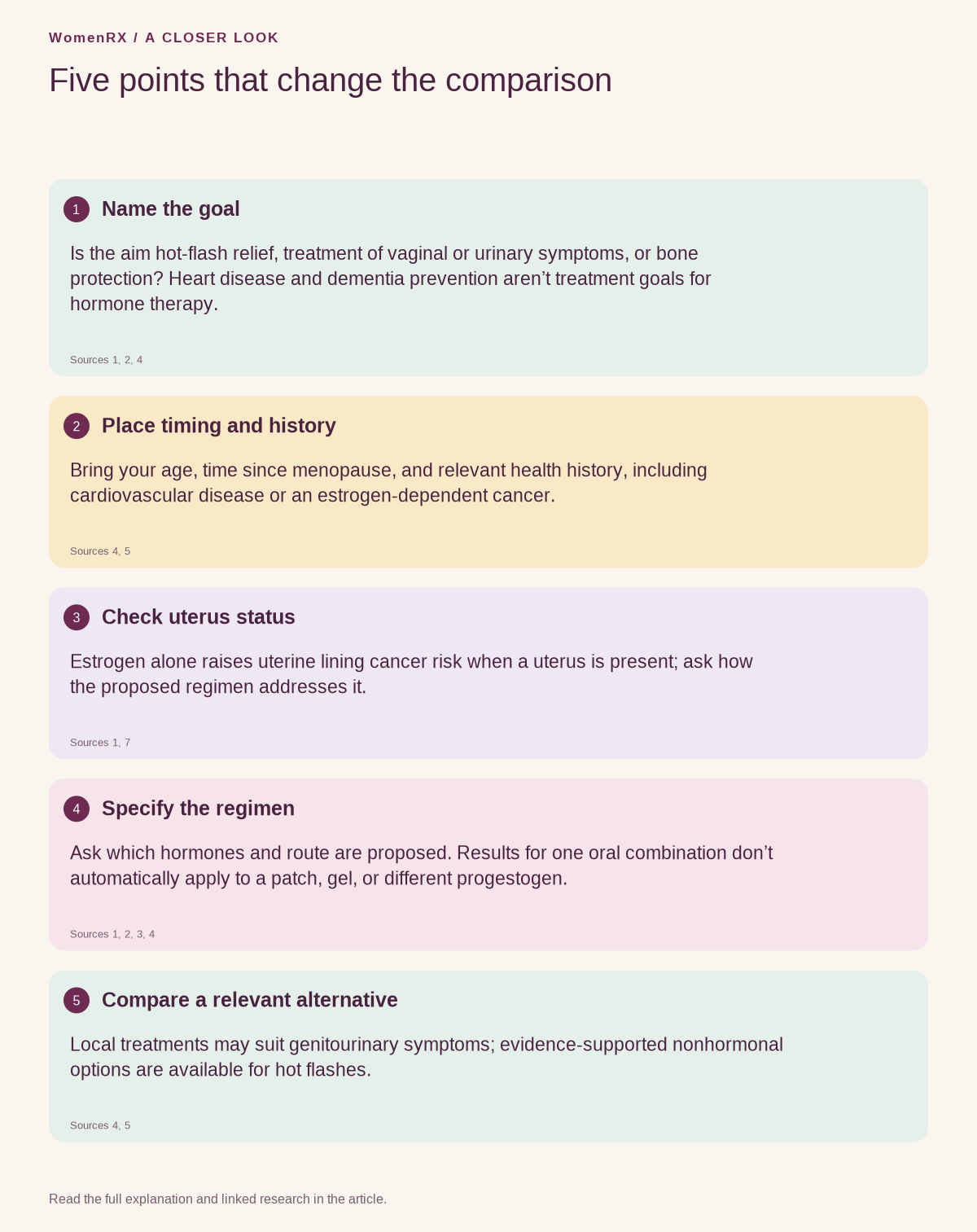
Five points that change the comparison
Name the goal: Is the aim hot-flash relief, treatment of vaginal or urinary symptoms, or bone protection? Heart disease and dementia prevention aren’t treatment goals for hormone therapy.124
Place timing and history: Bring your age, time since menopause, and relevant health history, including cardiovascular disease or an estrogen-dependent cancer.45
Check uterus status: Estrogen alone raises uterine lining cancer risk when a uterus is present; ask how the proposed regimen addresses it.17
Specify the regimen: Ask which hormones and route are proposed. Results for one oral combination don’t automatically apply to a patch, gel, or different progestogen.1234
Compare a relevant alternative: Local treatments may suit genitourinary symptoms; evidence-supported nonhormonal options are available for hot flashes.45
Read the figure as text
Use these questions to compare a proposed treatment with the benefit you actually want.- Name the goal: Is the aim hot-flash relief, treatment of vaginal or urinary symptoms, or bone protection? Heart disease and dementia prevention aren’t treatment goals for hormone therapy.124
- Place timing and history: Bring your age, time since menopause, and relevant health history, including cardiovascular disease or an estrogen-dependent cancer.45
- Check uterus status: Estrogen alone raises uterine lining cancer risk when a uterus is present; ask how the proposed regimen addresses it.17
- Specify the regimen: Ask which hormones and route are proposed. Results for one oral combination don’t automatically apply to a patch, gel, or different progestogen.1234
- Compare a relevant alternative: Local treatments may suit genitourinary symptoms; evidence-supported nonhormonal options are available for hot flashes.45
Sources you can check
- PREMARIN (ESTROGENS, CONJUGATED) TABLET, FILM COATED [WYETH PHARMACEUTICALS LLC, A SUBSIDIARY OF PFIZER INC.] | US prescribing information and patient instructionsAccessed 2026-09-25Return to first citation
- PREMPHASE (CONJUGATED ESTROGENS AND MEDROXYPROGESTERONE ACETATE) KIT PREMPRO (CONJUGATED ESTROGENS AND MEDROXYPROGESTERONE ACETATE) TABLET, SUGAR COATED [WYETH PHARMACEUTICALS LLC, A SUBSIDIARY OF PFIZER INC.] | US prescribing information and patient instructionsAccessed 2026-09-25Return to first citation
- Association of Menopausal Hormone Therapy With Breast Cancer Incidence and Mortality During Long-term Follow-up of the Women's Health Initiative Randomized Clinical Trials.Chlebowski RT, Anderson GL, Aragaki AK, Manson JE, Stefanick ML, Pan K, Barrington W, Kuller LH, Simon MS, Lane D, Johnson KC, Rohan TE, Gass MLS, Cauley JA, Paskett ED, Sattari M,... · JAMA · 2020Return to first citation
- The 2022 hormone therapy position statement of The North American Menopause Society.“The 2022 Hormone Therapy Position Statement of The North American Menopause Society” Advisory Panel. · Menopause (New York, N.Y.) · 2022Return to first citation
- The 2023 nonhormone therapy position statement of The North American Menopause Society.Menopause (New York, N.Y.) · 2023Return to first citation
- Management of menopausal hormone therapy.Switzer J, Vignali L, Vignali J, Jackson R. · Current opinion in obstetrics & gynecology · 2026Return to first citation
- Recommendations | Menopause: identification and management | Guidance | NICEAccessed 2026-09-25Return to first citation