Menopause Hormone Therapy for Mood: What to Know
Hormone therapy may ease some menopause-associated mood symptoms, but persistent depression or anxiety needs its own assessment and care.
Menopause hormone therapy can help some mood symptoms during the menopause transition, but it isn’t an established stand-alone treatment for depression. Clinic studies have found mood improvement after starting or adjusting therapy, though they can’t show that hormones caused it. If low mood or loss of interest lasts at least two weeks or disrupts daily life, ask for a depression assessment; menopause care and mental-health care can happen together. 5 6 1
First, look at the pattern, not just the timing
Mood changes can happen during perimenopause and early postmenopause, but being at this stage of life doesn’t automatically make every mood symptom hormonal. Menopause guidance recognizes mood disturbance as a possible menopause-related symptom. At the same time, depression can have biological, psychological, and environmental contributors, and medical conditions or medicines can sometimes cause similar symptoms. 7 1
A useful starting distinction is whether the mood change is part of a broader menopause symptom picture or whether it has become a persistent problem in its own right. For example, someone might notice irritability or emotional ups and downs alongside bothersome hot flashes. That pattern is worth discussing as part of menopause care. Low mood or loss of interest that lasts most of the day, nearly every day, for at least two weeks, especially when it makes work, sleep, or everyday tasks difficult, calls for a depression assessment too. 1
These possibilities can overlap. You don’t have to decide for yourself whether a symptom is “hormonal” before asking for help.
What the evidence says about hormone therapy and mood
The evidence suggests a possible benefit for menopause-associated mood symptoms, but it doesn’t establish hormone therapy as a treatment for clinical depression. A systematic review of menopause guidelines found that higher-quality guidelines consistently included menopause-associated mood disturbance among potential reasons to consider systemic hormone therapy, while distinguishing it from clinical depression. 7
Two clinic studies found that mood symptoms improved after hormone therapy was started or adjusted. In a Canadian menopause-clinic study, 170 participants completed symptom questionnaires at an initial visit and again 3 to 12 months later; hormone therapy use was associated with improved depressive-symptom scores, both on its own and alongside an antidepressant. A retrospective UK clinic study of 920 women also found lower average mood-symptom scores after hormone therapy was started or optimized. 5 6
Those findings are encouraging, but both studies followed people receiving care in specialist clinics rather than randomly assigning treatment against a control group. They show an association, not proof that hormone therapy caused the improvement or that it will treat a depressive disorder. The studies also don’t establish that every hormone regimen has the same effect for every person. 5 6
Hormone therapy has clearer support for bothersome hot flashes and night sweats than for depression. Its risks and benefits vary with factors such as the type and route of therapy, timing, and whether a progestogen is used, so decisions are individualized and revisited over time. 3
When to seek mental-health care
Don’t wait for menopause symptoms to end before getting a mental-health assessment if low mood or loss of interest persists for at least two weeks, occurs nearly every day, or is interfering with daily life. Depression doesn’t always feel like sadness; symptoms can vary, and irritability may be part of the picture. 1
An assessment can include your symptom and medical history, family history, and whether a medicine or health condition might be contributing. Depression treatment commonly includes psychotherapy, medication, or both. If depression or anxiety is diagnosed, hormone therapy shouldn’t be treated as a replacement for those care options. 1 2
If menopause symptoms and a mental-health condition are both present, care can address both. For example, a person might discuss hormone therapy for bothersome hot flashes while also receiving depression treatment. For hot flashes, evidence-based nonhormonal options are also available; which approach fits depends on the symptoms, health history, and preferences. 3 4
A practical way to start the conversation
Describe what changed, when it began, how often it happens, and whether it’s affecting your daily life. Mention hot flashes or night sweats if you have them, along with any past depression or anxiety and treatments you’ve tried. Then ask whether the pattern suggests menopause-associated mood symptoms, depression or anxiety, another possible cause, or more than one of these. A clinician can help sort out the possibilities without assuming that one explanation rules out the others. 1 7
Which kind of support fits the pattern?
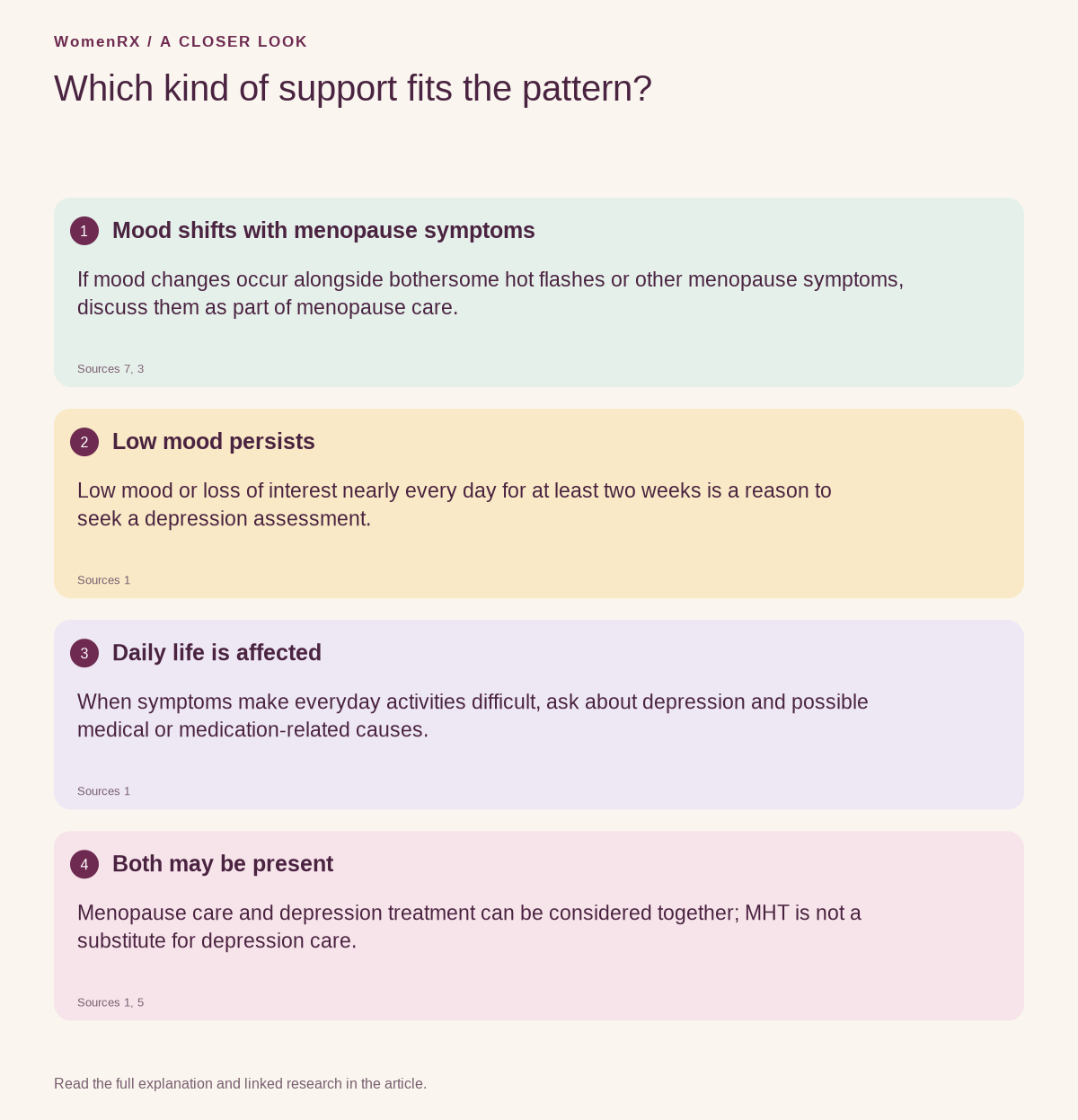
Mood shifts with menopause symptoms: If mood changes occur alongside bothersome hot flashes or other menopause symptoms, discuss them as part of menopause care.73
Low mood persists: Low mood or loss of interest nearly every day for at least two weeks is a reason to seek a depression assessment.1
Daily life is affected: When symptoms make everyday activities difficult, ask about depression and possible medical or medication-related causes.1
Both may be present: Menopause care and depression treatment can be considered together; MHT is not a substitute for depression care.15
Read the figure as text
Mood symptoms can overlap. This flow separates menopause-care questions from symptoms that deserve a depression assessment, without asking the reader to diagnose herself.- Mood shifts with menopause symptoms: If mood changes occur alongside bothersome hot flashes or other menopause symptoms, discuss them as part of menopause care.73
- Low mood persists: Low mood or loss of interest nearly every day for at least two weeks is a reason to seek a depression assessment.1
- Daily life is affected: When symptoms make everyday activities difficult, ask about depression and possible medical or medication-related causes.1
- Both may be present: Menopause care and depression treatment can be considered together; MHT is not a substitute for depression care.15
More questions, answered
Does feeling low during menopause mean I have depression?
No. Mood disturbance can occur during the menopause transition, but depression is assessed by the pattern, duration, and effect on daily life, not by age or life stage alone. A depressed mood or loss of interest occurring nearly every day for at least two weeks is a reason to seek an assessment. 7 1
Can hormone therapy and depression treatment be used at the same time?
They address different parts of the picture and may be considered together when both menopause symptoms and depression are present. One clinic study found improved depressive-symptom scores among people using hormone therapy alone or alongside an antidepressant, but it does not prove the hormone therapy caused the improvement. 5
Sources you can check
- Depression: MedlinePlusAccessed 2026-09-25Return to first citation
- Other medicines for menopause symptoms - NHSAccessed 2026-09-25Return to first citation
- The 2022 hormone therapy position statement of The North American Menopause Society.“The 2022 Hormone Therapy Position Statement of The North American Menopause Society” Advisory Panel. · Menopause (New York, N.Y.) · 2022Return to first citation
- The 2023 nonhormone therapy position statement of The North American Menopause Society.Menopause (New York, N.Y.) · 2023Return to first citation
- Does menopause hormone therapy improve symptoms of depression? Findings from a specialized menopause clinic.Gnanasegar R, Wolfman W, Galan LH, Cullimore A, Shea AK. · Menopause (New York, N.Y.) · 2024Return to first citation
- Transdermal oestradiol and testosterone therapy for menopausal depression and mood symptoms: retrospective cohort study.Glynne S, Kamal A, McColl L, Newson L, Reisel D, Mu E, Hendriks O, Saini P, Gurvich C, Kulkarni J. · The British journal of psychiatry : the journal of mental science · 2026Return to first citation
- A systematic review and critical appraisal of menopause guidelines.Hemachandra C, Taylor S, Islam RM, Fooladi E, Davis SR. · BMJ sexual & reproductive health · 2024Return to first citation