How to Read Reviews of Micronized Progesterone
A review is easier to compare with your experience when it explains why progesterone was used, what else was part of treatment, and what changed.
Read a personal account as one person’s report, not proof that micronized progesterone caused a change or a forecast of your response. Before comparing it with your situation, check the reason for treatment, whether estrogen was included, the exact medicine and regimen, duration, life stage, and the specific outcome. Missing details make the comparison less precise.
A review can give you words for an experience or suggest a question you want answered. But “I slept better” is hard to compare with your situation if you don’t know what the person was treating, what else they used, or what “better” meant.
Clinical studies show why those details matter: researchers have examined different symptoms, hormone regimens, and ways of measuring outcomes. Those findings aren’t interchangeable, and a personal account can’t show by itself what caused the change or whether someone else will have a similar experience.
Check the context before comparing
What was the treatment for? Keep accounts about the same concern together. Sleep, hot flashes, and mood are different outcomes, and research on one doesn’t establish an effect on another. A systematic review of micronized progesterone and sleep, for example, measured sleep outcomes, while a separate review examined progestin-only treatment for menopausal symptoms. 1 2
Was estrogen part of the treatment? Look for whether progesterone was used alone or with estrogen. Some studies in the micronized progesterone sleep review included estradiol, which limited conclusions about progesterone’s effect on its own. A report that doesn’t mention estrogen leaves out a meaningful part of the treatment context. 1
Which medicine and regimen? “Progesterone” can be used loosely in accounts. Check whether the person identifies micronized progesterone or another progestin, and note the route, schedule, and other hormones if they’re described. A review of progestin-only treatment included different formulations and doses, including oral micronized progesterone and medroxyprogesterone acetate. They aren’t the same treatment, so an account about one isn’t a direct comparison with the other. 2
How long was it used? An early impression and a report after a longer period describe different timeframes. In the progestin-only treatment review, trial durations ranged from 21 days to 12 months. That range is a reason to check duration when it’s available, not a timetable for when you should expect a change. 2
What outcome changed? Look for a specific result rather than a broad verdict. In a systematic review of nine randomized trials involving 388 participants, eight trials enrolled postmenopausal women. Pooled results favored micronized progesterone for sleep-onset latency, but not for total sleep time or sleep efficiency; most trials reported improvement in self-reported sleep. “Better sleep” can mean different things, even in clinical studies. 1
Is life stage clear? Perimenopause and postmenopause are useful context, but a label alone doesn’t predict how you’ll respond. The micronized progesterone sleep review’s trials were predominantly in postmenopausal women. A separate hormone-therapy sleep review allowed studies of women in perimenopause or postmenopause, but its eligibility criteria don’t show how many participants were in each life stage. If an account doesn’t say which stage the person is in, you can’t tell how closely it matches yours. 1 3
Missing details mean a narrower comparison
You don’t have to dismiss an account because it leaves out context. Just keep the conclusion modest. For example, if you’re using progesterone with estrogen and someone describes using progesterone alone for sleep, their story might prompt a question, but it doesn’t closely match your treatment situation.
A useful way to read a review is: “This person reported this outcome while using this treatment.” That’s different from concluding that the treatment caused the outcome, that the experience is common, or that you’ll have the same response. If you want to discuss the account, point to the detail that differs: “This person used progesterone alone, while my treatment includes estrogen. Does that change how useful this comparison is?”
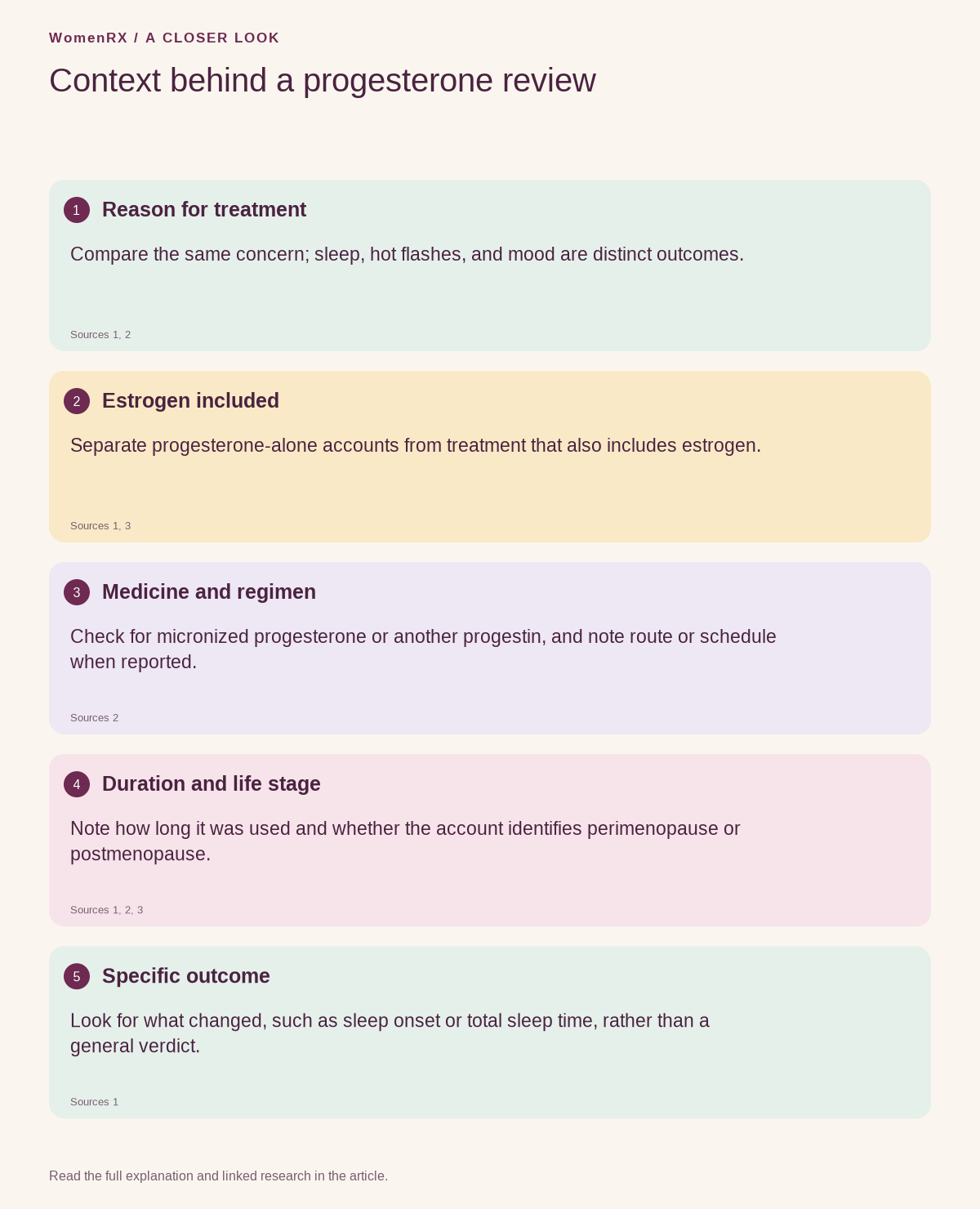
Context behind a progesterone review
Reason for treatment: Compare the same concern; sleep, hot flashes, and mood are distinct outcomes.12
Estrogen included: Separate progesterone-alone accounts from treatment that also includes estrogen.13
Medicine and regimen: Check for micronized progesterone or another progestin, and note route or schedule when reported.2
Duration and life stage: Note how long it was used and whether the account identifies perimenopause or postmenopause.123
Specific outcome: Look for what changed, such as sleep onset or total sleep time, rather than a general verdict.1
Read the figure as text
Check what an account tells you before deciding how closely it matches your own treatment situation.- Reason for treatment: Compare the same concern; sleep, hot flashes, and mood are distinct outcomes.12
- Estrogen included: Separate progesterone-alone accounts from treatment that also includes estrogen.13
- Medicine and regimen: Check for micronized progesterone or another progestin, and note route or schedule when reported.2
- Duration and life stage: Note how long it was used and whether the account identifies perimenopause or postmenopause.123
- Specific outcome: Look for what changed, such as sleep onset or total sleep time, rather than a general verdict.1
Sources you can check
- Efficacy of Micronized Progesterone for Sleep: A Systematic Review and Meta-analysis of Randomized Controlled Trial Data.Nolan BJ, Liang B, Cheung AS. · The Journal of clinical endocrinology and metabolism · 2021Return to first citation
- Efficacy of progestin-only treatment for the management of menopausal symptoms: a systematic review.Dolitsky SN, Cordeiro Mitchell CN, Stadler SS, Segars JH. · Menopause (New York, N.Y.) · 2020Return to first citation
- Different regimens of menopausal hormone therapy for improving sleep quality: a systematic review and meta-analysis.Pan Z, Wen S, Qiao X, Yang M, Shen X, Xu L. · Menopause (New York, N.Y.) · 2022Return to first citation