How to Review Your Micronized Progesterone Treatment Over Time
A useful follow-up starts with why you take progesterone, what has changed, and what you want to decide next.
There isn’t one results timeline that fits everyone taking micronized progesterone. The right review depends on its purpose: it may be paired with estrogen to protect the uterine lining, or prescribed with symptom relief in mind. Before your follow-up, note your original goal, changes you’ve noticed, side effects, and questions about the whole regimen. Menopause guidance recommends individualizing treatment and periodically reevaluating its benefits and risks. 2 3
Start with the reason it was prescribed
Write down the goal your prescriber gave you, in your own words. Micronized progesterone can have different jobs, and it may not be intended to relieve every menopause symptom.
If you take it with systemic estrogen and have a uterus, one key purpose may be to protect the uterine lining from estrogen’s effects. In that case, a review is not only about whether you feel different. It can also be about whether the combined plan remains appropriate and how bleeding is being managed. 2
If progesterone was prescribed on its own for symptoms, record the specific symptoms you hoped it would help, such as hot flashes or night sweats. A placebo-controlled trial found symptom improvement with oral micronized progesterone among healthy postmenopausal women who were 1 to 10 years past their final menstrual period. That finding applies to the study’s participants and treatment; it doesn’t set a guaranteed timetable or predict results for every person. 5
Fill in: “I’m taking progesterone to __.” If it is part of a combined regimen, add: “The estrogen is intended to help with ____.”
Make a small, useful record
You don’t need to track everything. Choose a few observations that connect directly to your goal, and use the same approach each time you review them.
| What to note | A practical prompt |
|---|---|
| Starting point | Before treatment, what symptom or concern led to the prescription? How much did it interfere with sleep, daily activities, or comfort? |
| What changed | What is better, worse, or unchanged? If symptoms come and go, note the pattern rather than relying on one unusually good or difficult day. |
| Bleeding | If you still have periods or have bleeding while taking a combined regimen, note when it happens and whether the pattern has changed. Ask how that fits with your specific plan. Progesterone is used in combined hormone therapy in part to protect the endometrium and regulate bleeding. 2 |
| Possible unwanted effects | Note any change you suspect may be related to treatment, including daytime sleepiness. A review of progestogen-only therapy flags possible sedating effects of oral micronized progesterone; your prescriber can help assess whether your experience fits your regimen. 1 |
| Treatment details | Record the product, route, and schedule you were prescribed, along with any changes made since your last review. Don’t change the plan based on someone else’s schedule. |
A brief note is usually more useful than trying to create a perfect diary. For example: “Night sweats are less disruptive, but I still wake up tired,” or “The original concern was bleeding control; I want to understand whether this pattern is expected for my regimen.” Those are examples of clear observations, not predictions about what treatment should do.
Adjust the review to your stage and regimen
If you’re in perimenopause, include what has happened with bleeding as well as the symptom that prompted treatment. Your review can distinguish changes that began before progesterone from changes you noticed after starting or adjusting the full regimen. If progesterone is paired with estrogen, ask about the combined plan rather than judging progesterone as if it were the only treatment.
If you’re postmenopausal, focus on the original treatment goal and whether it still matters to you. If you take estrogen too, include both its intended benefit and progesterone’s role in the regimen. If you take progesterone alone for symptoms, compare your current symptoms with your starting point without assuming that a result seen in a particular study will apply to you. Treatment decisions should be individualized, with periodic reevaluation of benefits and risks. 3
If mood is the main reason for your review, be precise about what your regimen contains. One randomized trial studied transdermal estradiol plus intermittent micronized progesterone for preventing depressive symptoms in initially euthymic perimenopausal and early postmenopausal women. Its findings concern that combination and prevention in that study population; they don’t establish that progesterone alone treats depression. 4
Turn your notes into a decision
A review doesn’t have to end with “keep going” or “stop.” It can clarify what the treatment is for, what seems to be helping, what is difficult, and whether another approach should be discussed. Menopause guidance supports individualized treatment and periodic review, rather than a universal schedule or a fixed duration for everyone. 3
Bring questions that match your situation:
- Is progesterone mainly protecting my uterine lining, addressing symptoms, or both?
- If I take estrogen, how should we assess the combined regimen rather than each medicine in isolation?
- Which changes in my symptoms or bleeding matter for the goal we set?
- Could a change I’ve noticed, such as daytime sleepiness, be related to this formulation or schedule?
- Given what has changed and what hasn’t, should we continue the plan or discuss an adjustment?
You don’t need to arrive with a verdict. The useful outcome is a shared understanding of the treatment’s purpose and a clear next step.
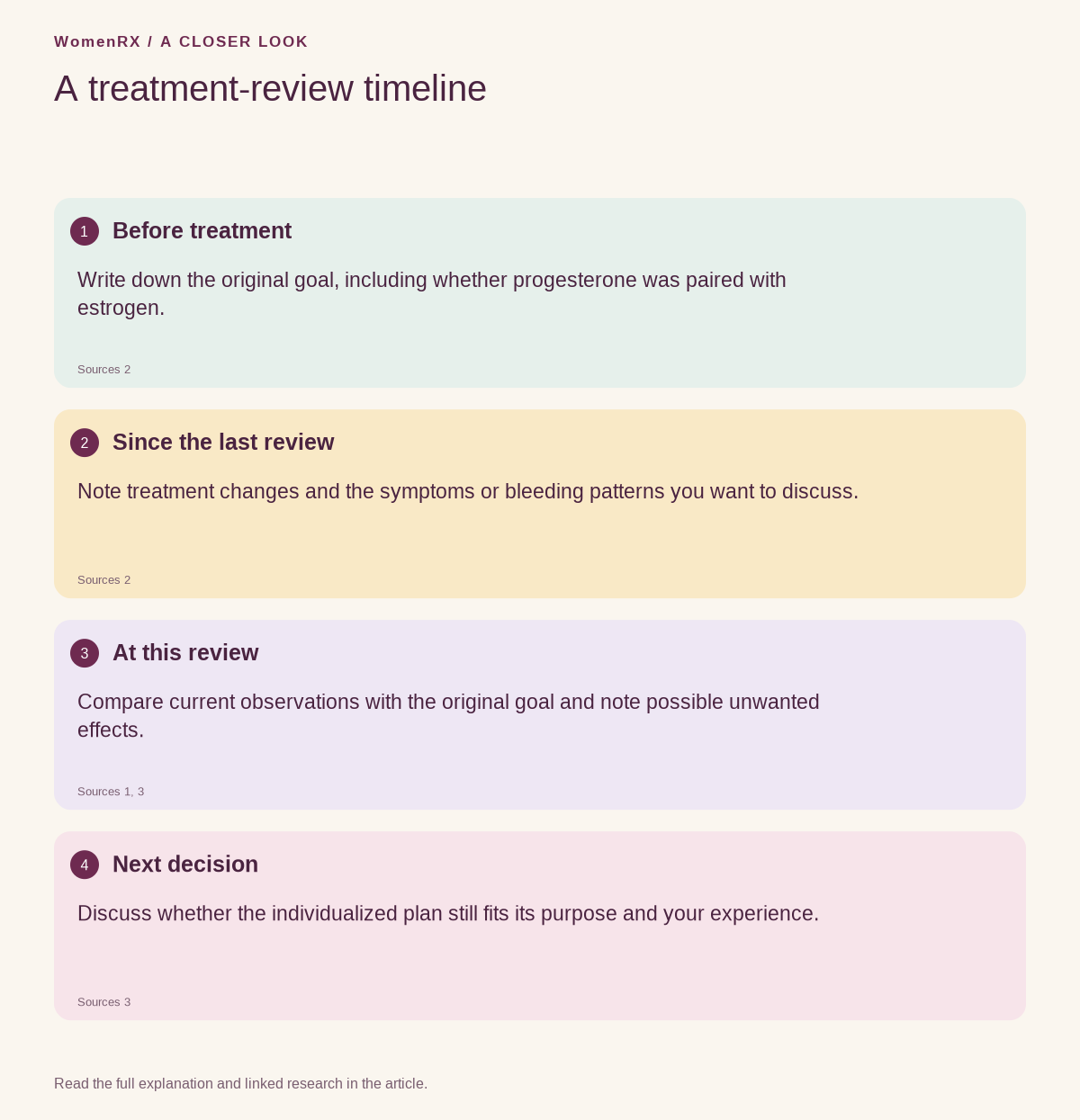
A treatment-review timeline
Before treatment: Write down the original goal, including whether progesterone was paired with estrogen.2
Since the last review: Note treatment changes and the symptoms or bleeding patterns you want to discuss.2
At this review: Compare current observations with the original goal and note possible unwanted effects.13
Next decision: Discuss whether the individualized plan still fits its purpose and your experience.3
Read the figure as text
Use these points to organize a follow-up discussion. They are recordkeeping steps, not a predicted sequence of treatment effects or a suggested review interval.- Before treatment: Write down the original goal, including whether progesterone was paired with estrogen.2
- Since the last review: Note treatment changes and the symptoms or bleeding patterns you want to discuss.2
- At this review: Compare current observations with the original goal and note possible unwanted effects.13
- Next decision: Discuss whether the individualized plan still fits its purpose and your experience.3
More questions, answered
If I take micronized progesterone with estrogen, should I expect it to relieve my hot flashes?
Not necessarily. In a combined regimen, progesterone may be prescribed to protect the uterine lining, while estrogen is used for symptoms such as hot flashes. Ask which goals apply to your plan rather than assuming each medicine has the same job. 2
Sources you can check
- Expanding the Horizons of Menopausal Hormone Therapy: A Narrative Review of Progestogen-Only and Testosterone-Only Strategies for Tailored Management.Lee HJ, Yu EH, Joo JK. · Journal of menopausal medicine · 2026Return to first citation
- Estradiol and Micronized Progesterone: A Narrative Review About Their Use as Hormone Replacement Therapy.Foschi M, Groccia G, Rusce ML, Medaglia C, Aio C, Sponzilli A, Setti V, Battipaglia C, Genazzani AD. · Journal of clinical medicine · 2025Return to first citation
- The 2022 hormone therapy position statement of The North American Menopause Society.“The 2022 Hormone Therapy Position Statement of The North American Menopause Society” Advisory Panel. · Menopause (New York, N.Y.) · 2022Return to first citation
- Efficacy of Transdermal Estradiol and Micronized Progesterone in the Prevention of Depressive Symptoms in the Menopause Transition: A Randomized Clinical Trial.Gordon JL, Rubinow DR, Eisenlohr-Moul TA, Xia K, Schmidt PJ, Girdler SS. · JAMA psychiatry · 2018Return to first citation
- Oral micronized progesterone for vasomotor symptoms--a placebo-controlled randomized trial in healthy postmenopausal women.Hitchcock CL, Prior JC. · Menopause (New York, N.Y.) · 2012Return to first citation