Are There Alternatives to Micronized Progesterone for Menopause Care?
The right alternative depends on why progesterone was prescribed, whether you have a uterus, and whether you plan to keep using systemic estrogen.
Yes, but the options do different jobs. If you have a uterus and use systemic estrogen, the replacement needs to address endometrial protection, not just symptoms. A different progestogen or a specific conjugated-estrogens/bazedoxifene combination may be discussed. If the goal is hot-flash relief, nonhormonal treatments can help, but they don’t protect the uterine lining. 1 2 6
Start with the reason it was prescribed
Micronized progesterone is one type of progestogen. In menopausal hormone therapy, a progestogen may be paired with systemic estrogen to protect the uterine lining. Estrogen without adequate protection can allow the lining to grow abnormally. That means a treatment that helps hot flashes may not be a replacement if you’re continuing systemic estrogen and have a uterus. 1 3
If you’ve had your uterus removed, protection of the uterine lining is no longer the reason to use a progestogen. Your treatment plan may still have other considerations, so the useful question is whether the original reason for progesterone still applies. 3
If you want to continue systemic estrogen
One possibility is a different progestogen. A review of menopausal hormone therapy describes several options besides micronized progesterone, including medroxyprogesterone acetate, norethisterone acetate, dydrogesterone, and levonorgestrel. These medicines aren’t automatically interchangeable: the appropriate choice depends on the treatment plan and the reason you’re changing. 1
A different approach is a specific estrogen-bazedoxifene combination. Bazedoxifene is a selective estrogen receptor modulator, not progesterone. In randomized trials, conjugated estrogens combined with bazedoxifene was studied in postmenopausal women with an intact uterus. This is a distinct combination, not evidence for adding bazedoxifene to your current estrogen. The trials reported low rates of endometrial hyperplasia over 12 months, but they don’t establish longer-term outcomes or answer every question about use during perimenopause. 2 3 4
So if you want to remain on systemic estrogen, compare options by asking whether they serve the same protective purpose. A nonhormonal hot-flash treatment, a different progestogen, and the studied estrogen-bazedoxifene combination are different kinds of choices.
If the main goal is symptom relief
For hot flashes and night sweats, the North American Menopause Society lists evidence-supported nonhormonal options that include cognitive behavioral therapy, clinical hypnosis, certain antidepressants (SSRIs or SNRIs), gabapentin, and fezolinetant. These target vasomotor symptoms; they don’t provide endometrial protection if you continue systemic estrogen and have a uterus. The same statement does not recommend supplements or herbal remedies as evidence-based treatments for these symptoms. 6
Vaginal or urinary symptoms have a separate set of options. For bothersome genitourinary symptoms that haven’t improved with over-the-counter therapies, the menopause position statement lists low-dose vaginal estrogen, vaginal dehydroepiandrosterone, and oral ospemifene for people without an indication for systemic hormone therapy. These options address a different symptom group than hot-flash treatments, so the choice depends on what you’re trying to relieve. 5
What changes the comparison
Your uterus status and whether you’re continuing systemic estrogen are central to the decision. If you have a uterus and keep using systemic estrogen, focus on a plan that addresses endometrial protection. If you’re stopping systemic estrogen, the question may instead be which treatment best matches your symptoms. If you’re in perimenopause, mention that when discussing options: the cited estrogen-bazedoxifene trials enrolled postmenopausal women, so they don’t directly settle treatment choices during the transition. 1 2 4
If progesterone is causing problems, describe what’s difficult about it, such as side effects or trouble taking it, and clarify whether you plan to continue systemic estrogen. That makes it easier to compare an alternative progestogen with a change in the overall hormone regimen or a symptom-specific treatment, without treating them as one-for-one substitutes.
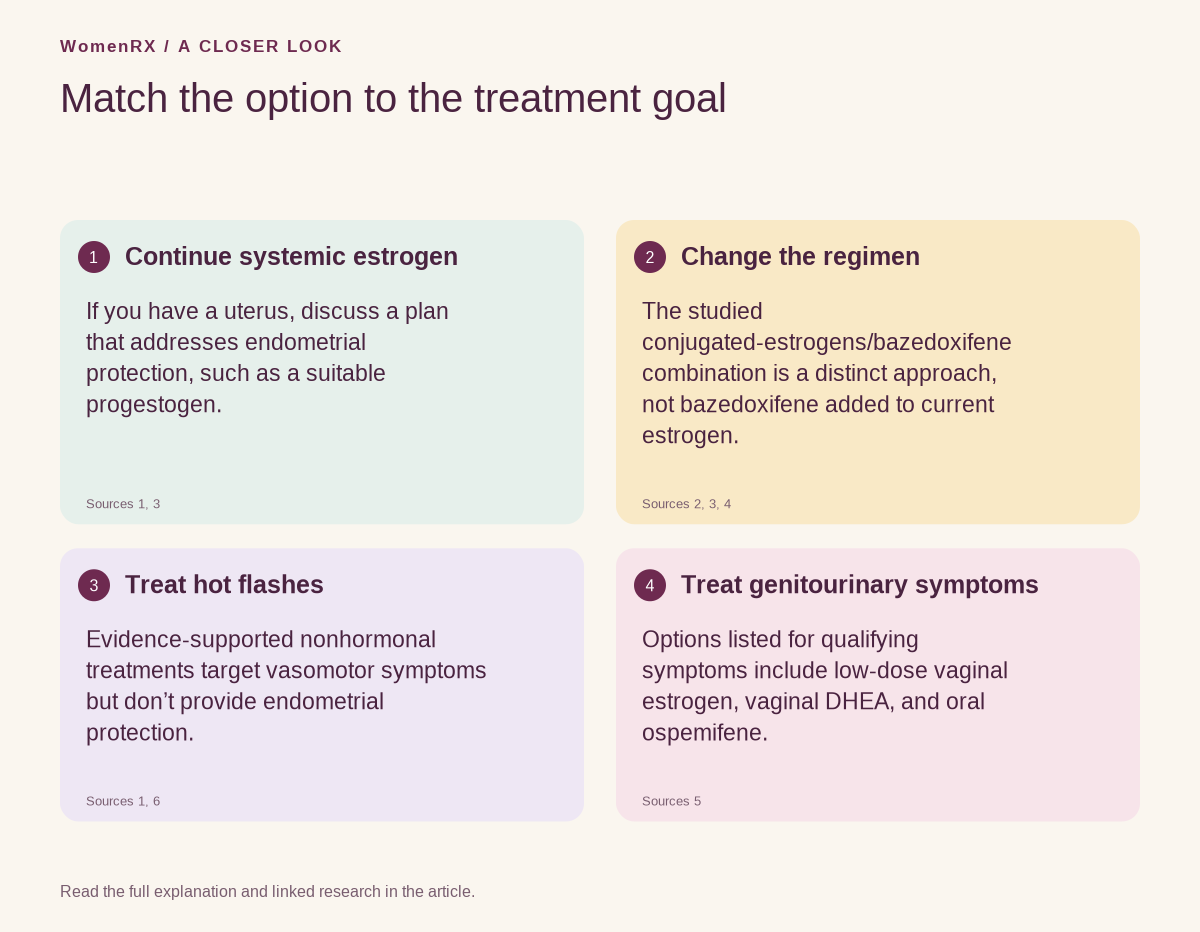
Match the option to the treatment goal
Continue systemic estrogen: If you have a uterus, discuss a plan that addresses endometrial protection, such as a suitable progestogen.13
Change the regimen: The studied conjugated-estrogens/bazedoxifene combination is a distinct approach, not bazedoxifene added to current estrogen.234
Treat hot flashes: Evidence-supported nonhormonal treatments target vasomotor symptoms but don’t provide endometrial protection.16
Treat genitourinary symptoms: Options listed for qualifying symptoms include low-dose vaginal estrogen, vaginal DHEA, and oral ospemifene.5
Read the figure as text
These options address different needs. Uterine status and whether you’re continuing systemic estrogen help determine which comparison matters.- Continue systemic estrogen: If you have a uterus, discuss a plan that addresses endometrial protection, such as a suitable progestogen.13
- Change the regimen: The studied conjugated-estrogens/bazedoxifene combination is a distinct approach, not bazedoxifene added to current estrogen.234
- Treat hot flashes: Evidence-supported nonhormonal treatments target vasomotor symptoms but don’t provide endometrial protection.16
- Treat genitourinary symptoms: Options listed for qualifying symptoms include low-dose vaginal estrogen, vaginal DHEA, and oral ospemifene.5
More questions, answered
Can a nonhormonal hot-flash treatment replace progesterone if I keep taking systemic estrogen?
No. Options such as SSRIs or gabapentin may help vasomotor symptoms, but they aren’t endometrial protection. If you have a uterus and continue systemic estrogen, the treatment plan still needs to address the uterine lining. 1 6
Does having had a hysterectomy change the options?
It changes the endometrial-protection question: if your uterus has been removed, there is no uterine lining to protect. Ask whether progesterone was prescribed for another reason before changing your plan. 3
Sources you can check
- Progestogens in Menopausal Hormone Therapy: A Double-Edged Sword.Ylikorkala O, Joensuu JM, Siitonen H, Mikkola TS. · Seminars in reproductive medicine · 2025Return to first citation
- Effects of bazedoxifene/conjugated estrogens on the endometrium and bone: a randomized trial.Pinkerton JV, Harvey JA, Lindsay R, Pan K, Chines AA, Mirkin S, Archer DF, SMART-5 Investigators. · The Journal of clinical endocrinology and metabolism · 2014Return to first citation
- Tissue selective estrogen complex (TSEC): a review.Pickar JH, Boucher M, Morgenstern D. · Menopause (New York, N.Y.) · 2018Return to first citation
- Effects of bazedoxifene/conjugated estrogens on endometrial safety and bone in postmenopausal women.Mirkin S, Komm BS, Pan K, Chines AA. · Climacteric : the journal of the International Menopause Society · 2013Return to first citation
- The 2022 hormone therapy position statement of The North American Menopause Society.“The 2022 Hormone Therapy Position Statement of The North American Menopause Society” Advisory Panel. · Menopause (New York, N.Y.) · 2022Return to first citation
- The 2023 nonhormone therapy position statement of The North American Menopause Society.Menopause (New York, N.Y.) · 2023Return to first citation