When Micronized Progesterone Isn’t the Right Fit
If micronized progesterone is causing problems, compare alternatives by what your estrogen plan requires, not by medicine name alone.
If you use systemic estrogen and have a uterus, don’t replace micronized progesterone without checking how the new plan will protect your uterine lining. Other progestogens discussed for menopause treatment include medroxyprogesterone acetate, norethisterone acetate, and intrauterine levonorgestrel. Their routes and regimens differ, and none is automatically the right substitute for your particular estrogen treatment. 35
Micronized progesterone may be unsuitable, hard to obtain, or simply not working well for you. The useful next question isn’t just “What else is progesterone?” It’s “What job is it doing in my treatment plan?” For postmenopausal women with a uterus who use estrogen therapy, adding a progestogen protects the uterine lining, or endometrium. That protection needs to remain part of the plan if the estrogen treatment requires it. 3
Start with the estrogen treatment you’re using
A change in progestogen may be one part of a larger change. Menopause hormone therapy risks vary with the type and dose of hormones, route, duration, timing, and whether a progestogen is used. That’s why a comparison of medicine names alone can’t tell you which plan fits your circumstances. 6
The distinction matters especially if you’re also reconsidering estrogen. Systemic hormone therapy can treat hot flashes and night sweats. If your concern is limited to vaginal or urinary symptoms and you don’t otherwise need systemic hormone therapy, low-dose vaginal estrogen or other targeted treatments may be options to discuss instead. That is a different treatment decision from replacing the progestogen in a systemic estrogen plan. 6
What alternatives are worth discussing?
A menopause review describes several progestogens used with estrogen for endometrial protection. They include medroxyprogesterone acetate and norethisterone acetate, which have oral routes; norethisterone acetate is also discussed by a transdermal route. Levonorgestrel can be delivered through an intrauterine device. These are categories for a conversation, not a list of interchangeable US products or a ranking of which is safest. Ask which specific product and route could work with your estrogen treatment. 5
Route is only half the question. Progestogens may be used continuously or sequentially, and the schedule affects the plan for protecting the endometrium. A review describes both approaches, with protection depending on sufficient progestogen exposure. Ask how the proposed regimen provides that protection rather than assuming that any progestogen, used in any pattern, will do the same job. 5
It’s also worth being precise about the reason you want to switch. If taking a pill is the problem, a different oral progestogen may not address it. If you’re concerned about a side effect, ask what is known about that effect with the proposed medicine and estrogen combination. If access is the issue, ask whether changing only the progestogen is practical or whether the whole regimen would need to change.
Don’t mistake a different form for equivalent protection
Skin-applied micronized progesterone is not an established workaround for endometrial protection. A systematic review concluded that transdermal micronized progesterone does not provide that protection. This finding is about micronized progesterone applied through the skin; it shouldn’t be confused with the review’s discussion of transdermal norethisterone acetate, a different progestogen. 35
The same caution applies to familiar drug names. Medroxyprogesterone acetate appears in oral estrogen-progestin menopause products, but it is also the active ingredient in a contraceptive injection. The injection’s prescribing information describes its contraceptive action; its shared ingredient name doesn’t establish that it can replace the progestogen regimen in your menopause treatment. 12
Compare risks without treating every option as identical
There isn’t a sound basis to promise that one of these alternatives will feel better for you or have the same risks as micronized progesterone. One well-known result shows why the combination matters: in postmenopausal women ages 50 to 79, the Women’s Health Initiative estrogen-plus-progestin substudy found increased risks of blood clots in the legs and lungs, stroke, and heart attack with daily oral conjugated estrogens plus medroxyprogesterone acetate, compared with placebo over 5.6 years. That result does not compare medroxyprogesterone acetate directly with micronized progesterone or establish the risk of every estrogen-progestogen pairing. 1
Breast risk also deserves a discussion in the context of your own history and how long you expect to use treatment. Reviews do not support treating any progestogen as risk-free simply because it may compare favorably with another in some research. 48
A focused conversation might sound like this: “I’m considering a change because of [the specific problem]. Does my estrogen plan require endometrial protection? If so, which product, route, and regimen would provide it? What would change about the effects and risks I’m concerned about?” That keeps the decision centered on the treatment you’d actually use.
If you’d rather reconsider systemic estrogen altogether, there are evidence-supported nonhormonal treatments for hot flashes and night sweats, including cognitive behavioral therapy, clinical hypnosis, certain SSRIs or SNRIs, gabapentin, and fezolinetant. They address symptoms; they do not replace endometrial protection while you continue an estrogen treatment that requires it. 37
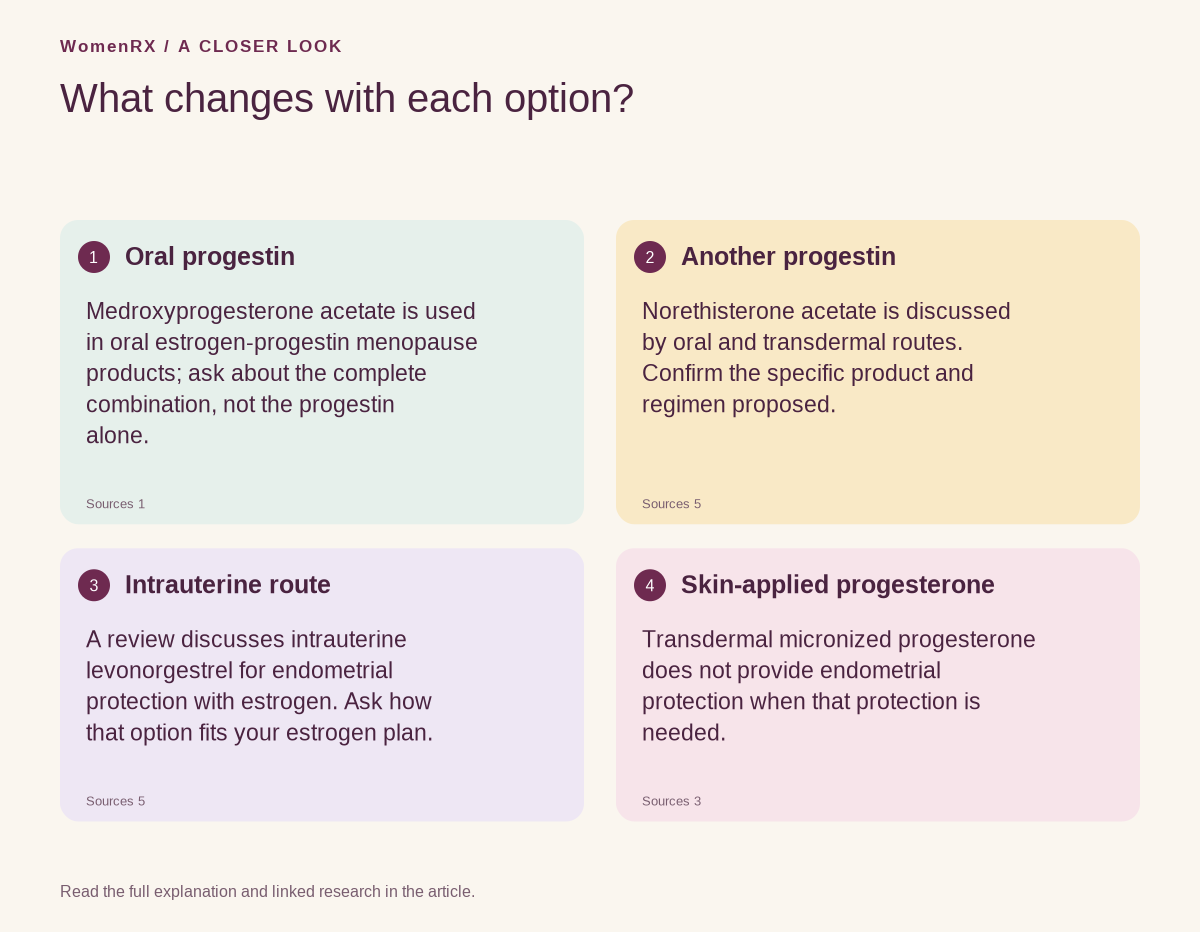
What changes with each option?
Oral progestin: Medroxyprogesterone acetate is used in oral estrogen-progestin menopause products; ask about the complete combination, not the progestin alone.1
Another progestin: Norethisterone acetate is discussed by oral and transdermal routes. Confirm the specific product and regimen proposed.5
Intrauterine route: A review discusses intrauterine levonorgestrel for endometrial protection with estrogen. Ask how that option fits your estrogen plan.5
Skin-applied progesterone: Transdermal micronized progesterone does not provide endometrial protection when that protection is needed.3
Read the figure as text
Use these distinctions to discuss a proposed change without assuming that routes, products, or purposes are interchangeable.- Oral progestin: Medroxyprogesterone acetate is used in oral estrogen-progestin menopause products; ask about the complete combination, not the progestin alone.1
- Another progestin: Norethisterone acetate is discussed by oral and transdermal routes. Confirm the specific product and regimen proposed.5
- Intrauterine route: A review discusses intrauterine levonorgestrel for endometrial protection with estrogen. Ask how that option fits your estrogen plan.5
- Skin-applied progesterone: Transdermal micronized progesterone does not provide endometrial protection when that protection is needed.3
More questions, answered
Is the medroxyprogesterone contraceptive shot an alternative to oral micronized progesterone?
Don’t assume so because the ingredient name matches. The contraceptive injection’s prescribing information describes a different product and purpose from oral estrogen-medroxyprogesterone menopause products. Ask about the exact product and how it would fit your estrogen and endometrial-protection plan. 12
Sources you can check
- PREMPHASE (CONJUGATED ESTROGENS AND MEDROXYPROGESTERONE ACETATE) KIT PREMPRO (CONJUGATED ESTROGENS AND MEDROXYPROGESTERONE ACETATE) TABLET, SUGAR COATED [WYETH PHARMACEUTICALS LLC, A SUBSIDIARY OF PFIZER INC.] | US prescribing information and patient instructionsAccessed 2026-09-25Return to first citation
- DEPO-PROVERA (MEDROXYPROGESTERONE ACETATE) INJECTION, SUSPENSION [PHARMACIA & UPJOHN COMPANY LLC] | US prescribing information and patient instructionsAccessed 2026-09-25Return to first citation
- The impact of micronized progesterone on the endometrium: a systematic review.Stute P, Neulen J, Wildt L. · Climacteric : the journal of the International Menopause Society · 2016Return to first citation
- The impact of micronized progesterone on breast cancer risk: a systematic review.Stute P, Wildt L, Neulen J. · Climacteric : the journal of the International Menopause Society · 2018Return to first citation
- Progestogens in Menopausal Hormone Therapy: A Double-Edged Sword.Ylikorkala O, Joensuu JM, Siitonen H, Mikkola TS. · Seminars in reproductive medicine · 2025Return to first citation
- The 2022 hormone therapy position statement of The North American Menopause Society.“The 2022 Hormone Therapy Position Statement of The North American Menopause Society” Advisory Panel. · Menopause (New York, N.Y.) · 2022Return to first citation
- The 2023 nonhormone therapy position statement of The North American Menopause Society.Menopause (New York, N.Y.) · 2023Return to first citation
- Evaluation of breast risk at menopause: what impact on the use of menopausal hormone therapy?Rodrigues MAH, Gompel A. · Maturitas · 2026Return to first citation