Why Progesterone or a Progestin Might Be Prescribed
The reason for treatment matters: medicines that act on progesterone pathways can be used for different goals, and one formulation isn’t automatically a substitute for another.
Progesterone and related progestins may be prescribed to help manage certain irregular bleeding patterns, support the uterine lining during some fertility treatments, or protect the uterus when systemic estrogen is used after menopause. Medroxyprogesterone acetate is one progestin; micronized progesterone is a different formulation. Ask what the treatment is meant to do, which medicine you’re taking, and what benefits and risks apply to that specific use. 1 4 5 6
Start with the treatment goal
“Progesterone” can refer to the hormone or to a prescribed medicine containing progesterone. A prescription might instead contain a related medicine called a progestin, such as medroxyprogesterone acetate (MPA). These medicines aren’t interchangeable simply because they act on related pathways: the purpose, formulation, and route of treatment matter. 1 2 6
Here are several different reasons a clinician might prescribe one of them:
| Treatment purpose | Example of the medicine or approach | The goal to clarify |
|---|---|---|
| Irregular bleeding from ovulatory dysfunction | A cyclic progestin, such as MPA, studied in premenopausal women | Help regulate bleeding and protect the uterine lining 4 |
| Fertility treatment | Progesterone support in some embryo-transfer cycles | Support the uterine lining as part of a specific fertility protocol 5 6 |
| Menopause therapy with systemic estrogen | A progestin added for a woman with a uterus | Reduce the risk of estrogen-related endometrial overgrowth 1 |
| Contraception | Medroxyprogesterone acetate injection | Prevent pregnancy; bleeding-pattern changes are common 2 |
These examples describe different clinical aims, not a menu of equivalent options. A medicine prescribed for contraception, for example, doesn’t automatically serve the same purpose as progesterone used in fertility treatment or a progestin added to menopause estrogen therapy.
For irregular bleeding, the aim may be more than timing
One specific menstrual-care use is abnormal bleeding linked to ovulatory dysfunction. When ovulation is irregular or absent, the uterine lining may have prolonged exposure to estrogen without the usual counterbalancing effects of progesterone. In chronic cases, the concern can include endometrial changes; treatment may aim both to improve bleeding patterns and to protect the lining. 4
In a randomized trial of 104 premenopausal women with this type of abnormal bleeding, cyclic medroxyprogesterone acetate was compared with the progestin desogestrel. Both treatments showed an endometrial response in the first treatment cycle, while the study’s measure of acceptable bleeding was higher with MPA. Those findings apply to the trial’s participants and regimens, not to every cause of heavy or irregular periods or every progestin. 4
Abnormal bleeding can have causes other than ovulatory dysfunction. A review of bleeding with hormonal contraception advises considering other causes before treating the bleeding as a medication effect. 3 The useful question is: “What do you think is causing my bleeding, and is this medicine meant to regulate bleeding, protect the lining, provide contraception, or do something else?”
Fertility support depends on the cycle protocol
Progesterone may be used as luteal-phase support in assisted reproduction, but the approach depends on the fertility treatment. One randomized-trial sub-study included 85 women having frozen embryo transfer in modified natural cycles. It compared progesterone support with no support and focused on thyroid function; it found no effect on the thyroid measures studied. That result doesn’t establish which fertility protocol is best or whether support is useful in other types of cycles. 5
A separate pilot randomized trial in artificial-cycle frozen embryo transfer compared oral dydrogesterone with vaginal micronized progesterone. Its ongoing-pregnancy results were not statistically significantly different, but the researchers described it as a pilot and called for larger studies. It’s a reminder that a medicine’s route and formulation can matter in a particular protocol, and that comparisons in one kind of transfer cycle may not answer questions about another. 6
If progesterone is part of fertility treatment, ask which type of transfer cycle you’re having, why support is included in that protocol, and whether the prescribed route is important for your specific plan.
With menopause estrogen, ask whether you have a uterus
After menopause, systemic estrogen without a progestin can increase the risk of endometrial cancer in a woman with a uterus. Adding a progestin has been shown to reduce endometrial hyperplasia, a possible precursor to endometrial cancer. The need for a progestin therefore depends in part on whether you have a uterus and on the estrogen treatment being considered. 1
The risk discussion also needs to stay specific. In the Women’s Health Initiative, postmenopausal women ages 50 to 79 taking daily oral conjugated estrogen with MPA were compared with women taking placebo over 5.6 years. The study reported higher risks of deep vein thrombosis, pulmonary embolism, stroke, and heart attack with that combination. The product labeling says that, without comparable data, similar risks should be assumed for other doses and other estrogen-progestin combinations or forms. That precaution concerns estrogen plus progestin therapy; it shouldn’t be presented as a finding about progesterone or progestins used without estrogen. 1
The same product information reports increased breast-cancer risk associated with estrogen-plus-progestin therapy after several years of use, including in an extension of the WHI trials. Keep that finding specific to combination therapy; it doesn’t establish the same risk for progesterone or progestins used without estrogen. 1
Formulation changes what to ask
Micronized progesterone, MPA, dydrogesterone, and other progestins aren’t one uniform treatment. Their use varies by purpose and protocol, and evidence about one formulation shouldn’t automatically be transferred to another. For example, the Depot-Provera label describes changes in menstrual bleeding as common during contraceptive use, with patterns that can include spotting, irregular bleeding, or no bleeding. That is a contraception-related effect, not evidence that the injection is the right treatment for every bleeding problem. 2
A few focused questions can make a prescription easier to understand:
- What is this medicine meant to do in my case?
- Is it progesterone or a progestin, and which formulation and route am I using?
- If it’s for bleeding, what cause is being treated, and what changes should I expect?
- If it’s part of menopause therapy, how does my uterus affect the plan and its risks?
- If it’s for fertility treatment, why does this protocol use this form of support?
Persistent or recurring abnormal bleeding after menopause needs evaluation; it shouldn’t simply be assumed to be a routine effect of hormone therapy. 1
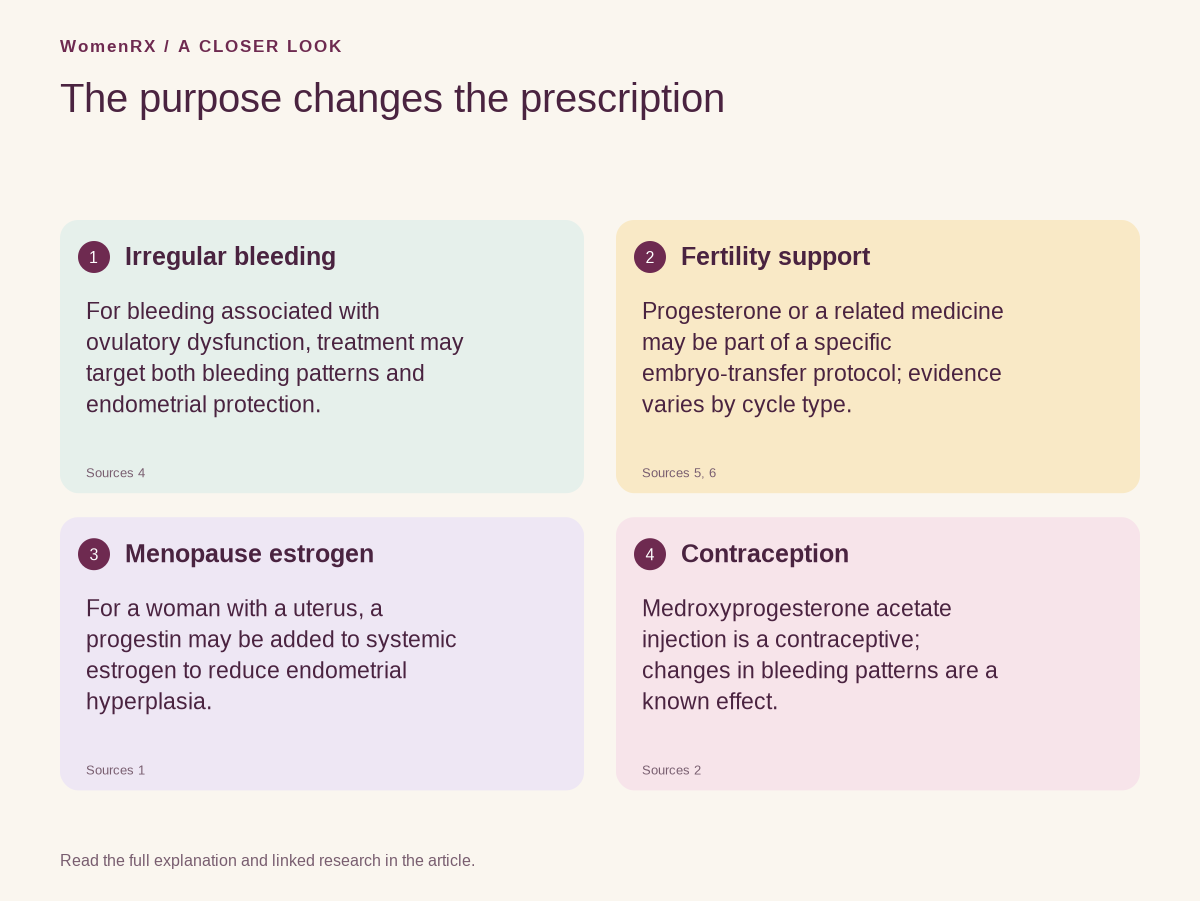
The purpose changes the prescription
Irregular bleeding: For bleeding associated with ovulatory dysfunction, treatment may target both bleeding patterns and endometrial protection.4
Fertility support: Progesterone or a related medicine may be part of a specific embryo-transfer protocol; evidence varies by cycle type.56
Menopause estrogen: For a woman with a uterus, a progestin may be added to systemic estrogen to reduce endometrial hyperplasia.1
Contraception: Medroxyprogesterone acetate injection is a contraceptive; changes in bleeding patterns are a known effect.2
Read the figure as text
These examples show why the treatment goal matters as much as the medicine name: related formulations are used in distinct clinical settings.- Irregular bleeding: For bleeding associated with ovulatory dysfunction, treatment may target both bleeding patterns and endometrial protection.4
- Fertility support: Progesterone or a related medicine may be part of a specific embryo-transfer protocol; evidence varies by cycle type.56
- Menopause estrogen: For a woman with a uterus, a progestin may be added to systemic estrogen to reduce endometrial hyperplasia.1
- Contraception: Medroxyprogesterone acetate injection is a contraceptive; changes in bleeding patterns are a known effect.2
More questions, answered
Is medroxyprogesterone acetate the same as micronized progesterone?
No. Medroxyprogesterone acetate is a progestin derived from progesterone, while micronized progesterone is a different formulation. The names don’t mean the products are interchangeable; the intended use and treatment protocol matter. 1 2 6
Can a progestin cause changes in bleeding?
Yes. With medroxyprogesterone acetate injection used for contraception, menstrual bleeding changes can include irregular or unpredictable bleeding, spotting, or no bleeding. That product-specific pattern doesn’t tell you what to expect from every progesterone or progestin prescription. 2
Sources you can check
- PREMPHASE (CONJUGATED ESTROGENS AND MEDROXYPROGESTERONE ACETATE) KIT PREMPRO (CONJUGATED ESTROGENS AND MEDROXYPROGESTERONE ACETATE) TABLET, SUGAR COATED [WYETH PHARMACEUTICALS LLC, A SUBSIDIARY OF PFIZER INC.] | US prescribing information and patient instructionsAccessed 2026-09-25Return to first citation
- DEPO-PROVERA (MEDROXYPROGESTERONE ACETATE) INJECTION, SUSPENSION [PHARMACIA & UPJOHN COMPANY LLC] | US prescribing information and patient instructionsAccessed 2026-09-25Return to first citation
- Abnormal Uterine Bleeding Associated With Hormonal Contraception.Schrager S, Fox K, Lee R. · American family physician · 2024Return to first citation
- The effectiveness of desogestrel for endometrial protection in women with abnormal uterine bleeding-ovulatory dysfunction: a non-inferiority randomized controlled trial.Soontrapa N, Rattanachaiyanont M, Warnnissorn M, Wongwananuruk T, Indhavivadhana S, Tanmahasamut P, Techatraisak K, Angsuwathana S. · Scientific reports · 2022Return to first citation
- Effect of luteal phase support with progesterone on thyroid function: a sub-study of the FET optimizing trial.Grove-Laugesen D, Saupstad M, Gabrielsen AV, Ebbehøj E, Løssl K, Knudsen UB, Pinborg A. · European thyroid journal · 2026Return to first citation
- Dydrogesterone versus micronized vaginal progesterone for luteal phase support in artificial cycle frozen embryo transfer (REMODEL): a pilot prospective randomized controlled trial.Roelens C, Mackens S, Drakopoulos P, Van Landuyt L, De Vos M, Tournaye H, Blockeel C. · Frontiers in endocrinology · 2026Return to first citation