Why menopause hormone therapy may include progesterone or a progestin
A progestogen protects the uterine lining when systemic estrogen is used by someone with a uterus, but the form and schedule need to fit the treatment.
If you have a uterus and use systemic estrogen for menopause symptoms, progesterone or a progestin is generally included to reduce the risk of overgrowth in the uterine lining. The specific form and schedule matter. If you’ve had a hysterectomy, lining protection usually isn’t needed, although some health histories may change the plan. 3 4 6
The uterine lining is the reason
Estrogen can stimulate the lining of the uterus, called the endometrium. In people with a uterus, estrogen used without a progestogen increases the risk of endometrial hyperplasia, or abnormal overgrowth of that lining. Hyperplasia can be a precursor to endometrial cancer. A progestogen counters estrogen’s effect on the lining and reduces the risk of hyperplasia. That’s its primary job in combined menopause hormone therapy, rather than making estrogen more effective for symptoms. 1 4 6
The key distinction is whether your treatment uses systemic estrogen, meaning estrogen intended to act throughout the body, and whether you have a uterus. This explanation shouldn’t be applied automatically to every estrogen product used for menopause symptoms. The question to settle is what the specific estrogen treatment calls for, not whether every product labeled estrogen needs the same companion medicine.
Progesterone and progestins: same job, different choices
Progestogen is the umbrella term. It includes progesterone, such as micronized progesterone, and synthetic progestins, such as medroxyprogesterone acetate and norethisterone acetate. Each may be discussed as part of an estrogen-plus-progestogen plan, but the ingredient name alone doesn’t tell you whether a particular form and schedule will adequately protect the lining. 1 2 6 7
For example, a systematic review found evidence supporting specific oral micronized progesterone regimens for endometrial protection, while concluding that micronized progesterone applied through the skin does not provide that protection. That finding is about the progesterone route. It isn’t a reason to assume an estrogen patch removes the need to consider the uterine lining. 7
It’s also too simple to call progesterone the safer choice overall. Researchers are studying how micronized progesterone and particular progestins compare on breast and endometrial outcomes, but a published protocol for a direct randomized comparison reports a study design, not its results. 2
Why the schedule belongs in the conversation
A progestogen may be paired continuously with estrogen or used during part of a treatment cycle. Both approaches have been studied. The protection shown for one combination, though, shouldn’t be treated as proof that every dose, form, and schedule works the same way. A Cochrane review found increased hyperplasia risk with unopposed estrogen over one to three years and reported results for certain low-dose estrogen regimens continuously combined with specific progestins; it did not establish a universal recipe. 6
This gives you a more useful way to discuss a proposed regimen than asking only, “Is it progesterone or a progestin?” Ask: Which part of my plan protects the uterine lining, and how does its form and schedule fit the estrogen I’m using? If bleeding is a concern, ask what pattern to expect with that plan and what would need assessment. Progestogen choice and regimen can affect bleeding, and there is no single preferred regimen for everyone. 4
A levonorgestrel-releasing intrauterine system is another progestogen approach discussed for endometrial protection alongside estrogen therapy. It may be especially relevant to a person in perimenopause who also needs contraception, but it’s a distinct option to discuss rather than a substitute for checking how an existing regimen is meant to work. 5
If you don’t have a uterus
After hysterectomy, there is generally no uterine lining to protect, so estrogen alone is often used. A history such as endometriosis or endometrial neoplasia can make the decision less straightforward. That’s why uterine status is the starting point, not a rule that everyone taking menopause estrogen needs a progestogen. 3
Whatever your regimen, persistent or recurring abnormal bleeding after menopause shouldn’t be dismissed as an expected hormone effect. It needs evaluation to find the cause. 1
Where lining protection fits
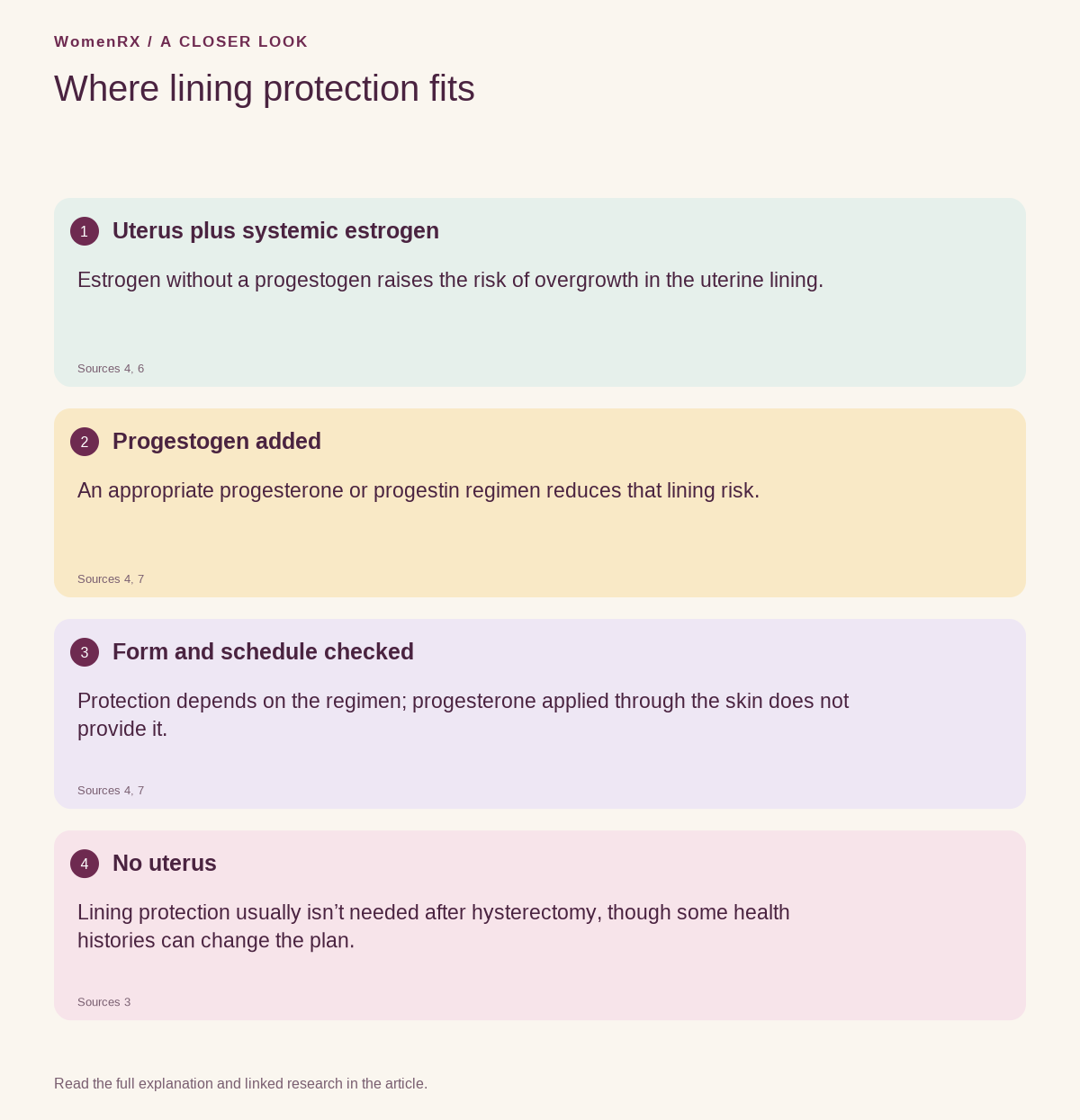
Uterus plus systemic estrogen: Estrogen without a progestogen raises the risk of overgrowth in the uterine lining.46
Progestogen added: An appropriate progesterone or progestin regimen reduces that lining risk.47
Form and schedule checked: Protection depends on the regimen; progesterone applied through the skin does not provide it.47
No uterus: Lining protection usually isn’t needed after hysterectomy, though some health histories can change the plan.3
Read the figure as text
The need for a progestogen starts with the uterus and the estrogen treatment, then depends on the specific protective regimen.- Uterus plus systemic estrogen: Estrogen without a progestogen raises the risk of overgrowth in the uterine lining.46
- Progestogen added: An appropriate progesterone or progestin regimen reduces that lining risk.47
- Form and schedule checked: Protection depends on the regimen; progesterone applied through the skin does not provide it.47
- No uterus: Lining protection usually isn’t needed after hysterectomy, though some health histories can change the plan.3
Sources you can check
- PREMPHASE (CONJUGATED ESTROGENS AND MEDROXYPROGESTERONE ACETATE) KIT PREMPRO (CONJUGATED ESTROGENS AND MEDROXYPROGESTERONE ACETATE) TABLET, SUGAR COATED [WYETH PHARMACEUTICALS LLC, A SUBSIDIARY OF PFIZER INC.] | US prescribing information and patient instructionsAccessed 2026-09-25Return to first citation
- Breast and endometrial safety of micronised progesterone versus norethisterone acetate in menopausal hormone therapy (PROBES): study protocol of a double-blind randomised controlled trial.Lundell C, Stergiopoulos N, Blomberg L, Ujvari D, Schuppe-Koistinen I, Kopp-Kallner H, Iliadis SI, Skalkidou A, Hirschberg AL. · BMJ open · 2024Return to first citation
- Options for hormone therapy in women who have had a hysterectomy.Haney AF, Wild RA. · Menopause (New York, N.Y.) · 2007Return to first citation
- Role of progestogen in hormone therapy for postmenopausal women: position statement of The North American Menopause Society.North American Menopause Society. · Menopause (New York, N.Y.) · 2003Return to first citation
- The levonorgestrel-releasing intrauterine system for endometrial protection during estrogen replacement therapy: a clinical review.Depypere H, Inki P. · Climacteric : the journal of the International Menopause Society · 2015Return to first citation
- Hormone therapy in postmenopausal women and risk of endometrial hyperplasia.Furness S, Roberts H, Marjoribanks J, Lethaby A. · The Cochrane database of systematic reviews · 2012Return to first citation
- The impact of micronized progesterone on the endometrium: a systematic review.Stute P, Neulen J, Wildt L. · Climacteric : the journal of the International Menopause Society · 2016Return to first citation