Micronized Progesterone and Progestins: What Differs?
They can have a shared role in menopause therapy, but evidence about one medicine doesn’t automatically describe the others.
Micronized progesterone is progesterone itself, processed to improve absorption; progestins are synthetic medicines, and their biological effects can differ. For someone with a uterus using estrogen, the exact regimen matters: evidence that adding a progestin reduces endometrial hyperplasia should not be treated as proof that every progesterone or progestin regimen offers the same protection. 1 2 4
Similar names, different medicines
Micronized progesterone is progesterone, a hormone the body also makes. “Micronized” describes processing that improves its absorption. Progestins are synthetic molecules. The broader term progestogen can include progesterone and progestins, but those medicines can have different biological effects. A finding about one shouldn’t automatically be applied to the whole group. 2 4
When someone with a uterus uses estrogen as menopause hormone therapy, the uterine lining is part of the comparison. Unopposed estrogen is associated with increased endometrial cancer risk. The Prempro prescribing information says adding a progestin reduces the risk of endometrial hyperplasia, a possible precursor to endometrial cancer. That specific statement about progestins doesn’t establish that every progesterone or progestin medicine, route, or regimen provides equivalent protection. 1 2
What studies of specific combinations show
One MPA combination and longer-term outcomes: The Women’s Health Initiative studied daily conjugated estrogen with medroxyprogesterone acetate (MPA) in postmenopausal women ages 50 to 79. Compared with placebo, the combination was associated with increased risks of several outcomes, including invasive breast cancer and cardiovascular events. These findings describe that particular combination, not a head-to-head comparison with micronized progesterone or a result for every progestin. 1
Micronized progesterone and short-term risk markers: A clinical trial included 86 early postmenopausal women who received non-oral estradiol, with or without cyclic vaginal micronized progesterone. The addition of progesterone did not change several measured markers, including blood pressure, glucose, insulin, HDL cholesterol, triglycerides, and C-reactive protein. These are intermediate markers, not outcomes such as heart attacks or blood clots, and the trial did not compare progesterone with a synthetic progestin. 3
Micronized progesterone and cognition under challenge: In a small crossover study, 20 postmenopausal participants received estradiol with micronized progesterone or estradiol alone, then completed cognitive tasks during a medication-induced challenge to cholinergic function. Some demanding tasks showed poorer performance with the combination under challenge conditions; other tasks did not differ. This experiment doesn’t establish an effect on everyday memory, and it wasn’t a comparison with a synthetic progestin. 5
Breast-cancer risk comparisons: Reviews describe observational findings that suggest risk profiles may differ between micronized progesterone and some synthetic progestins. These findings don’t prove that a medicine caused a difference or establish that micronized progesterone is safer than every progestin. The WHI result, meanwhile, concerns a specific estrogen-MPA combination and cannot serve as a direct comparison between MPA and micronized progesterone. 6 7 1
Make the comparison match your question
These studies answer different questions: one reports outcomes for a specific conjugated estrogen-MPA combination; one measures short-term markers with non-oral estradiol and vaginal micronized progesterone; another tests cognition during an experimental challenge. They don’t amount to a direct, comprehensive comparison of micronized progesterone with individual synthetic progestins across routes and long-term outcomes. 1 3 5
When weighing a claim, identify the exact estrogen and progestogen, the route, and the outcome studied. For example, a statement about breast-cancer risk, uterine-lining protection, or blood markers may come from a different medicine combination than the one you’re considering. That distinction is especially useful when discussing therapy with a uterus: ask whether the evidence applies to the specific progesterone or progestin regimen, rather than assuming the shared category name makes them interchangeable. Individual risks and treatment goals also shape the choice. 1 2
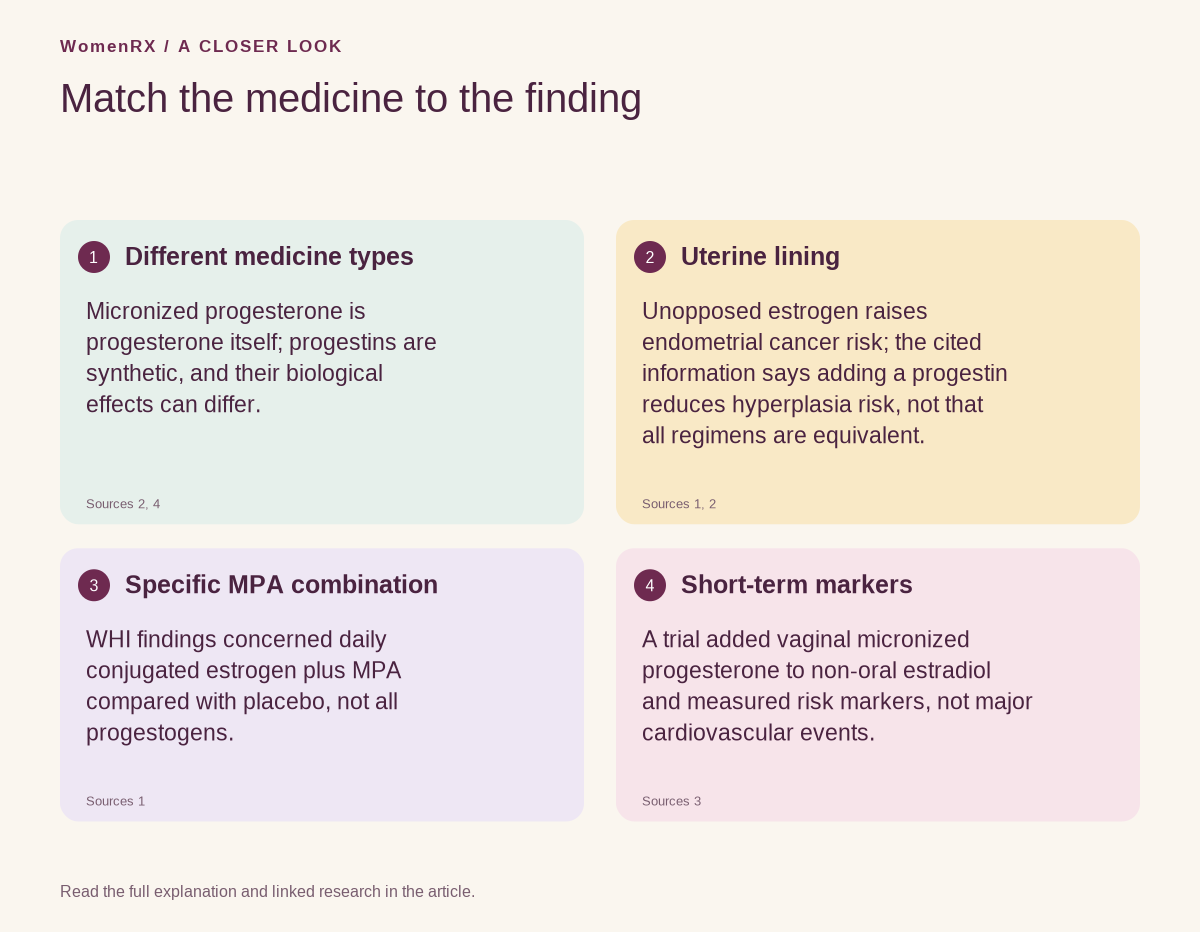
Match the medicine to the finding
Different medicine types: Micronized progesterone is progesterone itself; progestins are synthetic, and their biological effects can differ.24
Uterine lining: Unopposed estrogen raises endometrial cancer risk; the cited information says adding a progestin reduces hyperplasia risk, not that all regimens are equivalent.12
Specific MPA combination: WHI findings concerned daily conjugated estrogen plus MPA compared with placebo, not all progestogens.1
Short-term markers: A trial added vaginal micronized progesterone to non-oral estradiol and measured risk markers, not major cardiovascular events.3
Read the figure as text
These findings concern different medicines, combinations, and outcomes. They are not one direct ranking of all progestogens.- Different medicine types: Micronized progesterone is progesterone itself; progestins are synthetic, and their biological effects can differ.24
- Uterine lining: Unopposed estrogen raises endometrial cancer risk; the cited information says adding a progestin reduces hyperplasia risk, not that all regimens are equivalent.12
- Specific MPA combination: WHI findings concerned daily conjugated estrogen plus MPA compared with placebo, not all progestogens.1
- Short-term markers: A trial added vaginal micronized progesterone to non-oral estradiol and measured risk markers, not major cardiovascular events.3
More questions, answered
Does “micronized” mean the progesterone is synthetic?
No. Micronized progesterone is progesterone itself; micronization is processing that improves its absorption. Progestins are synthetic molecules. 4
Do WHI findings about MPA apply to all progestins?
No. The findings described here concern a specific daily combination of conjugated estrogen and MPA compared with placebo. They are not a head-to-head comparison with micronized progesterone or a study of every progestin. 1
Sources you can check
- PREMPHASE (CONJUGATED ESTROGENS AND MEDROXYPROGESTERONE ACETATE) KIT PREMPRO (CONJUGATED ESTROGENS AND MEDROXYPROGESTERONE ACETATE) TABLET, SUGAR COATED [WYETH PHARMACEUTICALS LLC, A SUBSIDIARY OF PFIZER INC.] | US prescribing information and patient instructionsAccessed 2026-09-25Return to first citation
- Micronized progesterone, progestins, and menopause hormone therapy.Hipolito Rodrigues MA, Gompel A. · Women & health · 2021Return to first citation
- Effects of micronized progesterone added to non-oral estradiol on lipids and cardiovascular risk factors in early postmenopause: a clinical trial.Casanova G, Spritzer PM. · Lipids in health and disease · 2012Return to first citation
- Diagnostic and therapeutic use of oral micronized progesterone in endocrinology.Memi E, Pavli P, Papagianni M, Vrachnis N, Mastorakos G. · Reviews in endocrine & metabolic disorders · 2024Return to first citation
- Effect of estradiol with or without micronized progesterone on cholinergic-related cognitive performance in postmenopausal women.Conley AC, Vega JN, Johnson JV, Dumas JA, Newhouse PA. · Frontiers in neuroscience · 2024Return to first citation
- Progesterone or progestin as menopausal ovarian hormone therapy: recent physiology-based clinical evidence.Prior JC. · Current opinion in endocrinology, diabetes, and obesity · 2015Return to first citation
- Expanding the Horizons of Menopausal Hormone Therapy: A Narrative Review of Progestogen-Only and Testosterone-Only Strategies for Tailored Management.Lee HJ, Yu EH, Joo JK. · Journal of menopausal medicine · 2026Return to first citation