Progesterone and progestins: how are they different in hormone therapy?
Progesterone is one hormone; progestins are a group of related synthetic compounds, and the specific ingredient matters more than the category name alone.
Progesterone is a hormone; progestins are synthetic compounds that act through progesterone receptors. In menopause therapy, progesterone and specific progestins such as medroxyprogesterone acetate or norethisterone may be paired with estrogen, including to help protect the uterine lining. Available comparisons suggest they can both serve that role at adequate doses, but evidence about differences in other health outcomes is limited and doesn’t establish one as best for everyone. 2 3
Start with the ingredient name
Progesterone is one hormone. Progestins are a group of synthetic compounds that act through progesterone receptors. The broader term progestogen is often used for progesterone and progestins together. They’re related, but the names don’t mean they’re the same substance.
On a prescription or medication list, you might see progesterone or micronized progesterone. You might instead see a specific progestin, such as medroxyprogesterone acetate or norethisterone. Those are examples, not interchangeable labels for one drug. In laboratory testing, progesterone and several progestins showed different patterns of activity at a progesterone receptor. That finding helps explain why researchers compare individual ingredients, but a cell study can’t tell you which option will work best for a person. 2
Why estrogen therapy may include one
For someone with a uterus who uses systemic estrogen, a progestogen may be included to help protect the lining of the uterus. A review of comparative studies found that progesterone and progestins were likely similarly effective at preventing endometrial hyperplasia and cancer when used at adequate doses. That finding is about this specific role; it doesn’t mean every product or regimen is interchangeable. 3
The word progestogen can help when you’re reading general information about this role. To understand what’s actually in a prescription, look for the specific ingredient. “Progestin” names a category; it doesn’t tell you which compound, formulation, or route is being used.
What the evidence says about differences
It’s tempting to look for a simple answer about which type has fewer risks. The available comparisons don’t support a universal winner. A review of 74 comparative publications reported that progesterone-based therapy had a similar or possibly better profile than progestin-based therapy for some breast and cardiovascular outcomes. But many studies were observational, and some weren’t large enough to reliably assess the outcomes. The authors described the findings as suggestive, not definitive. 3
One UK case-control study illustrates why the results need careful reading. Among women aged 50 or older, it found different breast-cancer associations for menopausal hormone therapy containing micronized progesterone versus synthetic progestins, compared with never-use. Because it was observational, it can show an association but can’t establish that the ingredient caused the difference. Its progesterone estimate was also imprecise. It isn’t enough to conclude that one option is safer for every woman. 4
Hormone-therapy risks can also depend on the estrogen, dose, duration, route, timing of treatment, and whether a progestogen is used. So a finding about one estrogen-progestogen combination shouldn’t automatically be applied to another. 1
A useful way to compare your options
If you’re reading a prescription or discussing a change, start with these questions:
- Which exact ingredient is listed? Is it progesterone, medroxyprogesterone acetate, norethisterone, or another compound?
- What is it being paired with? The evidence about a combined regimen depends partly on the estrogen and the specific progestogen.
- What job is it meant to do? If you have a uterus, ask how the proposed regimen addresses protection of the uterine lining.
- What does the comparison actually show? Evidence that two options can serve the same endometrial role doesn’t settle every question about breast, cardiovascular, or other outcomes.
The practical distinction is straightforward: progesterone is a particular hormone, while progestin is a category. The harder question, whether one specific option is a better fit for you, depends on the whole regimen and on evidence that remains incomplete for some outcomes.
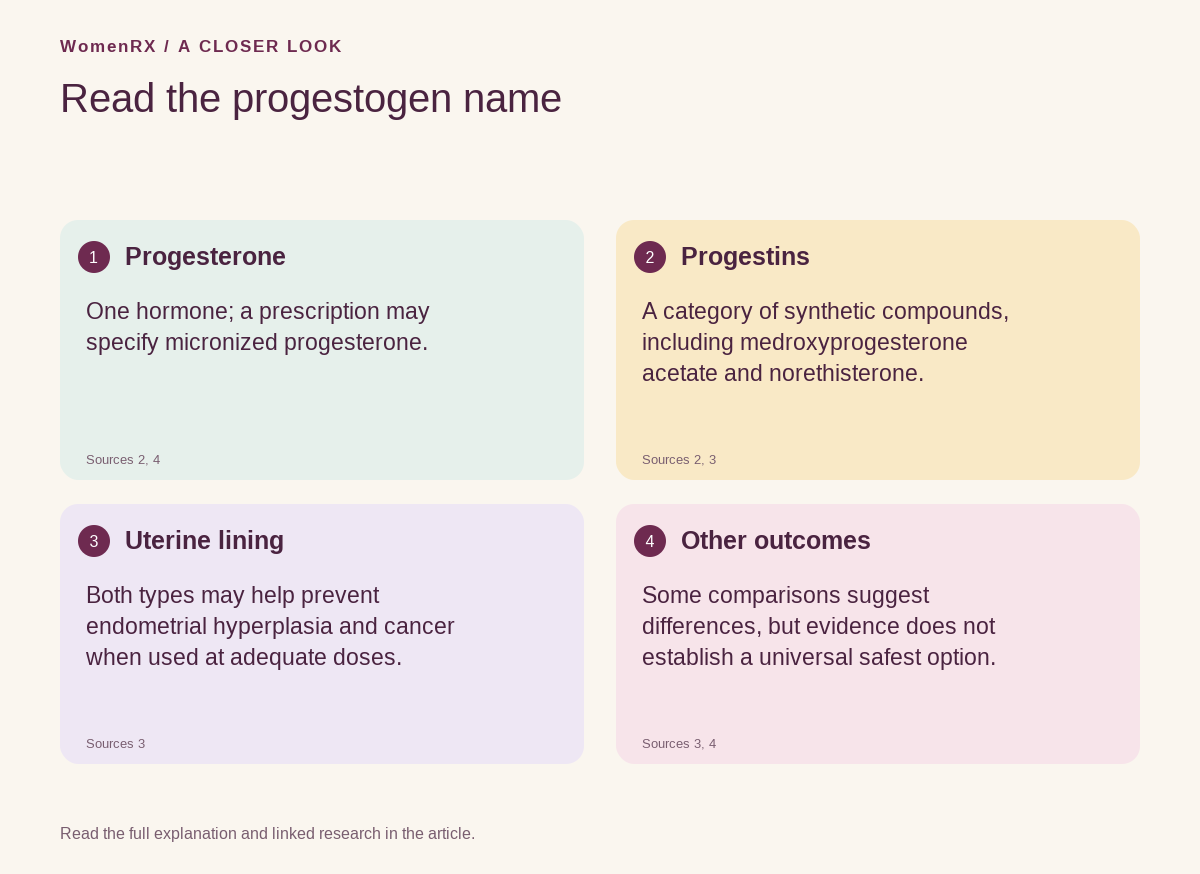
Read the progestogen name
Progesterone: One hormone; a prescription may specify micronized progesterone.24
Progestins: A category of synthetic compounds, including medroxyprogesterone acetate and norethisterone.23
Uterine lining: Both types may help prevent endometrial hyperplasia and cancer when used at adequate doses.3
Other outcomes: Some comparisons suggest differences, but evidence does not establish a universal safest option.34
Read the figure as text
Separate the hormone, the broader drug category, and the role a specific ingredient may serve in estrogen therapy.- Progesterone: One hormone; a prescription may specify micronized progesterone.24
- Progestins: A category of synthetic compounds, including medroxyprogesterone acetate and norethisterone.23
- Uterine lining: Both types may help prevent endometrial hyperplasia and cancer when used at adequate doses.3
- Other outcomes: Some comparisons suggest differences, but evidence does not establish a universal safest option.34
More questions, answered
Are progesterone and progestin interchangeable terms?
No. Progesterone is one hormone; progestins are a group of synthetic compounds that act through progesterone receptors. Progestogen is a broader term that can refer to progesterone and progestins together. 2 3
Does the evidence prove progesterone is safer than progestins?
No. Some comparisons suggest a potentially better profile for progesterone on certain outcomes, but the review found important limitations, including observational studies and studies too small to assess some outcomes well. One case-control study found different breast-cancer associations by formulation, but it cannot establish cause and effect. 3 4
Sources you can check
- The 2022 hormone therapy position statement of The North American Menopause Society.“The 2022 Hormone Therapy Position Statement of The North American Menopause Society” Advisory Panel. · Menopause (New York, N.Y.) · 2022Return to first citation
- The transcriptional activity of progestins used in contraception and menopausal hormone therapy via progesterone receptor A is dependent on the density of the receptor.Cartwright M, Toit RL, Africander D. · Biochemical and biophysical research communications · 2023Return to first citation
- Review of menopausal hormone therapy with estradiol and progesterone versus other estrogens and progestins.Graham S, Archer DF, Simon JA, Ohleth KM, Bernick B. · Gynecological endocrinology : the official journal of the International Society of Gynecological Endocrinology · 2022Return to first citation
- Menopausal Hormone Therapy Formulation and Breast Cancer Risk.Abenhaim HA, Suissa S, Azoulay L, Spence AR, Czuzoj-Shulman N, Tulandi T. · Obstetrics and gynecology · 2022Return to first citation