Cramping After Starting Menopause Hormone Therapy
The timing may be useful to track, but cramps alone can’t show whether hormone therapy is the cause.
If cramps start after you begin or change menopause hormone therapy, note when they occur, how strong they feel, and whether you have bleeding. Pelvic pain can come from the uterus, bowel, bladder, or other causes, and a product-specific side-effect listing doesn’t prove what’s causing your symptoms. If you’ve gone 12 months without a period, report any vaginal bleeding, even once. 1 2 3
First, separate cramps from bleeding
A cramp can feel as though it comes from the uterus, but pelvic pain can also come from the bowel, bladder, or other pelvic organs. Its pattern varies: it may come and go, stay in one place, or feel sudden and severe. So a new cramp after a hormone-therapy change is worth noticing, but the timing by itself doesn’t establish the cause. 2
There is a specific limitation to keep in mind: one US prescribing label for conjugated estrogen with medroxyprogesterone acetate lists pelvic pain and dysmenorrhea among reported genitourinary effects. That applies to the named product, not every menopause hormone therapy, and a side-effect listing cannot tell whether a particular person’s cramps came from treatment. A small clinical-practice audit of micronized progesterone users also identified unscheduled bleeding as a common side effect, but it did not establish a cause or expected course for cramps. 3 4
If you still have periods
During perimenopause, you may still have menstrual cycles. Note whether cramping lines up with bleeding, appears at another point in the cycle, or began after a treatment change. Also write down the date of the change, the medicines in your regimen, and any bleeding’s start and stop dates. This gives your prescriber a clearer picture without assuming the treatment is responsible.
Contact the prescriber if the cramps keep returning, don’t go away, or worry you. Pelvic pain has multiple possible causes, so persistent or recurring pain deserves attention even when there’s no bleeding. 2
If you’ve gone 12 months without a period
Bleeding after menopause needs assessment, even if it happens once or is only spotting. Menopause is generally identified after 12 months without a period; hormone therapy doesn’t make new bleeding something to dismiss as automatically expected. Causes can include noncancerous changes, but bleeding can also signal a more serious problem, so report it promptly rather than waiting to see whether it repeats. 1
US prescribing information for the specific conjugated-estrogen/medroxyprogesterone products also tells postmenopausal users to report abnormal vaginal bleeding as soon as possible, and calls for evaluation of persistent or recurring abnormal bleeding. That instruction is product-specific; the key point is not to self-diagnose bleeding as a harmless treatment effect. 3
Choose the next step by the symptom
Sudden, severe pelvic pain can have serious causes and needs urgent medical assessment. If the pain is not sudden or severe but keeps coming back or won’t go away, arrange a clinical assessment. If you have any vaginal bleeding after menopause, contact a clinician promptly even if the cramps are mild or absent. 1 2
For cramps without bleeding, keep a brief record of when they happen, how intense they feel, how long they last, and whether they coincide with a treatment change or other symptoms. Share the exact names of your estrogen and progestogen, if you use both, and any changes or missed doses.
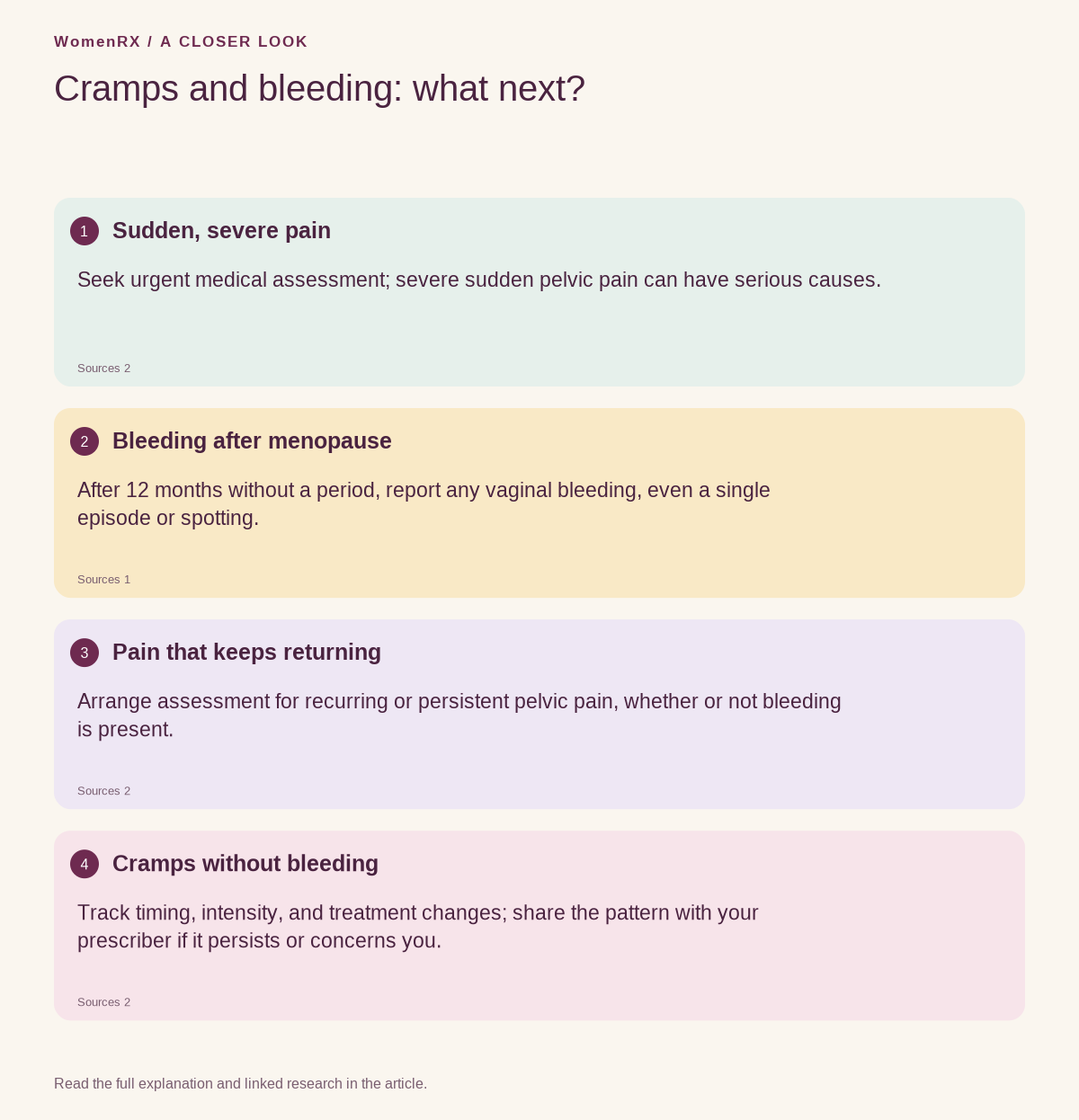
Cramps and bleeding: what next?
Sudden, severe pain: Seek urgent medical assessment; severe sudden pelvic pain can have serious causes.2
Bleeding after menopause: After 12 months without a period, report any vaginal bleeding, even a single episode or spotting.1
Pain that keeps returning: Arrange assessment for recurring or persistent pelvic pain, whether or not bleeding is present.2
Cramps without bleeding: Track timing, intensity, and treatment changes; share the pattern with your prescriber if it persists or concerns you.2
Read the figure as text
Use the pain pattern and whether bleeding is present to choose a next step. Any bleeding after menopause deserves prompt contact, even without cramps.- Sudden, severe pain: Seek urgent medical assessment; severe sudden pelvic pain can have serious causes.2
- Bleeding after menopause: After 12 months without a period, report any vaginal bleeding, even a single episode or spotting.1
- Pain that keeps returning: Arrange assessment for recurring or persistent pelvic pain, whether or not bleeding is present.2
- Cramps without bleeding: Track timing, intensity, and treatment changes; share the pattern with your prescriber if it persists or concerns you.2
More questions, answered
Does cramping mean my hormone therapy is causing a problem?
Not necessarily. Pelvic pain has several possible sources, and a reported side effect for one specific product cannot establish the cause of your symptoms or apply to every regimen. Bleeding after menopause still needs assessment, whether or not you think it is related to treatment. 1 2 3
Sources you can check
- Postmenopausal bleeding - NHSAccessed 2026-09-25Return to first citation
- Pelvic pain - NHSAccessed 2026-09-25Return to first citation
- PREMPHASE (CONJUGATED ESTROGENS AND MEDROXYPROGESTERONE ACETATE) KIT PREMPRO (CONJUGATED ESTROGENS AND MEDROXYPROGESTERONE ACETATE) TABLET, SUGAR COATED [WYETH PHARMACEUTICALS LLC, A SUBSIDIARY OF PFIZER INC.] | US prescribing information and patient instructionsAccessed 2026-09-25Return to first citation
- The use of micronised progesterone for menopausal hormone therapy, a clinical practice audit.Davis SR, Dempster G, Bell RJ. · The Australian & New Zealand journal of obstetrics & gynaecology · 2016Return to first citation