Starting Menopause Hormone Therapy: What to Expect
A first conversation can connect the symptoms you want help with to options that fit your health history and priorities.
You don’t need to decide on hormone therapy before your first discussion. Start with the symptoms affecting you most, then talk through your health history, whether symptoms are mainly vaginal or whole-body, and how timing and treatment type affect benefits and risks. If you’re still having periods, bring up your bleeding pattern and whether pregnancy is possible. Agree on what you’ll reassess if you start. 1
Begin with the change you want
You don’t need a perfect symptom diary or a particular number of symptoms to start the conversation. Choose the one or two things affecting you most, such as hot flashes, night sweats, or vaginal discomfort. Explain what improvement would look like in your day-to-day life. For example, you might want fewer night sweats or less discomfort during sex.
Hormone therapy is the most effective treatment for hot flashes and night sweats, and it can help genitourinary symptoms of menopause. It’s an option, not a required step, and the best fit depends on your symptoms and individual risks. 1
If you’re in perimenopause and still having periods, note how your bleeding has changed and whether pregnancy is possible. Bring those details into the discussion, and ask whether they affect the choices being considered. If pregnancy prevention is also a concern, raise that separately rather than assuming the menopause-treatment discussion answers it.
Share the context that can change the choice
Bring a current list of medicines and supplements, and describe relevant health conditions and past treatments. Mention any history of estrogen-dependent cancer or cardiovascular disease. These can affect whether hormone therapy is suitable, so ask how your own history changes the balance of options. 2
Tell the clinician whether you have a uterus or have had it removed. Ask how that affects the choices, including whether a progestogen such as progesterone would be part of the plan. The risk profile varies depending in part on whether a progestogen is used, but the specific regimen question needs an individualized answer. 1
Age and time since menopause also matter to the general benefit-risk discussion. For women younger than 60 or within 10 years of menopause onset who have no contraindications, the North American Menopause Society describes the balance as favorable for bothersome vasomotor symptoms and prevention of bone loss. For women starting more than 10 years after menopause or after age 60, it appears less favorable because certain risks are higher. These are group-level findings, not a personal prediction. 1
Match the treatment discussion to the symptom
A useful first distinction is whether you mainly want help with hot flashes and night sweats, vaginal or urinary symptoms, or both. For bothersome vaginal or urinary symptoms that haven’t improved with over-the-counter therapies, low-dose vaginal estrogen may be an option when there isn’t another reason to use systemic hormone therapy. Other treatments may also be considered. 1
If whole-body symptoms are the main concern, ask about systemic hormone therapy and what forms are available. Route is one factor in the risk discussion, along with treatment type, dose, duration, timing, and whether a progestogen is used. Ask how these factors apply to you rather than assuming one route is best for everyone. 1
You can also ask about nonhormonal options. Evidence-supported options for vasomotor symptoms include cognitive behavioral therapy, clinical hypnosis, certain prescription medicines, and weight loss. They aren’t interchangeable, and what fits depends on your circumstances and preferences. 2
Make a plan you can reassess
If you choose to start treatment, agree on which symptoms you’ll use to judge whether it’s helping. Ask what changes or side effects you should report and when you’ll revisit whether the benefits still match your goals. Guidance recommends periodic reevaluation of benefits and risks, but does not establish one follow-up interval for everyone. 1
If the approach doesn’t meet your goals, that gives you something specific to discuss: whether the treatment type, route, or overall plan needs reconsideration. You can also decide not to start, choose a nonhormonal approach, or return to the question later. Starting treatment doesn’t obligate you to continue indefinitely; ongoing decisions can reflect your experience and changing priorities. 12
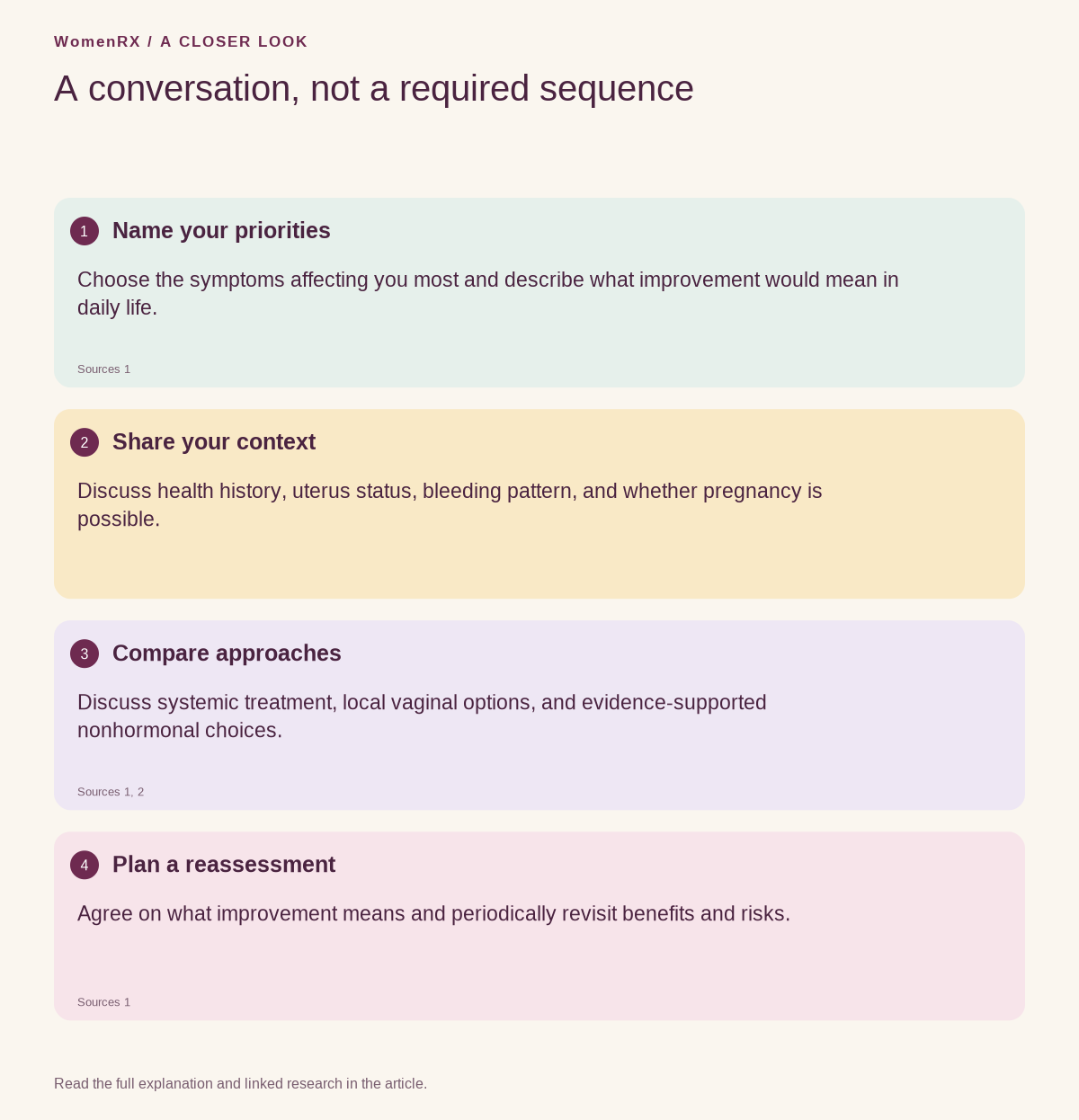
A conversation, not a required sequence
Name your priorities: Choose the symptoms affecting you most and describe what improvement would mean in daily life.1
Share your context: Discuss health history, uterus status, bleeding pattern, and whether pregnancy is possible.
Compare approaches: Discuss systemic treatment, local vaginal options, and evidence-supported nonhormonal choices.12
Plan a reassessment: Agree on what improvement means and periodically revisit benefits and risks.1
Read the figure as text
Use these discussion stages to connect what you want help with to a treatment choice and a plan to revisit it.- Name your priorities: Choose the symptoms affecting you most and describe what improvement would mean in daily life.1
- Share your context: Discuss health history, uterus status, bleeding pattern, and whether pregnancy is possible.
- Compare approaches: Discuss systemic treatment, local vaginal options, and evidence-supported nonhormonal choices.12
- Plan a reassessment: Agree on what improvement means and periodically revisit benefits and risks.1
More questions, answered
Do I have to try hormone therapy first?
No. Hormone therapy is the most effective treatment for vasomotor symptoms, but evidence-supported nonhormonal options are available. Your preferences and health history can shape the choice. 12
Is vaginal estrogen the same as systemic hormone therapy?
They’re different treatment discussions. For bothersome vaginal or urinary symptoms not relieved by over-the-counter options, low-dose vaginal estrogen may be considered when systemic therapy isn’t otherwise indicated. 1
Sources you can check
- The 2022 hormone therapy position statement of The North American Menopause Society.“The 2022 Hormone Therapy Position Statement of The North American Menopause Society” Advisory Panel. · Menopause (New York, N.Y.) · 2022Return to first citation
- The 2023 nonhormone therapy position statement of The North American Menopause Society.Menopause (New York, N.Y.) · 2023Return to first citation