When to Review a Menopause Hormone Therapy Dose
Persistent symptoms, difficult side effects, or new unexpected bleeding are reasons to review your whole regimen with your prescriber, not to adjust it on your own.
Consider a review if the symptoms you’re treating persist or return, side effects are hard to manage, or your bleeding pattern changes. Bring your hormone names and forms, how you use them, symptom timing, and bleeding details. Scheduled withdrawal bleeding can be expected with some sequential regimens, even after menopause; new or unexpected bleeding is different, so contact your prescriber rather than waiting to change your dose. 1 2 3
Look for a pattern before guessing at a dose
A symptom returning doesn’t automatically mean you need more hormone therapy. Menopause symptoms and treatment side effects can overlap, and a symptom may have another cause. Start by noting what you hoped treatment would improve, what has changed, and when the change began. 1
For example, you might note that hot flashes improved but sleep did not, or that a headache appeared after starting treatment. Write down how often symptoms happen and how much they affect your day. That pattern gives your prescriber more to work with than a general sense that the dose isn’t working.
Treatment decisions are individual. Benefits and risks vary with factors including dose, duration, route, timing of starting therapy, and whether a progestogen is included. A review can consider whether the current plan still fits your symptoms, health, and goals. 3
Bring the full regimen, not just the estrogen name
List each product you use, including its hormone name if you know it, form, and route. For example, that might mean a tablet, patch, gel, spray, or vaginal product. Include any separate progesterone or other progestogen, when you started each product, and any recent changes. The route and the complete regimen can matter when a prescriber considers whether a different dose, type, or way of taking treatment might help. 1 3
Be candid about missed or late doses and how you use each product in practice. This helps distinguish a plan that isn’t meeting your needs from one that hasn’t been taken consistently. Note new diagnoses or other health changes, too, because your benefits and risks may need to be reconsidered over time. 3
Describe side effects without assuming their cause
Note what the side effect is, when it started, and whether it is mild, disruptive, severe, or persistent. Some side effects improve over time, but severe effects or ones that continue are worth raising. Menopause symptoms can resemble treatment side effects, so a prescriber may consider other explanations rather than assuming the hormone dose is responsible. 1
A higher dose is only one possible change, and it may not be the right one. Depending on your symptoms and treatment, a prescriber might consider a different dose, type, or route. Don’t increase, reduce, stop, or switch hormone therapy on your own; the decision depends on your complete regimen and individual circumstances. 1 3
Separate scheduled bleeding from unexpected bleeding
Some sequential hormone therapy regimens include a scheduled withdrawal bleed at the end of the progestogen portion. That can happen even if you’re postmenopausal; it is different from new or unscheduled bleeding. Spotting or irregular bleeding can also occur in the first months of some regimens. 1
Contact your prescriber about bleeding that is new, unexpected for your regimen, or changing. Don’t wait to see whether a dose adjustment fixes it. This applies whether you still have periods or have reached menopause. Postmenopausal bleeding during hormone therapy needs assessment, although the best way to evaluate every case in hormone-therapy users remains an area of uncertainty. 2
When you contact the prescriber, describe when bleeding happens in relation to your regimen, how long it lasts, and whether it differs from your usual pattern. Some guidance suggests discussing irregular bleeding at an early treatment review and again if it continues, but the right timing depends on the person and situation. 1
Make the review specific
You can bring questions such as:
- Which symptom or treatment goal should guide this review?
- Could the symptom be a menopause symptom, a treatment effect, or something else?
- Do my product, route, and actual use pattern affect the options?
- Is my bleeding scheduled for this regimen, or is it unexpected and in need of assessment?
- If we change the plan, what should I watch for and when should we review it again?
The aim isn’t necessarily a higher dose. It’s a plan that fits your symptoms, side effects, bleeding pattern, regimen, and current health, with any adjustment made together with your prescriber. 1 3
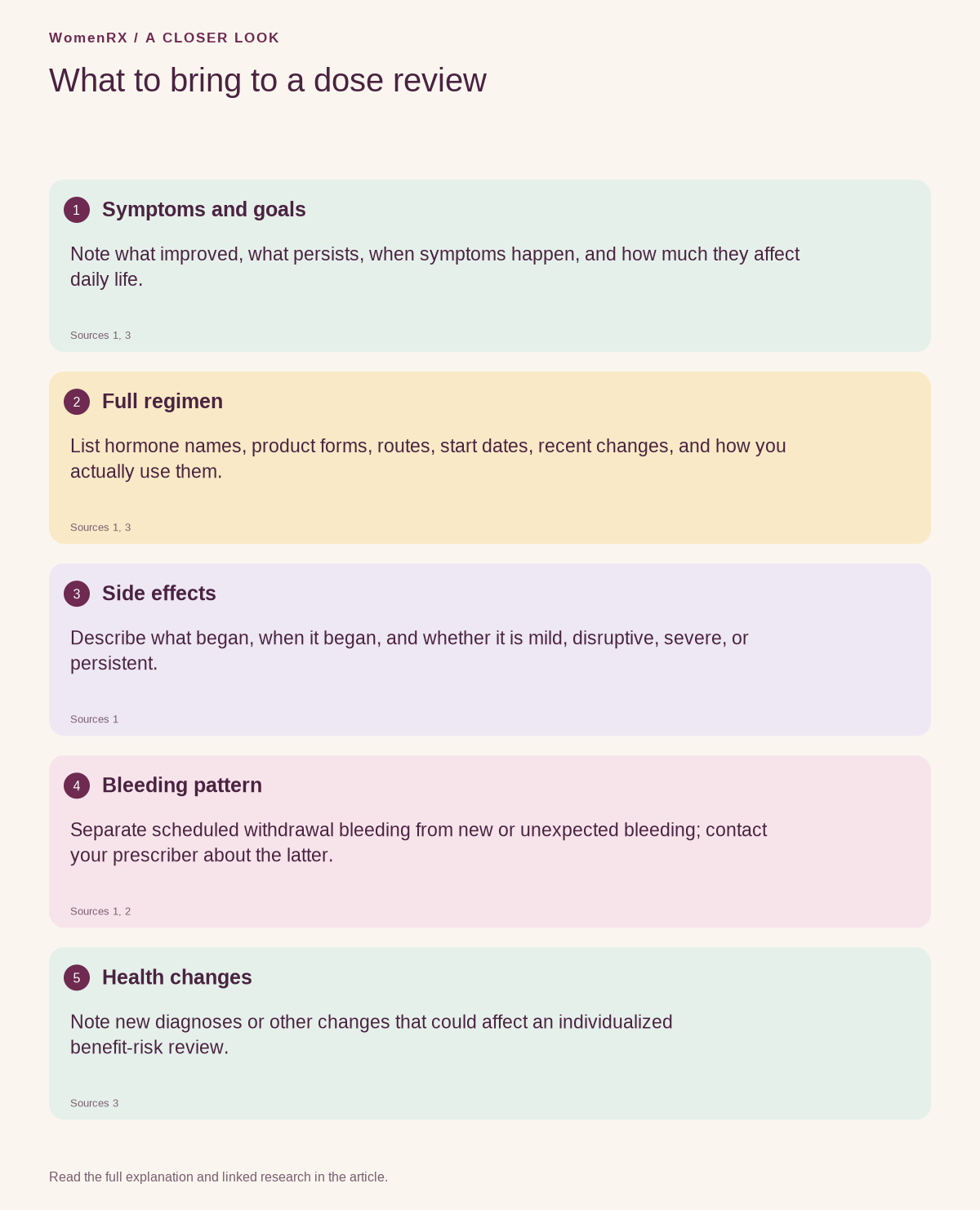
What to bring to a dose review
Symptoms and goals: Note what improved, what persists, when symptoms happen, and how much they affect daily life.13
Full regimen: List hormone names, product forms, routes, start dates, recent changes, and how you actually use them.13
Side effects: Describe what began, when it began, and whether it is mild, disruptive, severe, or persistent.1
Bleeding pattern: Separate scheduled withdrawal bleeding from new or unexpected bleeding; contact your prescriber about the latter.12
Health changes: Note new diagnoses or other changes that could affect an individualized benefit-risk review.3
Read the figure as text
Organize the details that help your prescriber review symptoms, treatment, side effects, bleeding, and health changes together.- Symptoms and goals: Note what improved, what persists, when symptoms happen, and how much they affect daily life.13
- Full regimen: List hormone names, product forms, routes, start dates, recent changes, and how you actually use them.13
- Side effects: Describe what began, when it began, and whether it is mild, disruptive, severe, or persistent.1
- Bleeding pattern: Separate scheduled withdrawal bleeding from new or unexpected bleeding; contact your prescriber about the latter.12
- Health changes: Note new diagnoses or other changes that could affect an individualized benefit-risk review.3
More questions, answered
Can scheduled bleeding happen after menopause if I use sequential hormone therapy?
Yes. Some sequential regimens have expected withdrawal bleeding at the end of the progestogen portion. New or unscheduled bleeding is different, so contact your prescriber about it rather than assuming it is part of the regimen. 1 2
Should I change my dose while waiting to speak with my prescriber?
No. Don’t change the dose, route, or type on your own. Those decisions depend on your complete regimen, response, and individual benefits and risks. Contact the prescriber’s office sooner if side effects are severe or you have new or unexpected bleeding. 1 3
Sources you can check
- Side effects of hormone replacement therapy (HRT) - NHSAccessed 2026-09-25Return to first citation
- Temporal Clustering of Endometrial Cancer and Hyperplasia in HRT Users with Unscheduled Bleeding: A Retrospective NHS Cohort Study.Abdelaziz MAM, Mohamed A, Olaleye A, Hesham N, Tasnim N, Ogundiran O, Sandison L, Sayed H, Juliana A. · Current oncology (Toronto, Ont.) · 2026Return to first citation
- The 2022 hormone therapy position statement of The North American Menopause Society.“The 2022 Hormone Therapy Position Statement of The North American Menopause Society” Advisory Panel. · Menopause (New York, N.Y.) · 2022Return to first citation