Questions to Ask at a Menopause Hormone Therapy Appointment
A focused conversation starts with how symptoms affect your life, then weighs treatment options against your health history and priorities.
Before your appointment, write down your most disruptive symptoms, what they interfere with, and what you hope treatment will change. Ask whether hormone therapy fits your health history and timing, how your uterus status affects the options, and what nonhormonal treatments might help. You can also ask about route, cost, how you’ll judge whether treatment is working, and when to revisit the decision. 1 2
Start with what you want help with
You don’t need to arrive asking for a particular hormone or prescription. A clearer starting point is what’s happening and what you want to be able to do more comfortably. For example: “Hot flashes are waking me several nights a week, and I’d like to sleep through the night. What options fit my situation?” Or: “Vaginal dryness is making sex uncomfortable. What could help with that?”
Write down your main symptoms and their effect on sleep, work, exercise, sex, or other parts of daily life. Mention whether you’re still having periods, when your last period was if you know, and whether symptoms are changing. Treatment decisions can depend on timing as well as the symptoms themselves. The North American Menopause Society’s 2022 position statement says the benefit-risk balance is generally more favorable for people under 60 or within 10 years of menopause onset who have no contraindications, and recommends individualizing treatment. 1
A useful opening line is: “These are the symptoms affecting me most, and this is what I’d like treatment to improve. Can we compare hormone and nonhormone options for my situation?”
Questions that make the options clearer
You can choose the questions that matter most to you. You don’t need to get through a long checklist in one visit.
- What is each option meant to treat? Hormone therapy is the most effective treatment for hot flashes and night sweats, while bothersome vaginal or urinary symptoms may call for a different discussion. Ask whether the proposed treatment is systemic or local and which of your symptoms it is expected to help. 1
- How does my health history change the balance? Ask which parts of your personal history matter for your choices and how they affect potential benefits and risks. The position statement says risks vary with factors including the type, dose, duration, route, timing, and whether a progestogen is used. 1
- Does the route matter for me? Ask what the differences are between the routes being considered, including their tradeoffs and which symptoms they’re intended to address. Risk can vary by route, so it’s reasonable to ask why one is being discussed for you. 1
- Does my uterus status change the plan? If you’ve had a hysterectomy, say what surgery you had and whether your uterus was removed. Ask whether the treatment being discussed requires protection of the uterine lining. Whether a progestogen is needed depends on the treatment plan and whether endometrial protection is required. 3
- What else could help? If you prefer not to use hormones, or they aren’t a suitable choice, ask about evidence-supported alternatives for your particular symptoms. For hot flashes and night sweats, the 2023 NAMS statement lists options including cognitive behavioral therapy, clinical hypnosis, certain prescription medicines, and weight loss; these aren’t all interchangeable, and the right discussion depends on your circumstances. 2
- What will it cost me? Ask what the likely out-of-pocket cost is with your insurance, whether a covered alternative is available, and whether the cost could change over time.
For vaginal and urinary symptoms, the options may differ from those for hot flashes. When over-the-counter treatments haven’t helped and systemic hormone therapy isn’t otherwise indicated, the 2022 position statement includes low-dose vaginal estrogen and other treatments among the options to discuss. 1
If you have a history of breast cancer, tell the clinician and ask how that history affects the choices. Evidence and recommendations for hormone therapy after breast cancer are not straightforward; a review describes systemic therapy as controversial, and a multidisciplinary consensus emphasizes weighing symptoms, recurrence risk, and your preferences together. 4 5
Leave with a way to judge the plan
Before you finish, ask: “What change should I look for, when should we check whether it’s helping, and what would make us reconsider?” You might define success as fewer disruptive hot flashes, better sleep, or less discomfort with vaginal symptoms. Agreeing on a specific goal makes it easier to tell whether the option is meeting your needs. Hormone therapy’s benefits and risks can change over time, so periodic reevaluation is part of the treatment discussion. 1
A visit can end with a decision, more information to consider, or a plan to compare options later. You can ask for an explanation of the tradeoffs in plain language and take time to decide. The aim is a plan that matches your symptoms, health history, and priorities, not a prescription chosen in advance. 1 2
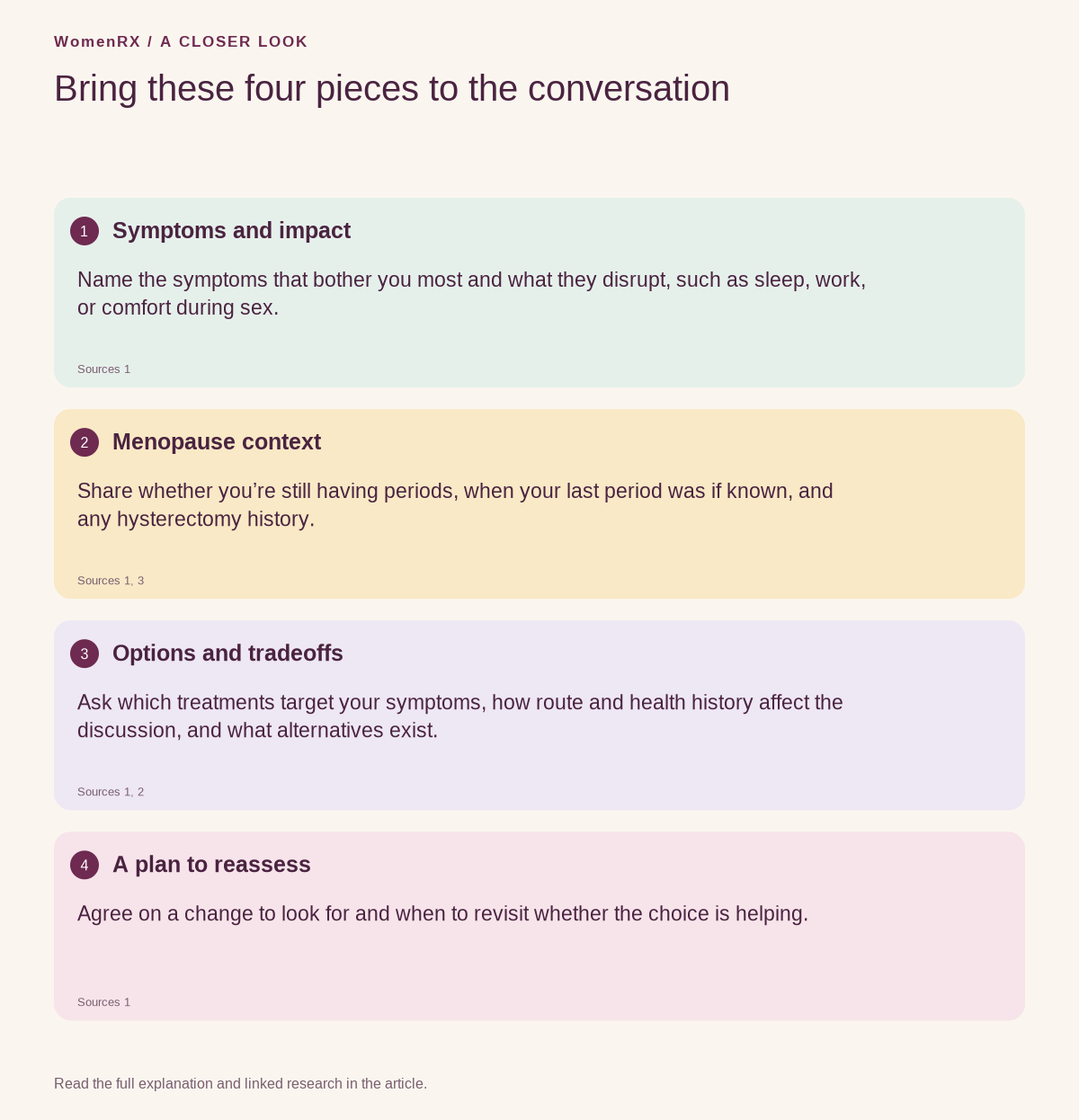
Bring these four pieces to the conversation
Symptoms and impact: Name the symptoms that bother you most and what they disrupt, such as sleep, work, or comfort during sex.1
Menopause context: Share whether you’re still having periods, when your last period was if known, and any hysterectomy history.13
Options and tradeoffs: Ask which treatments target your symptoms, how route and health history affect the discussion, and what alternatives exist.12
A plan to reassess: Agree on a change to look for and when to revisit whether the choice is helping.1
Read the figure as text
Use this checklist to connect what you’re experiencing with the questions that can clarify a treatment plan.- Symptoms and impact: Name the symptoms that bother you most and what they disrupt, such as sleep, work, or comfort during sex.1
- Menopause context: Share whether you’re still having periods, when your last period was if known, and any hysterectomy history.13
- Options and tradeoffs: Ask which treatments target your symptoms, how route and health history affect the discussion, and what alternatives exist.12
- A plan to reassess: Agree on a change to look for and when to revisit whether the choice is helping.1
More questions, answered
Do I need to decide about hormone therapy during the appointment?
No. You can use the visit to understand the options, ask how your health history affects the tradeoffs, and decide what information you still need. The position statement recommends individualized treatment decisions and periodic reassessment. 1
What if I’m still having periods?
Say so, and describe any changes in your cycle alongside your symptoms. The timing of treatment relative to menopause is part of the benefit-risk discussion, so your clinician needs to understand where you are in that transition. 1
Sources you can check
- The 2022 hormone therapy position statement of The North American Menopause Society.“The 2022 Hormone Therapy Position Statement of The North American Menopause Society” Advisory Panel. · Menopause (New York, N.Y.) · 2022Return to first citation
- The 2023 nonhormone therapy position statement of The North American Menopause Society.Menopause (New York, N.Y.) · 2023Return to first citation
- Menopausal Hormone Therapy: A Narrative Review of Contemporary Evidence.Finks SW, Cieri-Hutcherson NE, Vernon V, McBane SE. · Pharmacotherapy · 2026Return to first citation
- Menopausal hormone therapy in breast cancer survivors: A review.Granat LM, Pederson HJ, Kruse M. · Maturitas · 2026Return to first citation
- Menopausal hormone therapy for breast cancer patients: what is the current evidence?Glynne S, Simon J, Branson A, Payne S, Newson L, Manyonda I, Cleator S, Douek M, Usiskin S, Tobias JS, Vaidya JS. · Menopause (New York, N.Y.) · 2026Return to first citation