Menopause Hormone Therapy Before or After Surgery: What to Ask
There’s no single stop-or-continue rule for menopause hormone therapy around surgery, so your surgical and prescribing teams need to agree on a plan for your treatment and procedure.
If you use menopause hormone therapy and have surgery planned, don’t assume you should stop it or continue it unchanged. Ask your surgical team and the clinician who prescribes your therapy to review your exact medication, route, procedure, clotting history, and expected mobility together. Evidence is limited, and it doesn’t establish one stop or restart schedule for everyone. 3 4
The useful question isn’t simply “Should I stop HRT?” It’s “What plan fits this procedure, my health history, and the hormone therapy I actually use?” Menopause hormone therapy (MHT), also called hormone replacement therapy (HRT), doesn’t have one evidence-based stop-and-restart schedule for every operation. Guidance varies, and the research is limited. 3 4
Try to get the surgical team and the clinician who prescribes your therapy working from the same information. Ask who will give you the final instructions, including when treatment will be reviewed after surgery.
Why the answer can depend on the operation
Surgery can raise concern about venous thromboembolism (VTE), which includes deep vein thrombosis and pulmonary embolism. The procedure and your recovery matter: ask how much movement is expected, what steps the team plans to reduce clot risk, and whether your personal clotting history changes the recommendation. 3
The hormone route is another detail to discuss. Oral estrogen is associated with increased VTE risk outside the surgical setting, while transdermal estrogen is generally considered to have a more favorable clotting profile. But that difference doesn’t tell us exactly what to do for a particular operation. 3
Recommendations can also vary by procedure. A review of seven international guidelines for elective lower-limb joint replacement found a mixed picture: some gave detailed advice about MHT, while others offered no guidance. That review is about joint replacement, not a universal rule for gynecologic surgery or other operations. 4
A separate scoping review found only four eligible studies on perioperative HRT and VTE. Just one compared continuation with stopping; it found no significant increase in postoperative VTE with continuation. That result doesn’t prove the options are equally safe for every person or procedure. 3
Make your regimen part of the conversation
Bring a current medication list or the product information for everything you take. Include the exact hormone products and how you use them, such as a pill, patch, or gel. Say whether your regimen includes estrogen, a progestogen, or both, and why you take it. Hormone therapy risks vary with factors that include route and whether a progestogen is used, so the specific regimen matters. 2
If your surgery involves the uterus or ovaries, make sure both teams know what procedure is planned. Ask whether it changes the reason for your current therapy or what the prescriber will review after surgery. Don’t assume that the same plan applies to every gynecologic operation or every hormone regimen.
Stopping treatment may bring back disruptive menopause symptoms, so include that possibility in the discussion alongside procedure-related concerns. Don’t make a change on your own while waiting for instructions. 3
Questions to settle before surgery
You can use these questions to get one clear plan:
- Does my procedure and expected recovery change what you recommend for my specific hormone therapy?
- Does my clotting history affect the plan? What steps are planned to reduce clot risk?
- If you recommend a change, who will tell me when to make it and when to review or restart treatment?
- Is the review tied to a recovery milestone, and who should I contact if my symptoms return?
- Who is responsible for making sure the surgical and prescribing teams have given me consistent instructions?
If you’re already recovering and aren’t sure whether to resume therapy, contact the surgical team or prescriber for instructions based on your procedure and recovery rather than guessing at a timeline. Your surgeon can also explain what activity restrictions to expect after the operation. 1
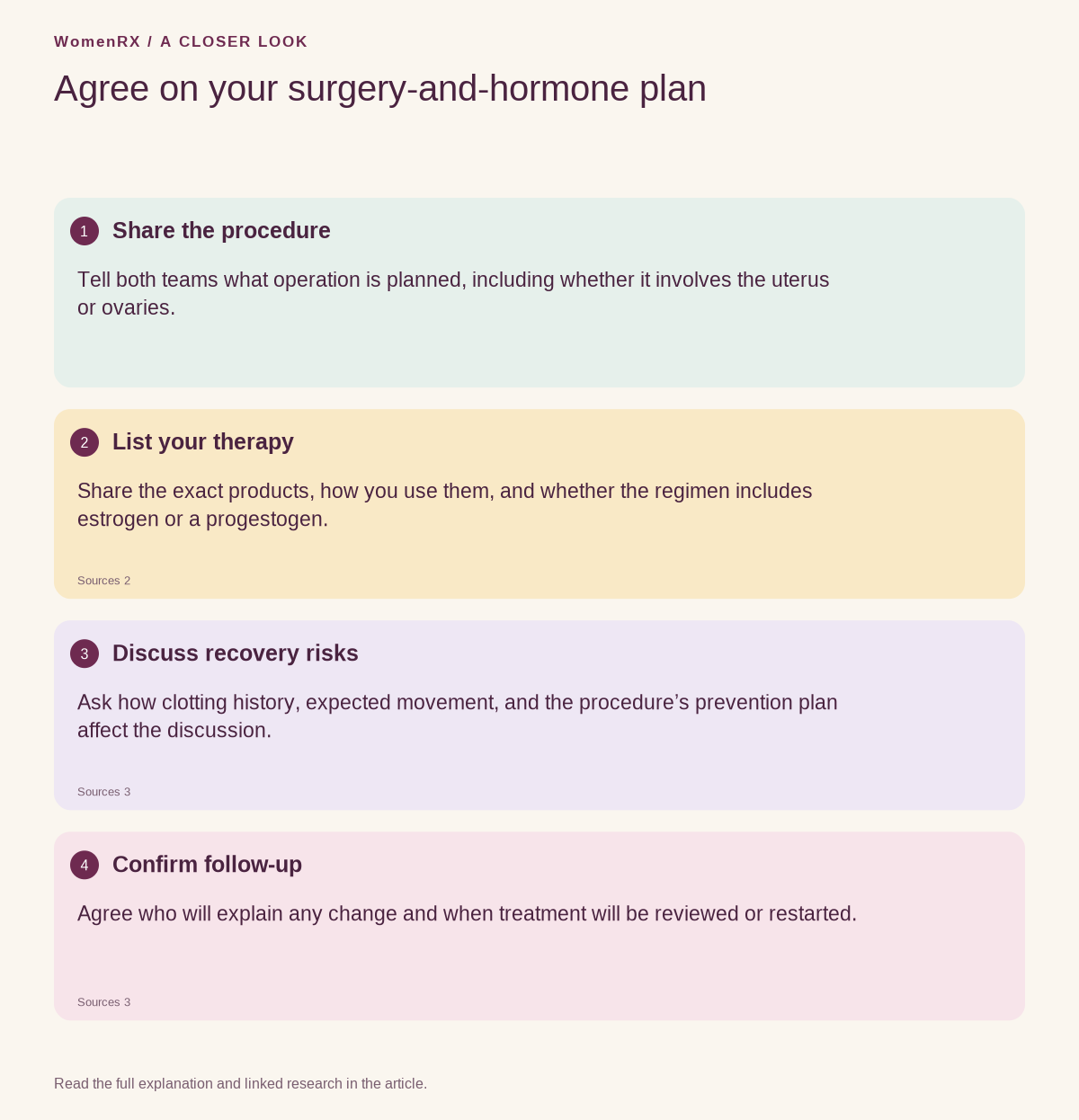
Agree on your surgery-and-hormone plan
Share the procedure: Tell both teams what operation is planned, including whether it involves the uterus or ovaries.
List your therapy: Share the exact products, how you use them, and whether the regimen includes estrogen or a progestogen.2
Discuss recovery risks: Ask how clotting history, expected movement, and the procedure’s prevention plan affect the discussion.3
Confirm follow-up: Agree who will explain any change and when treatment will be reviewed or restarted.3
Read the figure as text
Use this sequence to help your surgical team and prescribing clinician review the same details and confirm who will give you instructions.- Share the procedure: Tell both teams what operation is planned, including whether it involves the uterus or ovaries.
- List your therapy: Share the exact products, how you use them, and whether the regimen includes estrogen or a progestogen.2
- Discuss recovery risks: Ask how clotting history, expected movement, and the procedure’s prevention plan affect the discussion.3
- Confirm follow-up: Agree who will explain any change and when treatment will be reviewed or restarted.3
More questions, answered
Is there a standard number of days to stop hormone therapy before surgery?
The available evidence doesn’t establish one stop-before or restart-after interval for all procedures and regimens. Ask your surgical team and prescriber for a plan specific to your operation and recovery. 3 4
What if my menopause symptoms return after a change?
Tell the clinician who prescribes your therapy. Symptom return can be part of the tradeoff when stopping treatment, so it belongs in the discussion alongside surgical risks. 3
Sources you can check
- After Surgery: MedlinePlusAccessed 2026-09-25Return to first citation
- The 2022 hormone therapy position statement of The North American Menopause Society.“The 2022 Hormone Therapy Position Statement of The North American Menopause Society” Advisory Panel. · Menopause (New York, N.Y.) · 2022Return to first citation
- Perioperative hormone replacement therapy (HRT) and venous thromboembolism risk: a scoping review of available evidence and guidance.Helmy O, Sarathi CIP, Sarma D. · JRSM open · 2026Return to first citation
- Withholding of Hormone Replacement Therapy Prior to Total Joint Arthroplasty Surgery to Reduce the Risk of Postoperative Thromboembolic Events: Is It Justified?-A Systematic Review of Clinical Practice Guidelines.Abouharb ALZ, Mehta S, Rathnayake H, Pandit H. · The Journal of arthroplasty · 2024Return to first citation