Smoking and Menopause Hormone Therapy: What to Discuss With Your Clinician
Smoking is one part of your cardiovascular and clotting risk profile; your treatment goal, medical history, and hormone therapy route also belong in the discussion.
Smoking can raise cardiovascular and clotting risks, so it belongs in a hormone therapy risk review. But smoking alone doesn’t settle whether treatment is right for you. Discuss your health history, treatment goal, timing, and the specific options being considered. A study of one oral hormone combination compared it with placebo, not a patch, so it doesn’t answer which route is safer for an individual who smokes. 134
Smoking and menopause hormone therapy aren’t a simple yes-or-no combination. Cigarette smoking can damage blood vessels and increase the risk of blood clots and stroke. That makes smoking relevant to your risk discussion, but it doesn’t by itself determine whether hormone therapy is appropriate for you. The decision also depends on your health history, what symptoms you want to treat, and the treatment being considered. 124
Start with your health profile and treatment goal
Tell your clinician whether you currently smoke or recently quit. Review any history of blood clots, stroke, or heart attack, as well as blood pressure, cholesterol, diabetes, and other conditions that may affect cardiovascular or clotting risk. US prescribing information lists tobacco use among arterial vascular disease risk factors and personal or family history of venous thromboembolism (VTE) among VTE risk factors. It advises that relevant risk factors be managed appropriately. 2
It also helps to be clear about what you want treatment to address. Menopausal hormone therapy is an effective treatment for bothersome hot flashes and other vasomotor symptoms, and it can help prevent bone loss. It is not intended to prevent cardiovascular disease. 24
Ask about the actual treatment, not just the route
Oral and transdermal treatments are not interchangeable in every respect, but the route alone doesn’t tell you what your individual risk will be. The North American Menopause Society says hormone therapy risks vary with factors including treatment type, dose, duration, route, timing, and whether a progestogen is used. It recommends individualizing treatment and periodically reassessing its benefits and risks. 4
A specific example helps show why it’s worth asking about the evidence for the option being discussed. In a study of postmenopausal women ages 50 to 79, daily oral conjugated estrogens plus medroxyprogesterone acetate was associated with increased risks of deep vein thrombosis, pulmonary embolism, stroke, and heart attack compared with placebo during an average 5.6 years of treatment. That study compared one oral combination with placebo, not with a patch. It therefore doesn’t establish which route is safer for an individual who smokes, or how its findings apply to every product or treatment plan. 3
A useful question is: “Given my health history and treatment goal, what are the relevant tradeoffs for the specific oral or transdermal option we’re considering?” Don’t assume a patch eliminates risk, or that results for one oral combination describe all hormone therapy. 34
Timing and symptom type can change the conversation
Age and time since menopause began also matter. The North American Menopause Society describes the benefit-risk balance as generally favorable for women younger than 60 or within 10 years of menopause onset, without contraindications, when treating bothersome vasomotor symptoms or preventing bone loss. It describes the balance as less favorable when treatment starts later, in part because absolute risks of coronary heart disease, stroke, VTE, and dementia are greater. This is general guidance, not a smoking-specific rule; your circumstances still matter. 4
If your main symptoms are vaginal or urinary, ask whether you need systemic therapy. For bothersome genitourinary symptoms not relieved by over-the-counter therapies, the position statement recommends low-dose vaginal estrogen or other treatments for women without an indication for systemic hormone therapy. 4
A focused set of questions to bring
You might ask:
- How do my current or past smoking and my history of cardiovascular disease or blood clots affect this decision?
- Which risk factors should we review, such as blood pressure, cholesterol, diabetes, or personal or family clot history?
- What are the tradeoffs of the specific oral and transdermal options being considered for my symptoms?
- Do I need systemic treatment, or could a local treatment address my symptoms?
- If I start treatment, when should we revisit whether its benefits still outweigh its risks?
If you smoke, quitting can reduce your risk of smoking-related health problems. You can ask for help with quitting while you and your clinician consider the hormone therapy question. 1
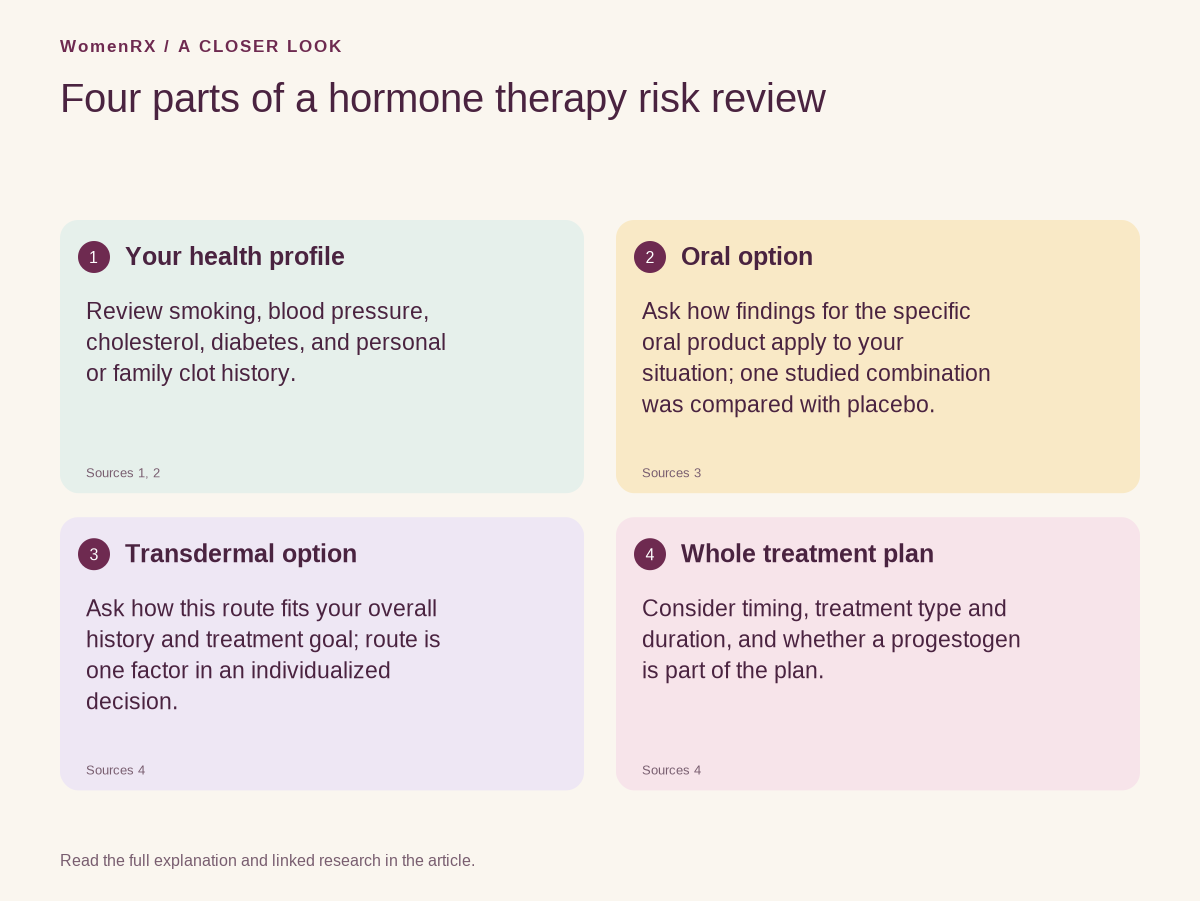
Four parts of a hormone therapy risk review
Your health profile: Review smoking, blood pressure, cholesterol, diabetes, and personal or family clot history.12
Oral option: Ask how findings for the specific oral product apply to your situation; one studied combination was compared with placebo.3
Transdermal option: Ask how this route fits your overall history and treatment goal; route is one factor in an individualized decision.4
Whole treatment plan: Consider timing, treatment type and duration, and whether a progestogen is part of the plan.4
Read the figure as text
Separate your baseline health profile from questions about a particular treatment route and the rest of the treatment plan.- Your health profile: Review smoking, blood pressure, cholesterol, diabetes, and personal or family clot history.12
- Oral option: Ask how findings for the specific oral product apply to your situation; one studied combination was compared with placebo.3
- Transdermal option: Ask how this route fits your overall history and treatment goal; route is one factor in an individualized decision.4
- Whole treatment plan: Consider timing, treatment type and duration, and whether a progestogen is part of the plan.4
Sources you can check
- Smoking | Quit Smoking | Effects of Smoking | MedlinePlusAccessed 2026-09-25Return to first citation
- PREMARIN (ESTROGENS, CONJUGATED) TABLET, FILM COATED [WYETH PHARMACEUTICALS LLC, A SUBSIDIARY OF PFIZER INC.] | US prescribing information and patient instructionsAccessed 2026-09-25Return to first citation
- PREMPHASE (CONJUGATED ESTROGENS AND MEDROXYPROGESTERONE ACETATE) KIT PREMPRO (CONJUGATED ESTROGENS AND MEDROXYPROGESTERONE ACETATE) TABLET, SUGAR COATED [WYETH PHARMACEUTICALS LLC, A SUBSIDIARY OF PFIZER INC.] | US prescribing information and patient instructionsAccessed 2026-09-25Return to first citation
- The 2022 hormone therapy position statement of The North American Menopause Society.“The 2022 Hormone Therapy Position Statement of The North American Menopause Society” Advisory Panel. · Menopause (New York, N.Y.) · 2022Return to first citation