Smoking and Menopause HRT: What to Discuss About Risks and Route
Smoking belongs in your hormone therapy risk discussion, but neither smoking status nor the choice of a patch settles the decision on its own.
If you smoke now or have smoked before, tell your prescriber when discussing menopausal hormone therapy. Ask how your smoking history fits with your cardiovascular health, symptoms, and proposed treatment. Smoking alone doesn’t establish that hormone therapy is off the table. A patch isn’t a guarantee against risk, either: the major trial cited in US product information studied a specific oral regimen, not patches in smokers. 123
Smoking is one part of a menopausal hormone therapy (MHT) decision, whether you’re having symptoms during perimenopause or are postmenopausal. It deserves attention without becoming a shortcut to a yes-or-no answer. A review of MHT discusses smoking among the circumstances that call for an individualized treatment choice; a review of cardiovascular prevention in women also identifies smoking cessation as a way to address heart and blood vessel risk. 23
What smoking changes about the conversation
Start with your history: Do you smoke now, did you quit, or are you trying to quit? Then put that history alongside the other factors your clinician needs to assess, including blood pressure, blood sugar, cholesterol, and any known cardiovascular condition. Those factors matter to cardiovascular prevention whether or not you use MHT. If you’d like help quitting, it’s worth raising that as its own goal, not just as a condition for discussing menopause treatment. 3
Your symptoms matter too. For example, if hot flashes are regularly interrupting your sleep, say so. The point of considering MHT is to weigh a treatment goal against your individual risks, rather than treating your smoking history as the whole story. 2
Why “oral or patch?” is a separate question
The Women’s Health Initiative (WHI) trial described in US product information found increased risks of deep vein thrombosis, pulmonary embolism, stroke, and heart attack compared with placebo among postmenopausal women using a specific daily oral estrogen-plus-progestin regimen. That result matters, but it isn’t a head-to-head test of oral therapy versus a skin patch in people who smoke. The product information says the extent to which those findings apply to other products or routes is unknown. It also cautions that the risks cannot be definitively excluded for those alternatives. 1
That makes “Would a patch remove my risk?” the wrong test of whether a route is suitable. A more useful question is: “Why do you recommend this product and route for me, and what can we say about its risks given my smoking history and other health factors?” The answer may also depend on what’s in the treatment, not only how estrogen is delivered. For someone with a uterus, estrogen without a progestogen raises concern about the uterine lining, so the accompanying treatment plan needs discussion too. 12
The WHI findings cited above concern postmenopausal women. They shouldn’t be turned into a precise risk estimate for someone still in perimenopause, or for a different hormone therapy product. At either stage, your symptoms, health history, and proposed treatment give the conversation its shape. 12
Four questions to bring to the visit
- How does my smoking history fit with my other risks? Mention whether you smoke currently or formerly, and ask how your blood pressure, blood sugar, cholesterol, and cardiovascular history affect the assessment. 23
- What are we trying to treat? Describe the symptoms that are affecting your daily life and ask what benefit the proposed therapy is intended to provide. 2
- Why this product and route? Ask what is known, and what remains uncertain, about the specific oral or skin-applied treatment being considered. Don’t assume that changing routes erases risk. 1
- What else is in the plan, and when will we revisit it? If you have a uterus, ask how the treatment protects its lining. If you’re already using MHT, ask whether changes in your health, smoking status, or symptoms call for a fresh look at the plan. 12
These questions leave room for an answer that fits you. They also keep two useful goals distinct: addressing menopause symptoms and reducing cardiovascular risk. Estrogen-plus-progestogen therapy should not be used to prevent cardiovascular disease. 13
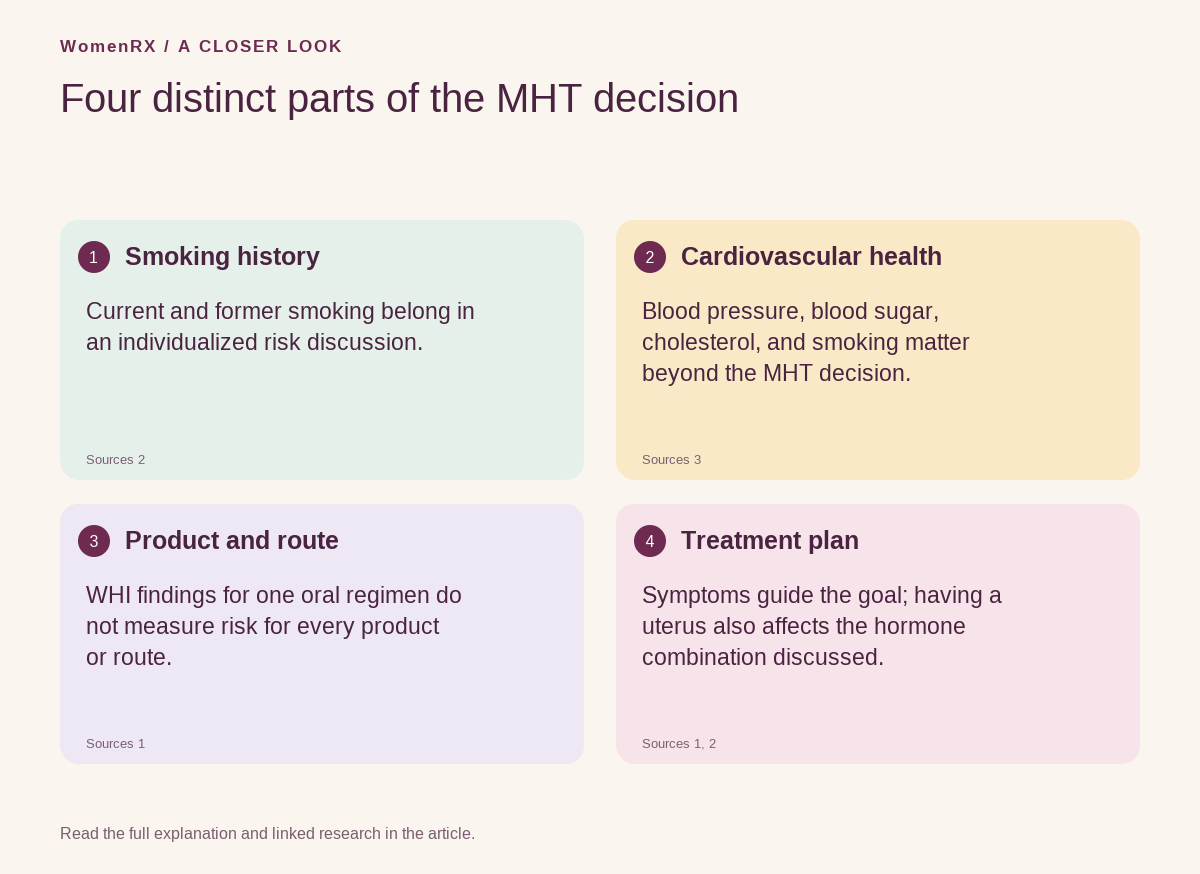
Four distinct parts of the MHT decision
Smoking history: Current and former smoking belong in an individualized risk discussion.2
Cardiovascular health: Blood pressure, blood sugar, cholesterol, and smoking matter beyond the MHT decision.3
Product and route: WHI findings for one oral regimen do not measure risk for every product or route.1
Treatment plan: Symptoms guide the goal; having a uterus also affects the hormone combination discussed.12
Read the figure as text
Each part answers a different question; none determines the treatment choice by itself.- Smoking history: Current and former smoking belong in an individualized risk discussion.2
- Cardiovascular health: Blood pressure, blood sugar, cholesterol, and smoking matter beyond the MHT decision.3
- Product and route: WHI findings for one oral regimen do not measure risk for every product or route.1
- Treatment plan: Symptoms guide the goal; having a uterus also affects the hormone combination discussed.12
Sources you can check
- CLIMARA PRO (ESTRADIOL AND LEVONORGESTREL) PATCH [BAYER HEALTHCARE PHARMACEUTICALS INC.] | US prescribing information and patient instructionsAccessed 2026-09-25Return to first citation
- Progestogens as a component of menopausal hormone therapy: the right molecule makes the difference.Stevenson JC, Rozenberg S, Maffei S, Egarter C, Stute P, Römer T. · Drugs in context · 2020Return to first citation
- Do we have new preventive strategies for optimizing cardiovascular health in women?Stuenkel CA. · Climacteric : the journal of the International Menopause Society · 2019Return to first citation