Menopause HRT Patches: How They Deliver Estrogen and What to Weigh
An estradiol patch is one way to deliver systemic estrogen, but the route is only one part of deciding whether hormone therapy fits your symptoms and health history.
An estradiol patch delivers estrogen through the skin into the body. It’s one route for systemic hormone therapy, which can help menopause symptoms, but the route alone doesn’t determine whether treatment is right for you. Risks of hormone therapy can include coronary heart disease, stroke, blood clots, and dementia, with greater absolute risks reported when treatment starts after age 60 or more than 10 years after menopause. If you have a uterus, the plan generally also needs a progestogen to protect its lining. 1 4
What the patch changes, and what it doesn’t
A transdermal estradiol patch releases estrogen through the skin. Estradiol is the estrogen commonly used in menopause hormone therapy. Because the estrogen is absorbed into the body, this is a systemic treatment, rather than a local treatment aimed only at vaginal or urinary symptoms. 1 2
The patch is one way to take estrogen, alongside options such as pills, gels, and sprays. The route may affect parts of the treatment discussion, but it doesn’t determine by itself whether hormone therapy is appropriate, which other hormone may be needed, or what risks apply to you. The North American Menopause Society says hormone therapy risks vary with factors including type, dose, duration, route, timing, and whether a progestogen is used. 4
Systemic hormone therapy is the most effective treatment for hot flashes and other vasomotor symptoms, and it can help prevent bone loss. That evidence concerns hormone therapy overall; it shouldn’t be read as a promise that a particular patch will relieve every symptom or suit every person. For vaginal dryness and related symptoms alone, low-dose vaginal estrogen is a different option. It can help those symptoms but does not treat hot flashes. 2 4
The main risks depend partly on timing and regimen
The major potential systemic risks named in the Menopause Society’s guidance include coronary heart disease, stroke, venous thromboembolism (blood clots in veins), and dementia. The statement says the benefit-risk balance appears less favorable for people who start hormone therapy after age 60 or more than 10 years after menopause, in part because the absolute risks of these outcomes are greater. This is guidance about hormone therapy overall, not a patch-specific risk estimate or a prediction of what will happen to one person. 4
There is also a risk tied to the uterus and the hormone combination. Estrogen can thicken the uterine lining and, when used without adequate progestogen in someone with a uterus, can increase the risk of uterine cancer. A progestogen is generally included to protect the lining. The treatment plan may differ after hysterectomy. 1 2
These risks don’t mean that every person using a patch will experience harm, or that a patch eliminates the risks of systemic treatment. The Menopause Society describes a generally favorable benefit-risk balance for people younger than 60 or within 10 years of menopause onset, without contraindications, when treating bothersome hot flashes or preventing bone loss. The decision still depends on personal health factors and the complete regimen. 4
The uterus question is part of the patch decision
Estrogen can thicken the lining of the uterus. If you still have a uterus, estrogen therapy generally needs a progestogen as part of the plan to protect that lining. The progestogen may be provided separately or in a combined hormone therapy product. After a hysterectomy, estrogen without a progestogen is often an option, though the details of an individual treatment plan still matter. 1 2
So, “patch or pill?” is only one useful question. If you have a uterus, another is, “How will the plan protect my uterine lining?” A patch delivers estrogen; it does not automatically include the progestogen that may be needed.
What to weigh with your clinician
Your symptoms and goals. Consider whether you’re seeking relief from hot flashes, prevention of bone loss, or help with vaginal symptoms alone. Those goals can point toward different treatments. For vaginal symptoms without a reason to use systemic therapy, the Menopause Society recommends considering low-dose vaginal estrogen or certain other treatments. 4
Timing and personal risk factors. The age and timing guidance above can help frame the benefit-risk discussion, but it is not a substitute for considering your own health history. The route alone doesn’t settle the balance. 4
The whole regimen. Ask how the treatment plan accounts for whether you have a uterus, what progestogen is involved if needed, and how benefits and risks will be reassessed. There isn’t one estradiol dose or blood level that guarantees symptom relief for everyone; dose decisions are individualized. 4 5
Skin and other effects. A patch can cause irritation where it touches the skin. Estrogen therapy can also have side effects, and bleeding or spotting may occur with some regimens. If a skin reaction or bleeding is bothersome, heavy, or unexpected, raise it with your clinician rather than assuming it’s an unavoidable part of treatment. 3
A practical way to frame the conversation is to separate two decisions: whether systemic hormone therapy matches your symptoms and health history, and, if so, which estrogen route and accompanying treatment fit your needs. The patch answers the second question only in part.
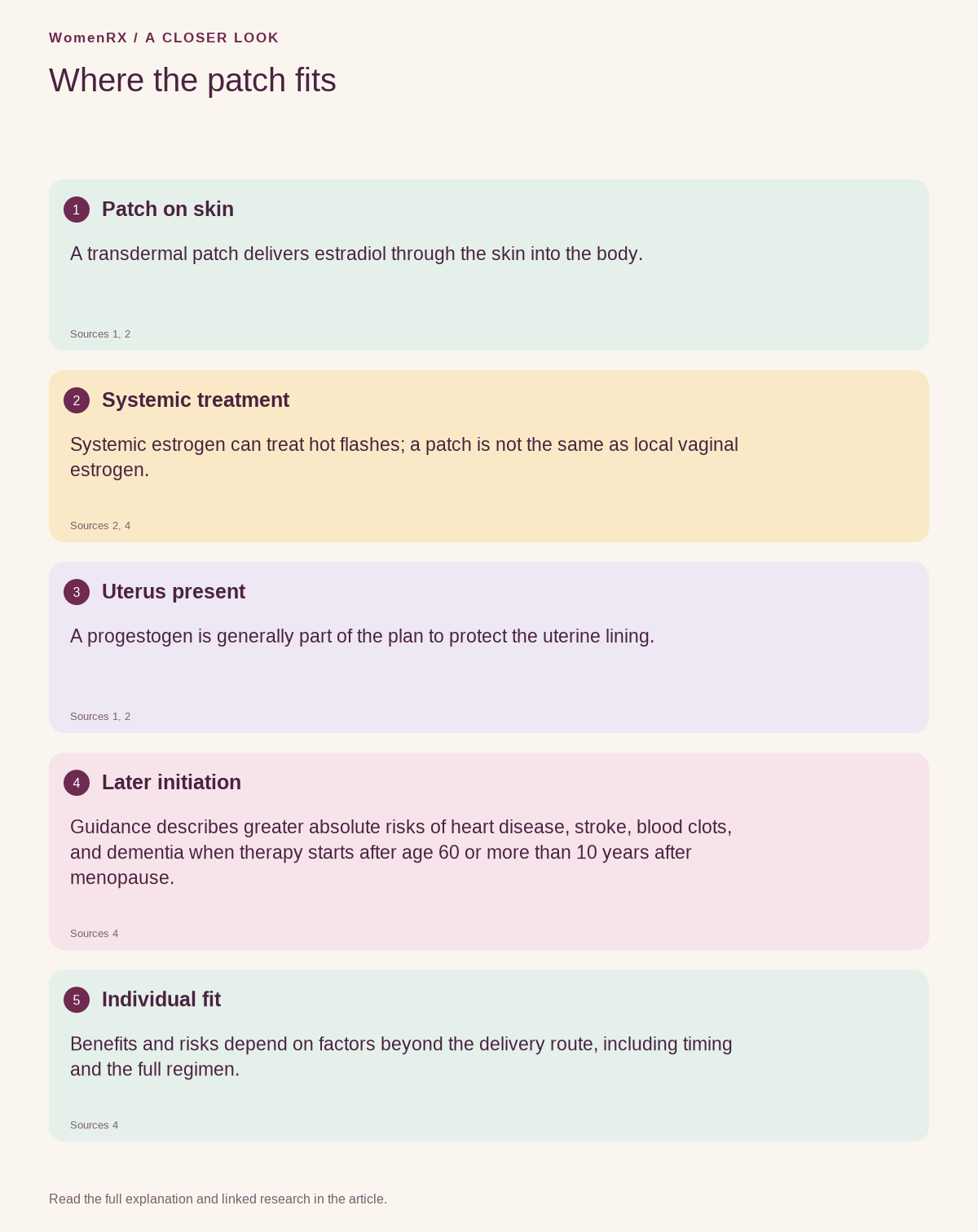
Where the patch fits
Patch on skin: A transdermal patch delivers estradiol through the skin into the body.12
Systemic treatment: Systemic estrogen can treat hot flashes; a patch is not the same as local vaginal estrogen.24
Uterus present: A progestogen is generally part of the plan to protect the uterine lining.12
Later initiation: Guidance describes greater absolute risks of heart disease, stroke, blood clots, and dementia when therapy starts after age 60 or more than 10 years after menopause.4
Individual fit: Benefits and risks depend on factors beyond the delivery route, including timing and the full regimen.4
Read the figure as text
The patch delivers estrogen systemically; the rest of the plan depends on symptoms, uterine status, timing, and personal risk.- Patch on skin: A transdermal patch delivers estradiol through the skin into the body.12
- Systemic treatment: Systemic estrogen can treat hot flashes; a patch is not the same as local vaginal estrogen.24
- Uterus present: A progestogen is generally part of the plan to protect the uterine lining.12
- Later initiation: Guidance describes greater absolute risks of heart disease, stroke, blood clots, and dementia when therapy starts after age 60 or more than 10 years after menopause.4
- Individual fit: Benefits and risks depend on factors beyond the delivery route, including timing and the full regimen.4
More questions, answered
Is an estrogen patch the same as vaginal estrogen?
No. A patch delivers estrogen systemically, while low-dose vaginal estrogen is used for local symptoms such as vaginal dryness. Vaginal estrogen does not treat hot flashes. 1 2
Can I use an estrogen patch by itself if I still have my uterus?
Usually, systemic estrogen needs to be paired with a progestogen when you have a uterus, because estrogen can thicken the uterine lining. The treatment plan should account for how that protection is provided. 1 2
Sources you can check
- About oestrogen tablets, patches, gel and spray - NHSAccessed 2026-09-25Return to first citation
- Common questions about oestrogen tablets, patches, gel and spray - NHSAccessed 2026-09-25Return to first citation
- Side effects of oestrogen tablets, patches, gel and spray - NHSAccessed 2026-09-25Return to first citation
- The 2022 hormone therapy position statement of The North American Menopause Society.“The 2022 Hormone Therapy Position Statement of The North American Menopause Society” Advisory Panel. · Menopause (New York, N.Y.) · 2022Return to first citation
- Tailoring transdermal estradiol dose to maximize benefits and minimize risks.Glynne SJ, Simon JA. · Menopause (New York, N.Y.) · 2026Return to first citation