How Do Estrogen Patches Work for Menopause Symptoms?
A patch delivers estradiol through your skin, but its schedule, companion hormones, and risks depend on the specific product and your health history.
An estrogen patch delivers estradiol through the skin to treat menopause symptoms such as hot flashes and night sweats. It stays in place and delivers estrogen while worn, with replacement scheduled for that particular product. If you still have a uterus, systemic estrogen usually needs to be paired with a progestogen to protect the uterine lining. A patch isn’t risk-free or automatically the best route for everyone. 1 2 4
What the patch does
An estradiol patch sticks to your skin and delivers estrogen into your body. This replaces some of the estrogen that declines during and after menopause. Systemic hormone therapy is the most effective treatment for hot flashes and other vasomotor symptoms, and it may be considered during perimenopause or after menopause when symptoms are bothersome and the individual benefit-risk balance supports it. 1 4
A patch is one way to take systemic estrogen, not a different kind of menopause treatment. Tablets, gels, and sprays are other systemic routes. The practical difference is how you use them: tablets and skin gels or sprays are generally used daily, while a patch stays in place and delivers estrogen between changes. Some patches are changed once or twice a week, but follow the directions for your own prescription rather than assuming all patches have the same schedule. If you’d rather not take or apply estrogen every day, a patch routine may appeal to you. 1
There’s no reason to assume the patch will work better for everyone. A network meta-analysis comparing estradiol patches with a metered-dose skin spray found no evidence of a difference in hot-flash effectiveness; the spray had fewer local skin reactions in the comparison. That analysis did not establish that one route is best for every person, and it did not compare every estrogen product or individual circumstance. 6
Your uterus changes the plan
If you still have your uterus, systemic estrogen can stimulate the uterine lining. A progestogen is generally added to protect that lining; it may be a separate medicine or part of a combined hormone product. If you’ve had a hysterectomy to remove your uterus, estrogen is often used without a progestogen. The exact regimen still depends on your situation. 1 2
Whether you’re still having periods can also matter when choosing a combined regimen. Some approaches use estrogen with progestogen in a sequence, while others use both continuously. Ask how the proposed plan accounts for your bleeding pattern and uterine status rather than assuming every patch contains both hormones. 2
A vaginal estrogen product is a different option for a different symptom set: vaginal estrogen can help vaginal dryness and irritation, but it doesn’t treat hot flashes. It isn’t interchangeable with a systemic patch for whole-body symptoms. 2
Safety is about more than the route
Hormone therapy’s benefits and risks depend on factors including the type and dose of hormones, how long they’re used, route, timing, and whether a progestogen is included. The North American Menopause Society says the balance is generally favorable for people younger than 60 or within 10 years of menopause onset who have no contraindications and are treating bothersome symptoms. Starting later may carry a less favorable balance because some risks are higher. These are general findings, not a personal risk estimate. 4
The patch doesn’t remove hormone therapy risks. Route is one part of the decision, not proof that patches eliminate risks or are safer for everyone. A useful conversation is: “Given my health history and the hormones in this regimen, what benefits and risks matter most for me?” A history of estrogen-dependent cancer or cardiovascular disease may change whether hormone therapy is appropriate. 4 5
Side effects can include headache, breast tenderness, bleeding or spotting, and irritation where a patch is applied. Some bleeding or spotting can happen in the first months of hormone therapy, but ask your prescriber what to expect with your specific regimen and what bleeding should prompt follow-up. If a patch causes a persistent or troublesome skin reaction, discuss whether another route might suit you better. 1 3
Questions that make the choice more specific
Before starting or changing a patch, it can help to ask:
- Is the goal to treat hot flashes, vaginal symptoms, or both?
- Do I still have my uterus, and what progestogen plan protects it?
- How often does this exact patch need changing, where should I apply it, and what should I do if it comes loose?
- How do my age, timing since menopause, and health history affect the expected benefits and risks?
- If the patch irritates my skin or doesn’t help enough, what other route or treatment could be considered?
If you’re in perimenopause, remember that hormone therapy isn’t contraception. Pregnancy may still be possible while periods continue, so ask separately about contraception if that applies to you. 2
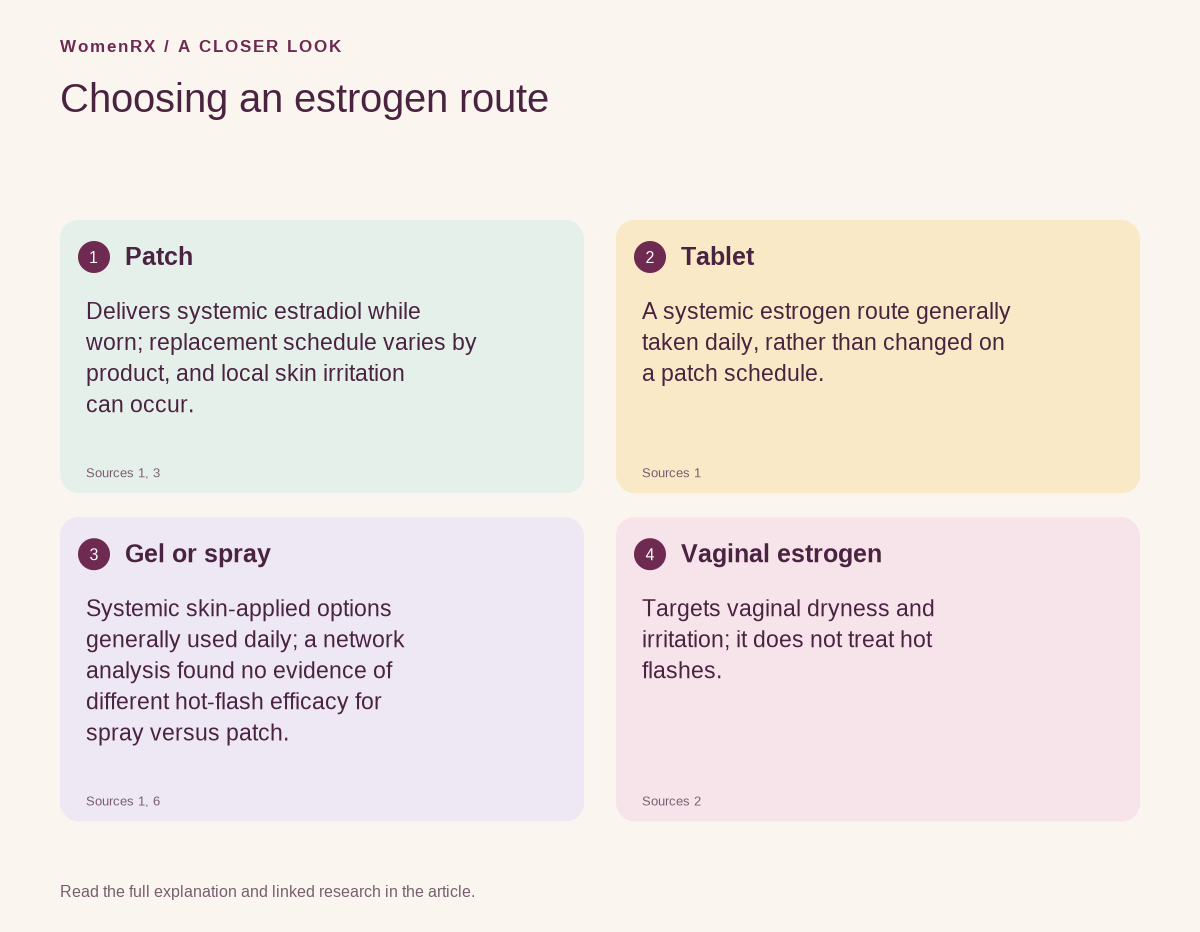
Choosing an estrogen route
Patch: Delivers systemic estradiol while worn; replacement schedule varies by product, and local skin irritation can occur.13
Tablet: A systemic estrogen route generally taken daily, rather than changed on a patch schedule.1
Gel or spray: Systemic skin-applied options generally used daily; a network analysis found no evidence of different hot-flash efficacy for spray versus patch.16
Vaginal estrogen: Targets vaginal dryness and irritation; it does not treat hot flashes.2
Read the figure as text
The routes differ in how they’re used and which symptoms they address; the best fit depends on the treatment goal and individual regimen.- Patch: Delivers systemic estradiol while worn; replacement schedule varies by product, and local skin irritation can occur.13
- Tablet: A systemic estrogen route generally taken daily, rather than changed on a patch schedule.1
- Gel or spray: Systemic skin-applied options generally used daily; a network analysis found no evidence of different hot-flash efficacy for spray versus patch.16
- Vaginal estrogen: Targets vaginal dryness and irritation; it does not treat hot flashes.2
More questions, answered
Does an estrogen patch prevent pregnancy?
No. Hormone therapy is not a contraceptive, and pregnancy may still be possible during perimenopause. If pregnancy prevention matters to you, discuss contraception separately. 2
Can I use a patch if I still have my uterus?
Often, but systemic estrogen is generally paired with a progestogen when the uterus is present, to protect the uterine lining. The appropriate combination and schedule depend on the prescribed regimen. 1 2
Sources you can check
- About oestrogen tablets, patches, gel and spray - NHSAccessed 2026-09-25Return to first citation
- Common questions about oestrogen tablets, patches, gel and spray - NHSAccessed 2026-09-25Return to first citation
- Side effects of oestrogen tablets, patches, gel and spray - NHSAccessed 2026-09-25Return to first citation
- The 2022 hormone therapy position statement of The North American Menopause Society.“The 2022 Hormone Therapy Position Statement of The North American Menopause Society” Advisory Panel. · Menopause (New York, N.Y.) · 2022Return to first citation
- The 2023 nonhormone therapy position statement of The North American Menopause Society.Menopause (New York, N.Y.) · 2023Return to first citation
- Comparison of efficacy and local tolerability of estradiol metered-dose transdermal spray to estradiol patch in a network meta-analysis.Kovács G, Zelei T, Vokó Z. · Climacteric : the journal of the International Menopause Society · 2016Return to first citation