Estradiol patches for menopause: benefits and trade-offs
A patch can treat bothersome hot flashes without a daily pill, but the route is only one part of choosing hormone therapy.
An estradiol patch delivers estrogen through your skin and is one way to treat menopausal hot flashes and night sweats. 24 Transdermal hormone therapy has a more favorable blood-clot risk profile than oral hormone therapy, but a patch isn’t risk-free. 5 If you have a uterus, you generally need a progestogen alongside systemic estradiol to protect its lining. 15 Your patch’s own instructions determine its change schedule and what to do if it comes loose. 4
What a patch is meant to help
If hot flashes interrupt a meeting or night sweats keep waking you, an estradiol patch is one way to take systemic menopausal hormone therapy. Systemic means the estrogen circulates through your body rather than acting only in one area. Hormone therapy is the most effective treatment for menopausal hot flashes and night sweats, and it has also been shown to prevent bone loss and fractures. That doesn’t mean every woman needs it. The useful question is which symptoms you want to treat and whether the likely benefit outweighs the risks for you. 25
Timing and health history matter. The North American Menopause Society’s 2022 position statement describes a generally favorable benefit-risk balance for treating bothersome hot flashes in women younger than 60 or within 10 years of menopause onset who have no contraindications. It describes a less favorable balance when treatment starts later, in part because the absolute risks of conditions including stroke and blood clots are greater. These are considerations for an individual decision, not an expiration date for treatment. 2
Why choose skin delivery instead of a pill?
A patch releases estradiol through the skin. Route matters for some risks: NICE guidance finds venous blood-clot risk greater with oral than transdermal hormone therapy and does not find an increased clot risk with transdermal therapy. That comparison is a reason to consider a patch, particularly if clot risk is part of your decision. It is not a promise that a clot cannot happen or that all other hormone-therapy risks disappear. 15
A patch is also a different routine from a daily pill. Depending on the product, patches are changed once or twice a week. You need to remember the change day and make sure the patch stays attached; sweating can affect how well it sticks. The right choice may come down to both your health history and which routine you can comfortably keep up. 4
The uterus question changes the plan
If you still have your uterus, a systemic estradiol patch generally needs to be paired with a progestogen to protect the uterine lining. Using estrogen-only hormone therapy with a uterus raises endometrial cancer risk whether that estrogen comes through the skin or is taken by mouth. A patch’s route does not solve that problem. If you’ve had a total hysterectomy, estrogen-only hormone therapy may be an option. 15
It’s worth knowing whether the patch you’re considering contains estradiol alone or is part of a combined treatment plan. Progestogen choice also matters to the overall balance: combined hormone therapy is associated with an increased breast cancer risk, while guidance finds very little or no increase with estrogen-only therapy. Your uterus status, breast cancer history and treatment goals belong in the same conversation as your preferred route. 15
What using a patch is like
General patch guidance describes applying a patch to skin below the waist, changing it on the schedule for that product, removing the old patch when you apply a new one, and using a different skin area for the next patch. Those points give you a picture of the routine, not placement instructions for every US product. Patches differ in how much estradiol they release and how often they’re changed, so use the directions for the exact patch you have. 4
If a patch peels away or you miss a change, don’t assume another brand’s directions apply. Check your product leaflet or ask your pharmacist what to do with that specific patch, including when the next change is due. The same product-specific approach applies to questions about placement and dose. 4
Match the treatment to the symptom
A systemic patch may make sense when hot flashes or night sweats are the main problem. If your only concern is vaginal dryness or other genitourinary symptoms, a whole-body treatment may not be the best starting point. The North American Menopause Society recommends considering local vaginal estrogen or other treatments when over-the-counter measures haven’t helped and there’s no other reason to use systemic hormone therapy. 2
If systemic hormone therapy isn’t a good fit, treatment doesn’t stop at supplements or simply putting up with symptoms. Evidence-supported nonhormone options for hot flashes include cognitive behavioral therapy, clinical hypnosis and several prescription medicines. The choice depends on the symptom you most want to change, your health history and which trade-offs you’re willing to make. 3
What changes when you choose a patch
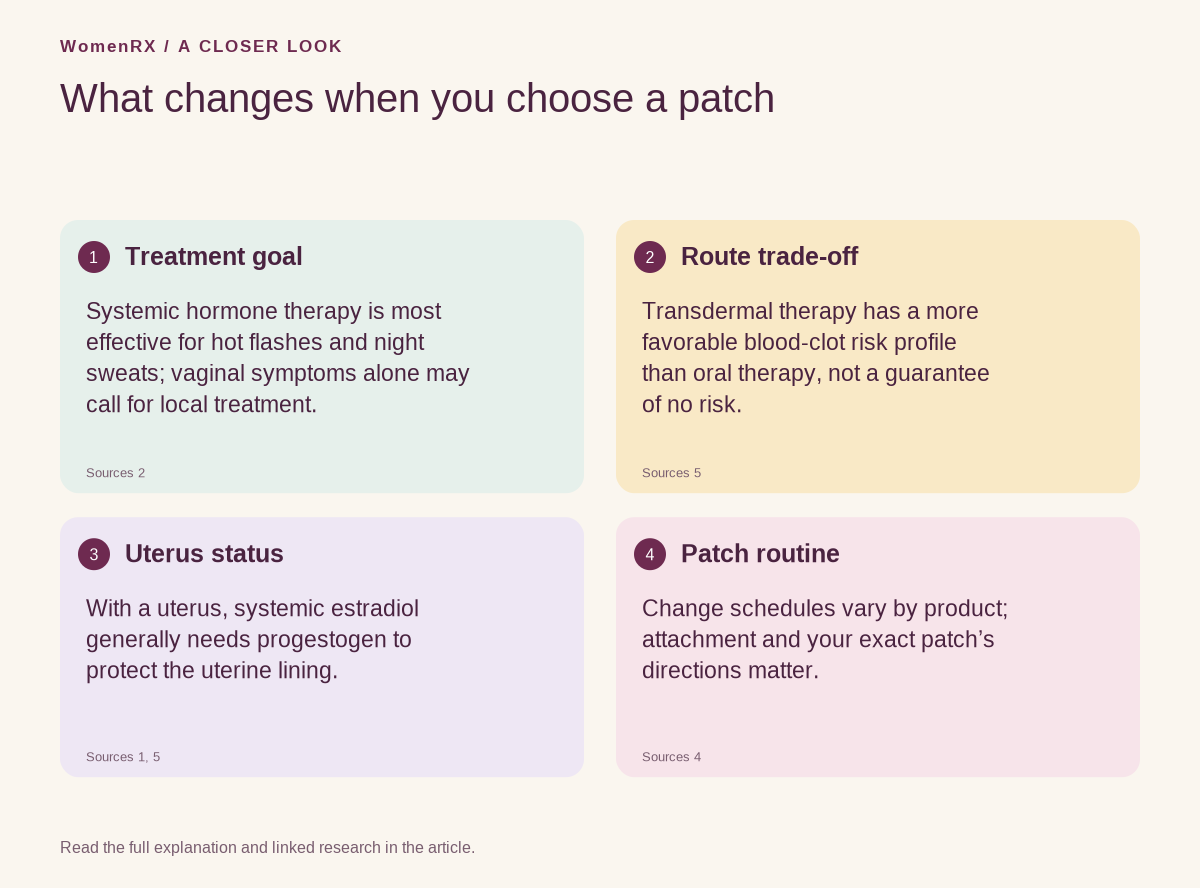
Treatment goal: Systemic hormone therapy is most effective for hot flashes and night sweats; vaginal symptoms alone may call for local treatment.2
Route trade-off: Transdermal therapy has a more favorable blood-clot risk profile than oral therapy, not a guarantee of no risk.5
Uterus status: With a uterus, systemic estradiol generally needs progestogen to protect the uterine lining.15
Patch routine: Change schedules vary by product; attachment and your exact patch’s directions matter.4
Read the figure as text
A patch changes how estrogen is delivered, but your treatment goal and whether you have a uterus still shape the decision.- Treatment goal: Systemic hormone therapy is most effective for hot flashes and night sweats; vaginal symptoms alone may call for local treatment.2
- Route trade-off: Transdermal therapy has a more favorable blood-clot risk profile than oral therapy, not a guarantee of no risk.5
- Uterus status: With a uterus, systemic estradiol generally needs progestogen to protect the uterine lining.15
- Patch routine: Change schedules vary by product; attachment and your exact patch’s directions matter.4
More questions, answered
Does a patch avoid the breast cancer risk of hormone therapy?
No. Skin delivery does not remove every risk associated with systemic hormone therapy. Breast cancer risk differs notably between combined estrogen-progestogen therapy and estrogen-only therapy, so whether you have a uterus and need endometrial protection is central to that discussion. 51
Sources you can check
- Choice of progestogen for endometrial protection in combination with transdermal estradiol in menopausal women.Mueck AO, Römer T. · Hormone molecular biology and clinical investigation · 2018Return to first citation
- The 2022 hormone therapy position statement of The North American Menopause Society.“The 2022 Hormone Therapy Position Statement of The North American Menopause Society” Advisory Panel. · Menopause (New York, N.Y.) · 2022Return to first citation
- The 2023 nonhormone therapy position statement of The North American Menopause Society.Menopause (New York, N.Y.) · 2023Return to first citation
- How and when to take or use oestrogen tablets, patches, gel and spray - NHSAccessed 2026-09-25Return to first citation
- Recommendations | Menopause: identification and management | Guidance | NICEAccessed 2026-09-25Return to first citation