What Estrogen Patches Do and How They Fit Into Menopause Care
An estradiol patch delivers estrogen through the skin to ease some menopause symptoms, but whether it needs to be paired with a progestogen depends in part on whether you have a uterus.
An estrogen patch delivers estradiol through the skin into the body. Systemic hormone therapy can ease bothersome hot flashes and other menopause symptoms, and it can help prevent bone loss. If you have a uterus, estrogen is generally paired with a progestogen to protect the uterine lining. The patch’s schedule, ingredients, benefits, and risks depend on the specific product and your health history. 4 5 1
A skin patch with whole-body effects
An estradiol patch is a form of systemic menopausal hormone therapy: the medicine is absorbed through the skin rather than swallowed. It can be prescribed for bothersome symptoms such as hot flashes, and hormone therapy can also help prevent bone loss. The patch treats more than a single area, unlike vaginal estrogen, which is used for symptoms such as vaginal dryness and irritation and does not treat hot flashes. 4 5 2
The patch is one way to take estrogen, alongside pills, gels, and sprays. There isn’t one form that suits everyone. The product and regimen can affect practical use as well as the balance of benefits and risks, so an estradiol patch isn’t automatically interchangeable with another type of hormone therapy. 2 5
The uterus question changes the plan
Estrogen can thicken the lining of the uterus. If you still have a uterus, systemic estrogen is generally combined with a progestogen to protect that lining. The progestogen may come in a separate medicine, or in a patch that contains both estrogen and progestogen. These are different regimens, not just different packaging. 1 2 4
If you’ve had a hysterectomy, estrogen without a progestogen is often an option. Your treatment plan still depends on your circumstances, but the need to protect the uterine lining is different when the uterus has been removed. 1
What changes from one patch to another
Some patches contain estradiol alone; others combine estrogen with a progestogen. Patch-change schedules vary by product. Many are changed once or twice a week, but follow the instructions for the specific patch prescribed to you rather than assuming another patch’s schedule applies. 1 4
A patch can also cause irritation or itching where it touches the skin. If that reaction keeps bothering you, the patch’s formulation or another delivery method may be worth discussing. Side effects can come from the estrogen, the progestogen, or both when the regimen combines them. 3
How to think about benefits and risks
Hormone therapy is the most effective treatment for menopause-related vasomotor symptoms, including hot flashes. Its benefit-risk balance is not identical for everyone: it varies with factors such as the product, route, dose, timing, duration, and whether a progestogen is used. For women younger than 60 or within 10 years of menopause who have no contraindications, the North American Menopause Society describes the balance as generally favorable for bothersome symptoms and prevention of bone loss. That is a group-level guideline, not a guarantee about an individual patch or person. 5
Route can matter when considering blood-clot risk, but it shouldn’t be simplified to “patches are safe, pills are risky.” A 2026 review reports increased venous thromboembolism risk with oral formulations, while transdermal estradiol with micronized progesterone did not appear to increase that risk. This finding does not establish that every patch or every hormone combination carries the same risk. Personal health history and the exact regimen still matter. 6 5
If your main concern is vaginal dryness or irritation, a systemic patch may not be the only option to ask about. Vaginal estrogen can address those local symptoms, but it does not treat hot flashes. That distinction can help focus a conversation on the symptom you most want to improve. 2
Useful questions when comparing options
When weighing a patch against pills, gel, spray, or vaginal treatment, it may help to ask: Is the goal to treat hot flashes, vaginal symptoms, or both? Does this patch contain a progestogen, or would I take one separately? How often does this specific product need changing? And how do my health history and the timing of menopause affect the balance of benefits and risks? The answers depend on the indication and the exact treatment, not on the word “patch” alone. 1 2 5
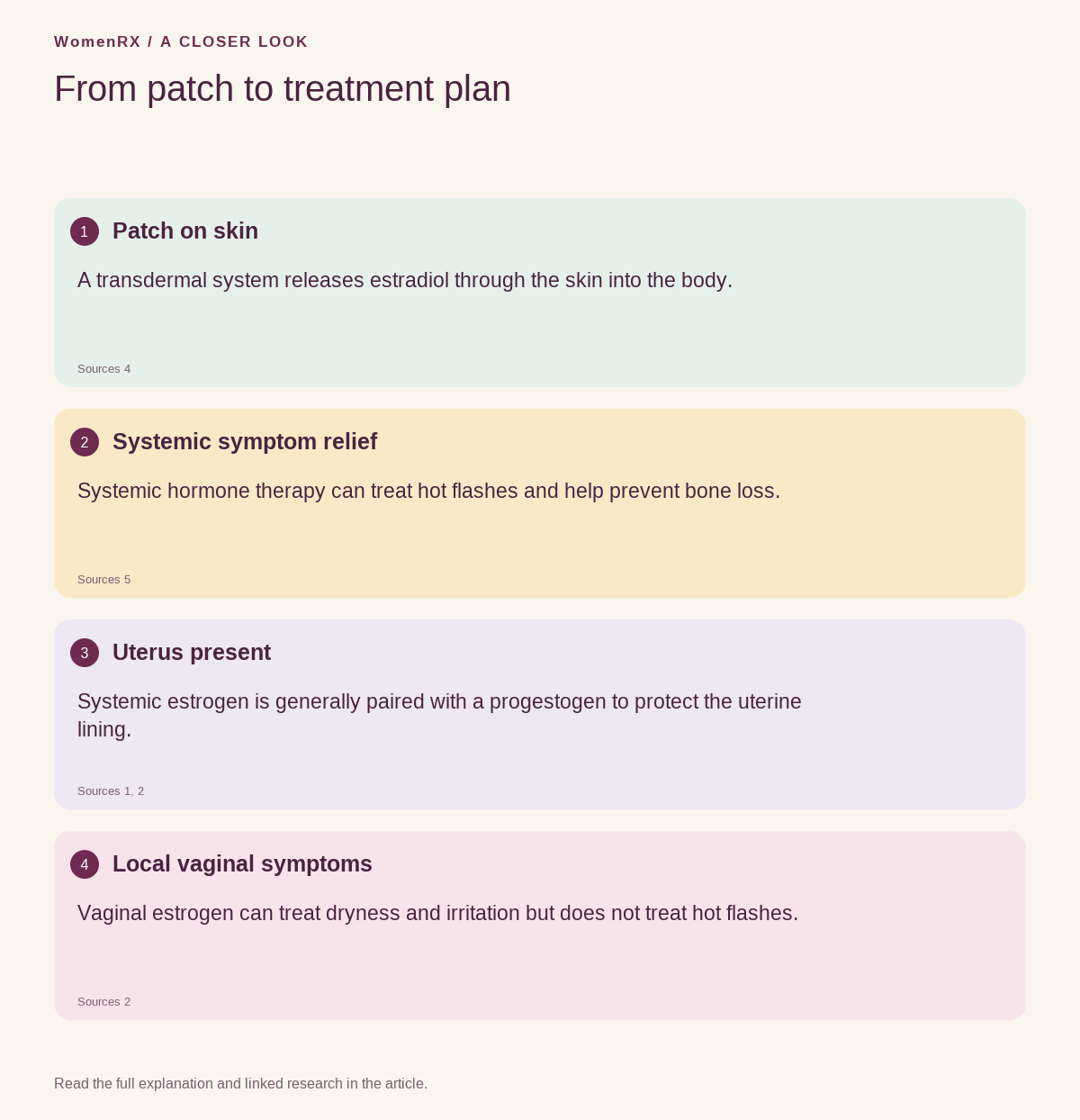
From patch to treatment plan
Patch on skin: A transdermal system releases estradiol through the skin into the body.4
Systemic symptom relief: Systemic hormone therapy can treat hot flashes and help prevent bone loss.5
Uterus present: Systemic estrogen is generally paired with a progestogen to protect the uterine lining.12
Local vaginal symptoms: Vaginal estrogen can treat dryness and irritation but does not treat hot flashes.2
Read the figure as text
This figure shows how skin delivery connects to the symptom being treated and why uterine status can change the hormone regimen.- Patch on skin: A transdermal system releases estradiol through the skin into the body.4
- Systemic symptom relief: Systemic hormone therapy can treat hot flashes and help prevent bone loss.5
- Uterus present: Systemic estrogen is generally paired with a progestogen to protect the uterine lining.12
- Local vaginal symptoms: Vaginal estrogen can treat dryness and irritation but does not treat hot flashes.2
More questions, answered
Does every estrogen patch include progesterone?
No. Some patches contain estradiol alone, while combined patches contain estrogen and a progestogen. If you have a uterus, systemic estrogen is generally paired with a progestogen for uterine-lining protection, whether the hormones come in one product or separate medicines. 1 2 4
Can an estrogen patch treat vaginal dryness?
Systemic estrogen may affect menopause symptoms throughout the body, but vaginal estrogen is a separate option specifically used for symptoms such as vaginal dryness and irritation. Vaginal estrogen does not treat hot flashes. 2
Sources you can check
- About oestrogen tablets, patches, gel and spray - NHSAccessed 2026-09-25Return to first citation
- Common questions about oestrogen tablets, patches, gel and spray - NHSAccessed 2026-09-25Return to first citation
- Side effects of oestrogen tablets, patches, gel and spray - NHSAccessed 2026-09-25Return to first citation
- CLIMARA PRO (ESTRADIOL AND LEVONORGESTREL) PATCH [BAYER HEALTHCARE PHARMACEUTICALS INC.] | US prescribing information and patient instructionsAccessed 2026-09-25Return to first citation
- The 2022 hormone therapy position statement of The North American Menopause Society.“The 2022 Hormone Therapy Position Statement of The North American Menopause Society” Advisory Panel. · Menopause (New York, N.Y.) · 2022Return to first citation
- Management of menopausal hormone therapy.Switzer J, Vignali L, Vignali J, Jackson R. · Current opinion in obstetrics & gynecology · 2026Return to first citation