What Estradiol Patches Treat During Menopause
Estradiol patches are mainly used for bothersome hot flashes and night sweats, with the treatment plan shaped by your symptoms, health history, and whether you have a uterus.
An estradiol patch delivers estrogen through the skin. Its clearest menopause treatment goal is reducing hot flashes and night sweats; systemic hormone therapy can also help prevent bone loss. If vaginal dryness is your only concern, over-the-counter treatments may help; if symptoms persist, a local treatment may make more sense than a systemic patch. Whether a patch suits you, and whether you also need a progestogen, depends on your health and whether you have a uterus.27
Start with the symptom you want to change
If hot flashes interrupt a meeting or night sweats keep waking you, an estradiol patch is one way to use systemic menopausal hormone therapy. The patch releases estradiol through your skin rather than being swallowed as a tablet. Hormone therapy is the most effective treatment for these vasomotor symptoms, the clinical name for hot flashes and night sweats.27
There’s evidence for patches specifically, not just hormone therapy in general. In a 12-week randomized trial of 156 people in natural or surgical menopause who had at least five hot flashes a day, estradiol patches reduced hot flashes more than placebo patches. A separate 12-week trial in 220 postmenopausal women with frequent moderate to severe hot flashes tested a regimen that paired estradiol patches with estradiol-plus-progestogen patches; it also found greater relief than placebo. Those studies support the hot-flash treatment goal, though neither study determines which regimen is right for you.54
The patch may be part of a plan to prevent bone loss after menopause, but that’s a different goal from treating symptoms you can feel. Your reason for considering treatment matters: it shapes which benefits and risks are worth discussing.2
A patch isn’t the answer to every menopause symptom
Vaginal dryness or irritation can happen around menopause, but it doesn’t automatically call for a systemic patch. For bothersome genitourinary symptoms not relieved by over-the-counter therapies, and when there’s no separate reason to use systemic hormone therapy, the 2022 Menopause Society position statement recommends low-dose vaginal estrogen or other treatments. Vaginal moisturizers or lubricants are nonhormonal options.21
That distinction is useful if you’re comparing treatments: a patch delivers estrogen throughout the body, while vaginal estrogen is aimed at local symptoms. Likewise, feeling tired, sleeping poorly, or having a low mood deserves a closer look at what’s going on rather than an assumption that changing estrogen alone will fix it. A clear starting question is, “Which symptom are we treating, and how will we tell whether this treatment is helping?”27
What using a patch involves
Patch routines vary. Estradiol patches release different amounts of hormone and, depending on the product, are changed once or twice a week. NHS general guidance describes placing a patch on skin below the waist, such as the thigh or buttock, and changing to a different area if one falls off. Those are general instructions, not directions for every US product. Before starting, check the instructions for your prescribed patch for its approved application sites, change schedule, and what to do if it loosens.6
You can also ask what to do if the patch irritates your skin or your symptoms aren’t improving. It may take time to find a suitable type and dose of hormone therapy; changing the dose or treatment is something to discuss rather than improvise with patches.67
The uterus question changes the treatment plan
If you have a uterus, an estradiol-only patch generally needs to be paired with a progestogen to protect the uterine lining. Estrogen without that protection increases endometrial cancer risk in people with a uterus, and using estrogen through the skin does not remove that risk. If you’ve had a hysterectomy, estrogen without a progestogen is usually an option. A patch that contains estradiol alone and a combined hormone patch are therefore not interchangeable plans.174
Before choosing a patch, make sure the discussion includes any unexplained vaginal bleeding, history of breast cancer or a blood clot, heart or liver problems, and whether you might be pregnant or are breastfeeding. These details can change whether estrogen treatment is suitable; they’re reasons for an individual assessment, not a way to rule yourself in or out from a list.8
Timing matters too. The 2022 Menopause Society statement finds the benefit-risk balance more favorable for treating bothersome hot flashes in women younger than 60 or within 10 years of menopause onset who have no contraindications. Starting later tends to carry greater absolute risks of several serious outcomes. That’s a reason to discuss your own circumstances, not a cutoff that answers the question by itself. The same statement recommends periodically reassessing whether treatment’s benefits still outweigh its risks.2
A focused conversation can end with a practical plan: name the symptom you most want relieved, establish whether you need uterine protection, review the health history that affects suitability, and confirm the instructions for the specific patch you’re prescribed. Then agree on when to revisit whether it’s helping.267
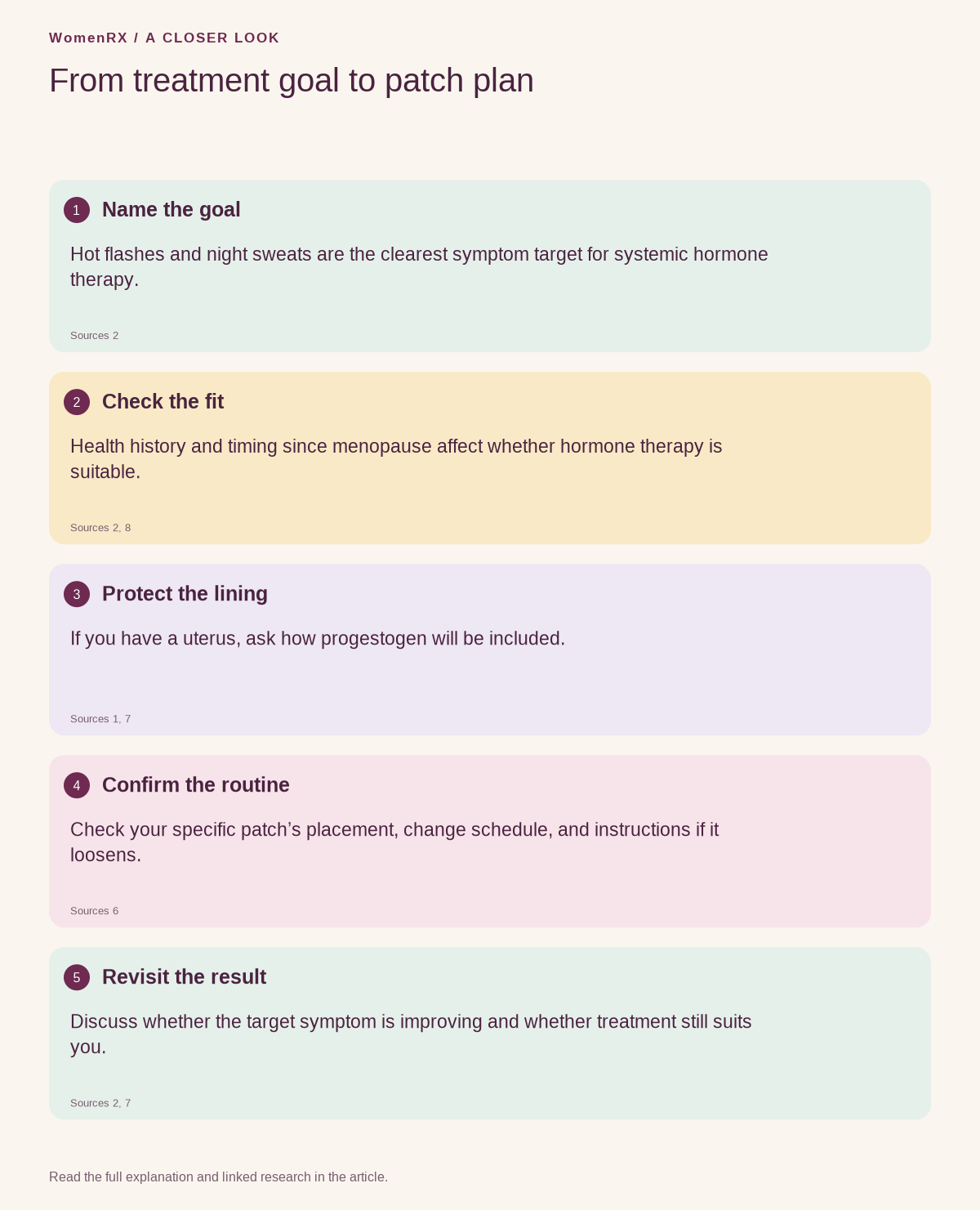
From treatment goal to patch plan
Name the goal: Hot flashes and night sweats are the clearest symptom target for systemic hormone therapy.2
Check the fit: Health history and timing since menopause affect whether hormone therapy is suitable.28
Protect the lining: If you have a uterus, ask how progestogen will be included.17
Confirm the routine: Check your specific patch’s placement, change schedule, and instructions if it loosens.6
Revisit the result: Discuss whether the target symptom is improving and whether treatment still suits you.27
Read the figure as text
Four different questions shape a useful discussion about an estradiol patch.- Name the goal: Hot flashes and night sweats are the clearest symptom target for systemic hormone therapy.2
- Check the fit: Health history and timing since menopause affect whether hormone therapy is suitable.28
- Protect the lining: If you have a uterus, ask how progestogen will be included.17
- Confirm the routine: Check your specific patch’s placement, change schedule, and instructions if it loosens.6
- Revisit the result: Discuss whether the target symptom is improving and whether treatment still suits you.27
More questions, answered
Can I consider a patch if I’m still having periods?
Menopause symptoms can begin during perimenopause, while periods are still happening. Whether systemic hormone therapy is suitable, and what progestogen plan you need if you have a uterus, depends on your circumstances. Don’t assume a regimen described for someone after menopause is the right one for you.87
What if I’d rather not use hormone therapy for hot flashes?
There are evidence-supported nonhormone options. The 2023 Menopause Society statement recommends options including cognitive behavioral therapy, clinical hypnosis, and several prescription treatments. Which is worth considering depends on your preferences and health history.3
Sources you can check
- Recommendations | Menopause: identification and management | Guidance | NICEAccessed 2026-09-25Return to first citation
- The 2022 hormone therapy position statement of The North American Menopause Society.“The 2022 Hormone Therapy Position Statement of The North American Menopause Society” Advisory Panel. · Menopause (New York, N.Y.) · 2022Return to first citation
- The 2023 nonhormone therapy position statement of The North American Menopause Society.Menopause (New York, N.Y.) · 2023Return to first citation
- Efficacy of continuous sequential transdermal estradiol and norethindrone acetate in relieving vasomotor symptoms associated with menopause.Notelovitz M, Cassel D, Hille D, Furst KW, Dain MP, VandePol C, Skarinsky D. · American journal of obstetrics and gynecology · 2000Return to first citation
- Efficacy on climacteric symptoms and safety of low dose estradiol transdermal matrix patches. A randomized, double-blind placebo-controlled study.De Aloysio D, Rovati LC, Giacovelli G, Setnikar I, Bottiglioni F. · Arzneimittel-Forschung · 2000Return to first citation
- How and when to take or use oestrogen tablets, patches, gel and spray - NHSAccessed 2026-09-25Return to first citation
- About oestrogen tablets, patches, gel and spray - NHSAccessed 2026-09-25Return to first citation
- Who can and cannot take or use oestrogen tablets, patches, gel and spray - NHSAccessed 2026-09-25Return to first citation