Vaginal Dryness in Perimenopause: Causes and Care Options
Dryness can happen while your periods are still changing, but hormones aren’t the only possible cause, and different care options serve different purposes.
Yes, vaginal dryness can occur before periods stop. Hormone changes may affect vaginal fluid, but medicines, irritating products, and some health conditions can also play a role. A water-based lubricant is for use before sex; a vaginal moisturizer is for ongoing dryness. If symptoms persist or affect daily life, an evaluation can help identify the cause and whether vaginal estrogen is an option. 14
Dryness can happen before periods stop
Vaginal dryness doesn’t mean menopause is complete. Hormone changes can affect vaginal fluid, and dryness was reported in a study that included women in perimenopause. That study focused on women with migraine, however, so it can’t tell us how common dryness is among people in perimenopause generally. 14
Hormones aren’t the only possible explanation. Some hormonal contraceptives, antidepressants, and cancer treatments are associated with dryness or irritation. Perfumed soaps, washes, and douches can irritate the area, and conditions such as diabetes or Sjögren’s syndrome may also be involved. 1
If the discomfort is new, think about whether a medicine or personal-care product changed around the same time. Avoid perfumed products around the vagina, and don’t use ordinary creams or moisturizers internally; products not made for vaginal use may worsen irritation. 1
Choose care by what it’s meant to do
Lubricant is for sex. Water-based lubricant can be used before sex to reduce friction and discomfort. It’s intended for that moment, rather than to address dryness throughout the day. 1
Vaginal moisturizer is for dryness. A vaginal moisturizer is used inside the vagina to help keep it moist. It’s a different kind of self-care from lubricant, though the two options may both be relevant if dryness affects comfort during sex. 1
Vaginal estrogen is a treatment to discuss. For bothersome genitourinary symptoms that haven’t improved with over-the-counter care, low-dose vaginal estrogen is one option supported in menopause guidance. That guidance doesn’t set out a separate treatment rule for perimenopause, so whether it fits your symptoms and health history is a discussion to have with a clinician. 3
If you’ve had breast cancer or are being treated for it, treatment decisions need an individualized discussion with your care team. 2
When to get checked
Arrange an evaluation if dryness has lasted for weeks despite self-care, affects your daily life, or comes with unusual discharge. Bleeding after sex, bleeding between periods, or bleeding after menopause also warrants evaluation. These symptoms don’t by themselves identify the cause, and dryness can have explanations other than hormone changes. 1
Persistent soreness, itching, or pain during sex is also worth raising, especially if it isn’t improving. An evaluation can help sort out whether dryness, irritation, a medicine, or another condition may be contributing rather than assuming perimenopause is the cause. 1
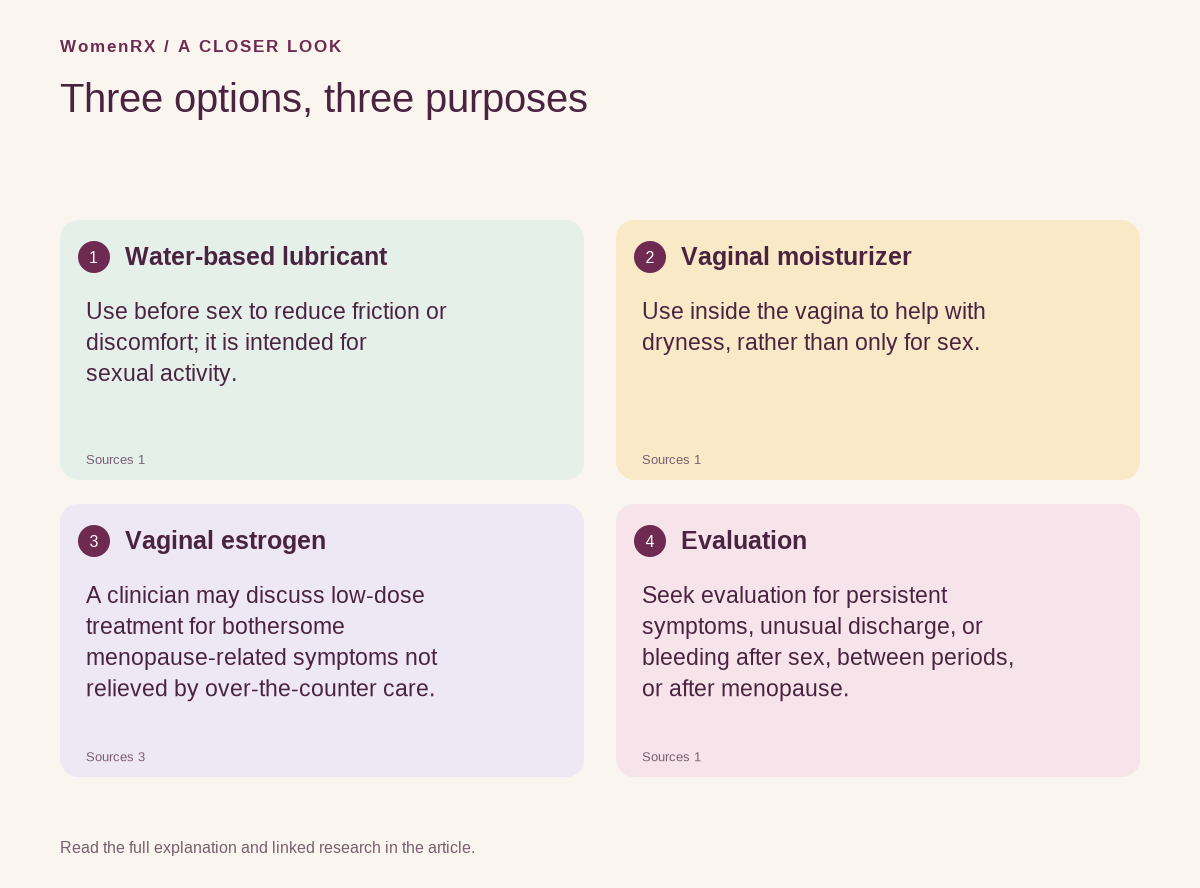
Three options, three purposes
Water-based lubricant: Use before sex to reduce friction or discomfort; it is intended for sexual activity.1
Vaginal moisturizer: Use inside the vagina to help with dryness, rather than only for sex.1
Vaginal estrogen: A clinician may discuss low-dose treatment for bothersome menopause-related symptoms not relieved by over-the-counter care.3
Evaluation: Seek evaluation for persistent symptoms, unusual discharge, or bleeding after sex, between periods, or after menopause.1
Read the figure as text
Lubricant, moisturizer, and vaginal estrogen aren’t interchangeable: each has a different role and context.- Water-based lubricant: Use before sex to reduce friction or discomfort; it is intended for sexual activity.1
- Vaginal moisturizer: Use inside the vagina to help with dryness, rather than only for sex.1
- Vaginal estrogen: A clinician may discuss low-dose treatment for bothersome menopause-related symptoms not relieved by over-the-counter care.3
- Evaluation: Seek evaluation for persistent symptoms, unusual discharge, or bleeding after sex, between periods, or after menopause.1
More questions, answered
Does vaginal dryness mean menopause is complete?
No. Dryness has been reported in a study that included perimenopausal women, but that study involved a specific group and doesn’t establish how common dryness is during perimenopause overall. 4
Sources you can check
- Vaginal dryness - NHSAccessed 2026-09-25Return to first citation
- Case-Based Perspectives on the Management of Genitourinary Syndrome of Menopause.Cyriac J, Sood R. · Clinics and practice · 2026Return to first citation
- The 2022 hormone therapy position statement of The North American Menopause Society.“The 2022 Hormone Therapy Position Statement of The North American Menopause Society” Advisory Panel. · Menopause (New York, N.Y.) · 2022Return to first citation
- Clinical characteristics of perimenopausal migraine and its correlation to hormonal levels.El-Ghoneimy LT, Elfayoumy NM, Helmy H, Elaguizy MMS, Nasser AMA, Abdelghany H. · The journal of headache and pain · 2026Return to first citation