Menopause Vaginal Dryness: Which Relief Option Fits?
A lubricant helps with friction during sex; a vaginal moisturizer addresses dryness at other times, and persistent symptoms may call for treatment.
If dryness bothers you during sex, a lubricant may help with friction. If you feel dry at other times, try a vaginal moisturizer made for that purpose. When self-care isn’t helping or symptoms affect daily life, ask about other options, including local vaginal estrogen. Mention unusual discharge, spotting, or bleeding when you seek assessment rather than assuming dryness explains them. 1 2 3
Match the option to when you feel discomfort
As estrogen levels fall during and after menopause, vaginal fluid can change. Dryness and irritation may follow, sometimes with discomfort during sex. Menopause isn’t the only possible cause: inadequate arousal during sex, perfumed products, diabetes, and Sjögren’s syndrome are also listed as possible contributors to dryness. 1 2
The first choice is often about when you want relief:
- For friction during sex, try a lubricant. Water-based lubricant is one option used around sexual activity. 1
- For dryness at other times, try a vaginal moisturizer. Choose a product made for vaginal use. Ordinary creams and lotions may cause more irritation or infection. 1
These products do different jobs, so one needn’t replace the other. If the area feels irritated, avoiding perfumed soaps, washes, and douches in and around the vagina may also help remove a possible contributor. 1
What changes when self-care isn’t enough
If dryness continues, a clinician can help assess the cause and discuss treatments beyond lubricants and moisturizers. Low-dose vaginal estrogen is a local treatment for menopause-related vaginal dryness and irritation. It doesn’t treat hot flashes. The North American Menopause Society recommends considering it for bothersome genitourinary symptoms that haven’t improved with over-the-counter therapies when there’s no reason to use systemic hormone therapy. Your health history and preferences matter to that choice. 2 3
There are other treatments to discuss, too. A systematic review of randomized trials in postmenopausal women found that vaginal estrogen may improve dryness and pain with sex. Vaginal moisturizers, vaginal DHEA, and oral ospemifene may also improve some symptoms, although the review rated the evidence for those options as low certainty. The trials varied too much for the reviewers to combine their results into a reliable comparison, so they don’t establish one best treatment for everyone. 4
That review studied postmenopausal women, so its findings don’t answer every treatment question for someone still in perimenopause. Most trials lasted 12 weeks or less, and few included women with a history of cancer. If that history affects your treatment decisions, bring it into the conversation rather than assuming a particular option is or isn’t right for you. 4
When dryness deserves a closer look
Seek an assessment if dryness has lasted a few weeks and what you’ve tried isn’t working, if it affects daily life, or if you have unusual vaginal discharge. Mention pain or irritation that persists, too. These symptoms can occur alongside dryness, but dryness alone doesn’t establish what’s causing them. 1
Tell the clinician about any spotting or bleeding as well. It can appear in descriptions of vaginal dryness, but that doesn’t mean dryness is the cause. A useful description is whether discomfort happens only during sex or at other times, and whether you’ve also noticed itching, discharge, spotting, or bleeding. 1
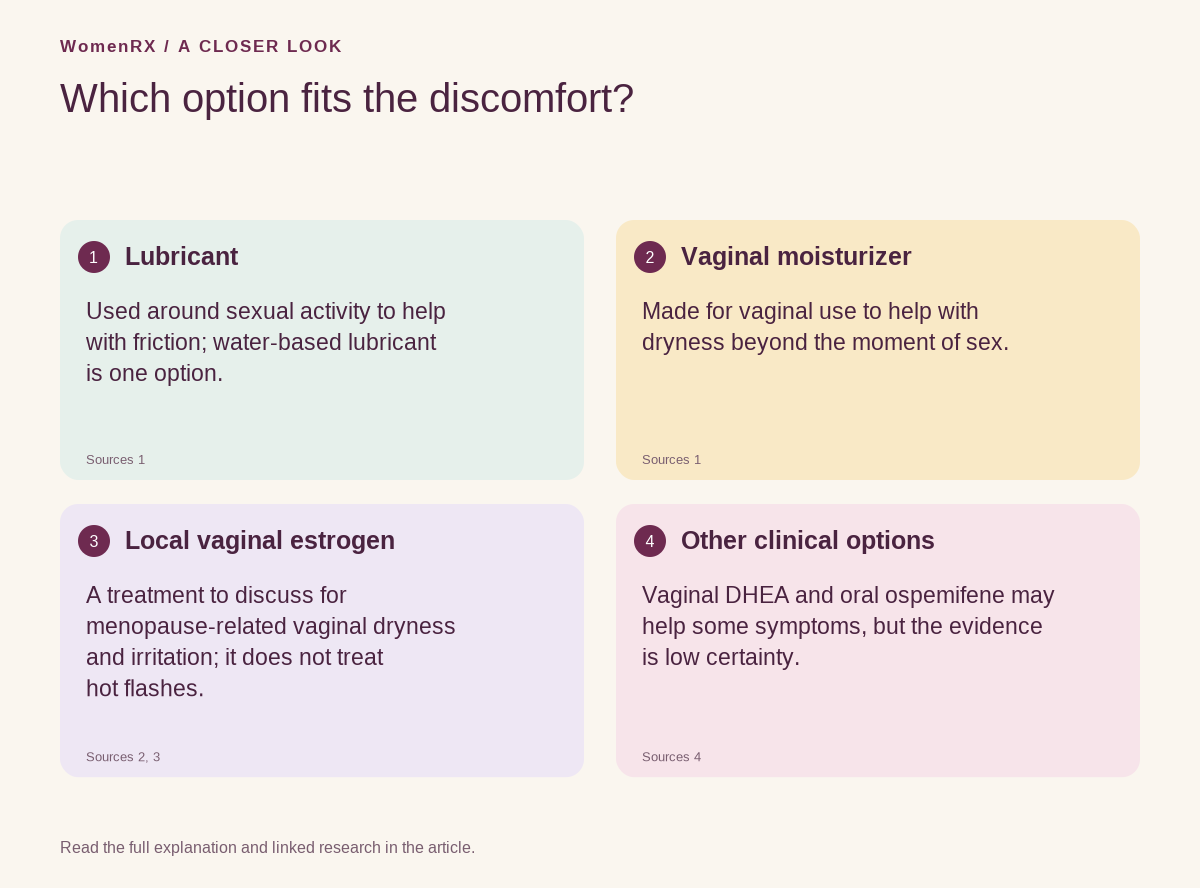
Which option fits the discomfort?
Lubricant: Used around sexual activity to help with friction; water-based lubricant is one option.1
Vaginal moisturizer: Made for vaginal use to help with dryness beyond the moment of sex.1
Local vaginal estrogen: A treatment to discuss for menopause-related vaginal dryness and irritation; it does not treat hot flashes.23
Other clinical options: Vaginal DHEA and oral ospemifene may help some symptoms, but the evidence is low certainty.4
Read the figure as text
The options differ in what they’re meant to relieve. Ongoing symptoms are a reason to discuss whether a clinical treatment fits.- Lubricant: Used around sexual activity to help with friction; water-based lubricant is one option.1
- Vaginal moisturizer: Made for vaginal use to help with dryness beyond the moment of sex.1
- Local vaginal estrogen: A treatment to discuss for menopause-related vaginal dryness and irritation; it does not treat hot flashes.23
- Other clinical options: Vaginal DHEA and oral ospemifene may help some symptoms, but the evidence is low certainty.4
More questions, answered
Will vaginal estrogen help hot flashes too?
No. Vaginal estrogen treats local symptoms such as dryness and irritation; it does not treat hot flashes or other whole-body menopause symptoms. 2
Sources you can check
- Vaginal dryness - NHSAccessed 2026-09-25Return to first citation
- About vaginal oestrogen - NHSAccessed 2026-09-25Return to first citation
- The 2022 hormone therapy position statement of The North American Menopause Society.“The 2022 Hormone Therapy Position Statement of The North American Menopause Society” Advisory Panel. · Menopause (New York, N.Y.) · 2022Return to first citation
- Hormonal Treatments and Vaginal Moisturizers for Genitourinary Syndrome of Menopause : A Systematic Review.Danan ER, Sowerby C, Ullman KE, Ensrud K, Forte ML, Zerzan N, Anthony M, Kalinowski C, Abdi HI, Friedman JK, Landsteiner A, Greer N, Nardos R, Fok C, Dahm P, Butler M, Wilt TJ, Die... · Annals of internal medicine · 2024Return to first citation