Can Vaginal Dryness Improve? Causes, Care, and Next Steps
Vaginal dryness can ease, but the best approach depends on what’s causing it and whether symptoms are persistent or come with pain, discharge, or bleeding.
Yes, vaginal dryness can improve. It may be temporary, for example when arousal is low, or continue when hormone levels change during or after menopause or with some treatments. Lubricants can help with sex, while vaginal moisturizers are used regularly for ongoing dryness. If symptoms last for weeks, disrupt daily life, or include unusual discharge or bleeding, get assessed rather than assuming the cause is low estrogen. 12
The cause matters more than your age
Dryness isn’t automatically a menopause symptom. Falling estrogen during and after menopause can cause ongoing vaginal dryness and irritation. But dryness can also happen when you aren’t sufficiently aroused during sex, or alongside conditions such as diabetes or Sjögren’s syndrome. Some medicines, hormonal treatments, and cancer treatments, including radiation, may also contribute. So a new symptom in your 20s, 40s, or later doesn’t identify its cause by itself. 125
The pattern can offer clues, but it can’t confirm a diagnosis. Dryness mainly during sex may relate to arousal or friction. Dryness or irritation that persists outside sex, particularly around menopause or during a treatment that affects hormones, has a different context. Burning, soreness, itching, and pain with sex can occur with low-estrogen tissue changes, but other vulvovaginal conditions can cause similar symptoms. An assessment can help distinguish them. 15
Match the option to the situation
If discomfort is mostly during sex, a water-based lubricant used before sex may reduce friction. A vaginal moisturizer is different: it’s used inside the vagina to help with ongoing dryness, rather than just to make sex more comfortable. Choose unperfumed washes around the vagina, since perfumed products can be irritating. 1
When menopause-related dryness continues, local vaginal estrogen is one treatment option to discuss with a clinician. It delivers estrogen in the vagina and is used for vaginal dryness and irritation; it isn’t intended to treat other menopause symptoms such as hot flashes or sleep problems. It can take up to three months to work fully, so improvement may not be immediate. Whether it’s appropriate depends on your situation. 23
Nonhormonal products may also be an option. In one randomized, open-label trial, 144 women described as postmenopausal were assigned to hyaluronic-acid vaginal gel or estriol cream; 133 completed the study. After ten applications, both groups reported improved dryness. That study offers a comparison, not proof that every moisturizer works as well as estrogen, or that the result applies to dryness from every cause. 4
When to stop guessing and get assessed
Arrange an appointment if dryness has lasted a few weeks and self-care hasn’t helped, is affecting daily life, or comes with unusual discharge. Recurrent urinary tract infections can also occur alongside vaginal dryness and are worth discussing. Persistent pain with sex deserves attention too, because dryness is not the only possible explanation for pain. 15
Bleeding after sex, between periods, or after menopause should be assessed rather than treated as ordinary dryness. A clinician may ask about your symptoms and treatments and examine the area to check for other causes. 15
The practical takeaway: brief, sex-related discomfort may respond to lubricant, while ongoing symptoms call for a closer look at the context and sometimes a different treatment. You don’t have to decide on your own that estrogen is the answer, or that the symptom is permanent.
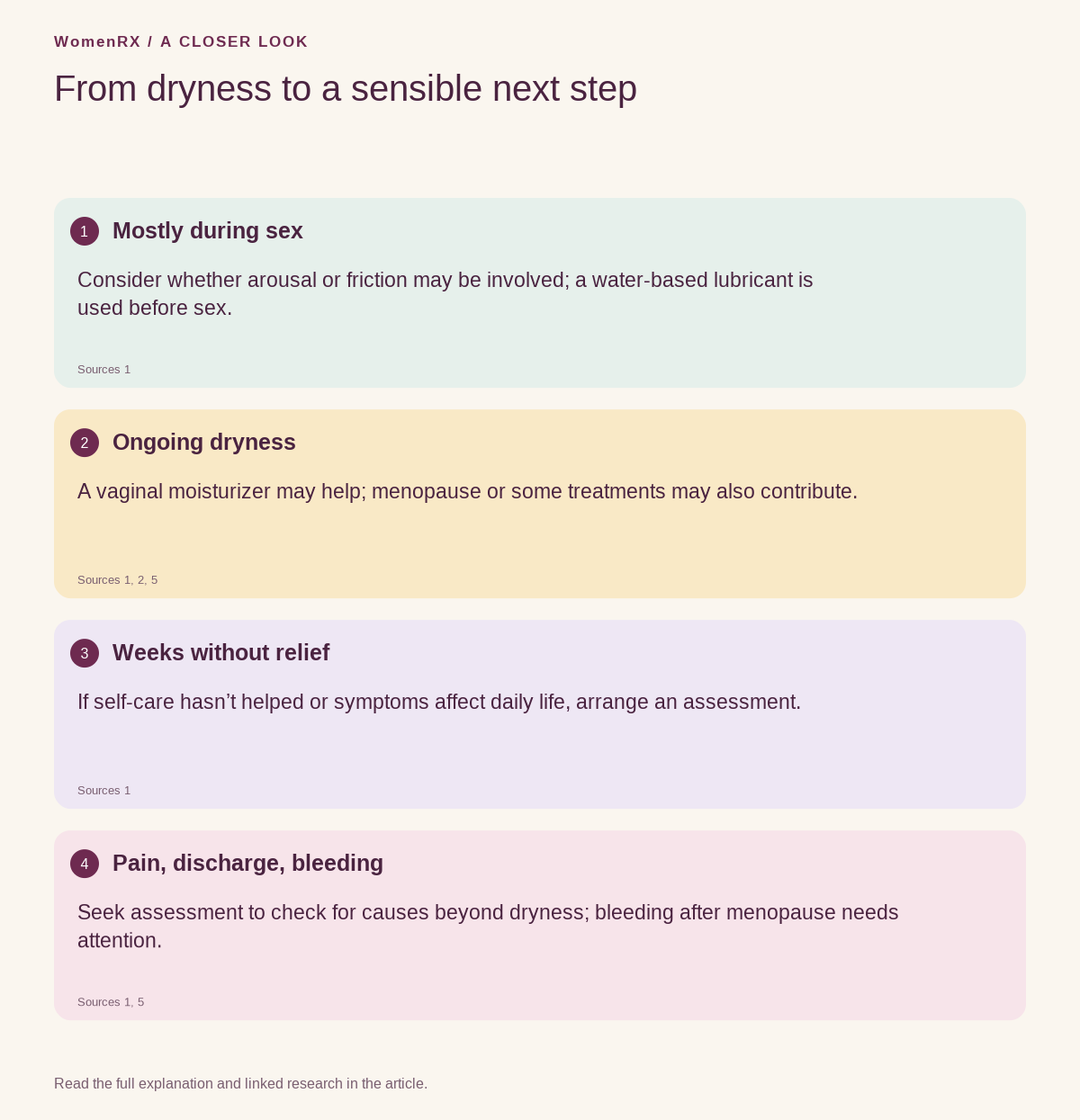
From dryness to a sensible next step
Mostly during sex: Consider whether arousal or friction may be involved; a water-based lubricant is used before sex.1
Ongoing dryness: A vaginal moisturizer may help; menopause or some treatments may also contribute.125
Weeks without relief: If self-care hasn’t helped or symptoms affect daily life, arrange an assessment.1
Pain, discharge, bleeding: Seek assessment to check for causes beyond dryness; bleeding after menopause needs attention.15
Read the figure as text
Use the symptom pattern to distinguish simple comfort measures from situations that merit assessment. This is a guide, not a diagnosis.- Mostly during sex: Consider whether arousal or friction may be involved; a water-based lubricant is used before sex.1
- Ongoing dryness: A vaginal moisturizer may help; menopause or some treatments may also contribute.125
- Weeks without relief: If self-care hasn’t helped or symptoms affect daily life, arrange an assessment.1
- Pain, discharge, bleeding: Seek assessment to check for causes beyond dryness; bleeding after menopause needs attention.15
More questions, answered
What’s the difference between a vaginal lubricant and a moisturizer?
Lubricant is used before sex to reduce friction. A vaginal moisturizer is used inside the vagina to help with ongoing dryness. They serve different purposes, and one may fit your symptoms better than the other. 1
Does vaginal estrogen treat hot flashes too?
No. Vaginal estrogen is used for vaginal symptoms such as dryness and irritation. It does not treat other menopause symptoms such as hot flashes or sleep problems. 2
Sources you can check
- Vaginal dryness - NHSAccessed 2026-09-25Return to first citation
- About vaginal oestrogen - NHSAccessed 2026-09-25Return to first citation
- Common questions about vaginal oestrogen - NHSAccessed 2026-09-25Return to first citation
- Is vaginal hyaluronic acid as effective as vaginal estriol for vaginal dryness relief?Stute P. · Archives of gynecology and obstetrics · 2013Return to first citation
- Clinical manifestations and evaluation of postmenopausal vulvovaginal atrophy.Pérez-López FR, Vieira-Baptista P, Phillips N, Cohen-Sacher B, Fialho SCAV, Stockdale CK. · Gynecological endocrinology : the official journal of the International Society of Gynecological Endocrinology · 2021Return to first citation