Vaginal Dryness: Moisturizers, Lubricants, and Next Steps
A vaginal moisturizer is for ongoing dryness; a lubricant is for reducing friction during sex.
If dryness is linked to menopause and you want to avoid hormones, start by matching the product to the moment: a vaginal moisturizer helps keep tissue moist between sexual activity, while lubricant is used before or during sex. They serve different purposes, and relief varies. If symptoms continue for a few weeks, affect daily life, or come with unusual discharge or bleeding, seek an evaluation. 14
Two products, two jobs
Menopause-related changes in hormone levels can reduce vaginal fluid and lead to dryness. For mild symptoms, nonhormonal options such as vaginal moisturizers and lubricants are commonly used first. They aren't interchangeable: a moisturizer is intended to help with dryness beyond sex, while lubricant reduces friction when you're sexually active. 146
Vaginal moisturizer: Choose this when dryness bothers you at other times too, not just during sex. It's used in the vagina to help keep it moist. Follow the product's directions for use; a moisturizer isn't the same thing as a lubricant applied for sex. 1
Lubricant: Choose this when you want extra slipperiness during sexual activity. NHS guidance describes using a water-based lubricant before sex, including around the vagina or on a partner's fingers, penis, or a sex toy. 1
You may find one product is enough, or that you want a moisturizer for ongoing dryness and lubricant for sex. The aim is comfort, not pushing through discomfort. A product that doesn't help or feels irritating isn't a reason to keep using it; ask about another option or whether something else is causing the symptoms.
A simple way to choose and assess
Start with the situation you want to improve. If dryness is present during the day, or discomfort isn't limited to sex, try a vaginal moisturizer. If discomfort mainly arises with sexual activity, try lubricant at that time. If both patterns apply, the two products address different needs. 1
Check the label for the product's intended use: does it say vaginal moisturizer or lubricant, and does its direction match when you plan to use it? Don't assume that a product designed for one purpose will do the other's job. Keep track of whether the symptom you chose it for improves and whether you notice irritation. There isn't a single product that works equally well for everyone, and menopause may not be the only explanation for dryness.
If sexual activity is part of the picture, arousal can also affect lubrication. NHS guidance suggests trying different types of foreplay to find what helps you feel more aroused. That may help with lubrication during sex, but it doesn't replace a moisturizer for dryness that persists at other times. 1
If you have a cancer history
A preference to avoid hormones is a valid part of choosing care, and nonhormonal moisturizers and lubricants are options to discuss or try for mild menopause-related symptoms. Cancer treatments, including some hormone therapies, can also bring on or worsen menopause-related vaginal symptoms. 14
A cancer history doesn't make every next treatment choice automatic. If nonhormonal products aren't enough, decisions about other treatments can depend on the cancer and its treatment. For hormone-sensitive cancers in particular, treatment decisions call for individualized discussion with the oncology team; a review describes shared decision-making as central. 34
Be cautious about marketed procedures
Vaginal laser and radiofrequency procedures are sometimes presented as hormone-free approaches, but the studies here don't establish them as reliable substitutes for moisturizer or lubricant. A review of vaginal laser research says robust sham-controlled trials are still needed. A radiofrequency study was an unblinded case series without a comparison group. These findings are preliminary, so don't treat a promising result from a small study as proof that a procedure will work for you. 25
When to look beyond self-care
Dryness can have causes other than menopause, including not being aroused during sex and certain health conditions. If a few weeks of self-care haven't helped, dryness is affecting daily life, or you have unusual discharge, seek medical evaluation rather than simply switching products. Bleeding after sex, between periods, or after menopause also warrants evaluation. 1
If you've tried a moisturizer and lubricant but still have symptoms, the useful next question is not just which product to buy next: it's whether the cause has been identified and what options fit your health history and preferences.
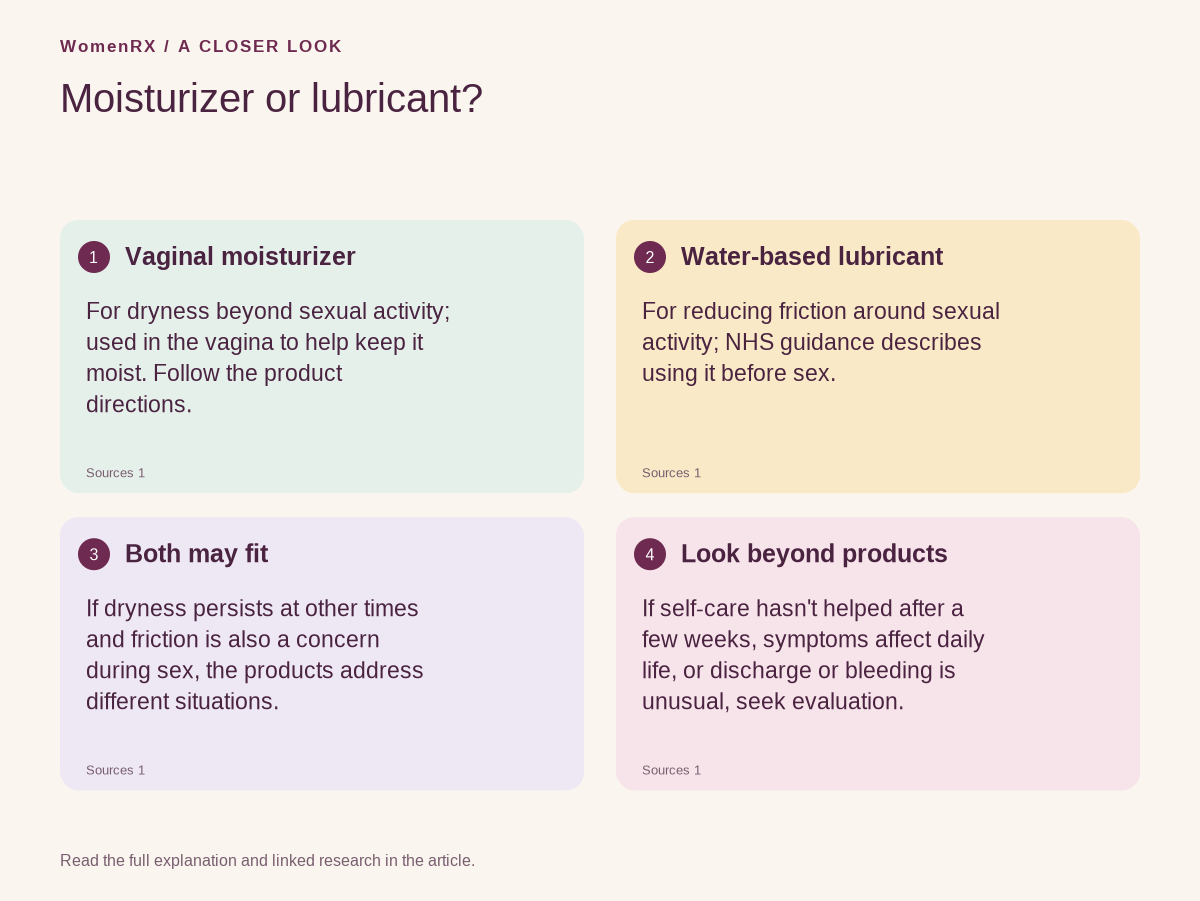
Moisturizer or lubricant?
Vaginal moisturizer: For dryness beyond sexual activity; used in the vagina to help keep it moist. Follow the product directions.1
Water-based lubricant: For reducing friction around sexual activity; NHS guidance describes using it before sex.1
Both may fit: If dryness persists at other times and friction is also a concern during sex, the products address different situations.1
Look beyond products: If self-care hasn't helped after a few weeks, symptoms affect daily life, or discharge or bleeding is unusual, seek evaluation.1
Read the figure as text
Choose by when dryness or friction bothers you. These products have different intended uses, and persistent symptoms may need evaluation.- Vaginal moisturizer: For dryness beyond sexual activity; used in the vagina to help keep it moist. Follow the product directions.1
- Water-based lubricant: For reducing friction around sexual activity; NHS guidance describes using it before sex.1
- Both may fit: If dryness persists at other times and friction is also a concern during sex, the products address different situations.1
- Look beyond products: If self-care hasn't helped after a few weeks, symptoms affect daily life, or discharge or bleeding is unusual, seek evaluation.1
More questions, answered
Can I use a moisturizer only when I have sex?
A moisturizer is intended to help keep the vagina moist, while lubricant is used around sexual activity. If dryness happens only during sex, lubricant may fit that situation; if it also bothers you at other times, a moisturizer may address a different need. Follow the product directions. 1
When should I get help rather than keep trying products?
Seek evaluation if dryness lasts a few weeks despite self-care, affects daily life, or comes with unusual discharge or bleeding. Bleeding after sex, between periods, or after menopause should also be checked. 1
Sources you can check
- Vaginal dryness - NHSAccessed 2026-09-25Return to first citation
- Use of radiofrequency ablation of the vaginal canal for genitourinary syndrome of menopause.Rothenberger R, Kopinga E, Dell J, Moore RD, Miklos JR, Karram M. · The journal of sexual medicine · 2025Return to first citation
- Genitourinary syndrome of menopause in women with cancer - a narrative review.Ryan HM, Brennan DJ. · Maturitas · 2026Return to first citation
- Case-Based Perspectives on the Management of Genitourinary Syndrome of Menopause.Cyriac J, Sood R. · Clinics and practice · 2026Return to first citation
- Practical Guidance on the Use of Vaginal Laser Therapy: Focus on Genitourinary Syndrome and Other Symptoms.Kershaw V, Jha S. · International journal of women's health · 2024Return to first citation
- Female Pelvic Conditions: Genitourinary Syndrome of Menopause.Brady PH, Gin GT, Rosenblum E, Wilkinson LD. · FP essentials · 2022Return to first citation