How to Choose and Use a Vaginal Moisturizer
A moisturizer is for ongoing dryness; a lubricant is for reducing friction during sex.
For recurring vaginal dryness, choose a product whose label clearly says it is intended for vaginal use, then follow its directions for where and how often to apply it. Moisturizers are used regularly for longer-lasting moisture, while lubricants are used around sexual activity. Menopause is a common cause of dryness, but persistent symptoms, unusual discharge, or bleeding deserve assessment rather than just another product. 14
Start with the job you need the product to do
Vaginal moisturizers and sexual lubricants can both ease discomfort, but they’re designed for different situations. A moisturizer is used regularly to relieve ongoing dryness, including discomfort that shows up during ordinary daily activities. A lubricant is used before or during sex to reduce friction in the moment. If sex is uncomfortable because you’re dry between encounters, a moisturizer may address the day-to-day dryness; lubricant can still help during sex. 14
Dryness is common around and after menopause, when hormone changes can affect vaginal moisture. It can also happen during pregnancy or breastfeeding, after some cancer treatments, or for other reasons. It isn’t limited to one age or life stage. 1
Read the label in this order
1. Check the directions for vaginal use. Look for a product labeled as a vaginal moisturizer and read its instructions for use inside the vagina. If those directions aren’t clear, choose a product with clear instructions. 1
2. Look at the ingredients without treating one as a guarantee. Formulas vary. Moisturizers may contain water and polymers that help the product adhere to the vaginal lining; hyaluronic acid is another ingredient used in vaginal products. Human studies of hyaluronic acid have reported improvements in several vulvovaginal symptoms, but the review called for better-designed trials to clarify how well it works and its safety profile. That evidence doesn’t establish that hyaluronic acid is better than other moisturizers, or that every product containing it will work for you. 45
3. Find the use directions and frequency. Moisturizers are generally used on a regular schedule, but schedules vary by product. A review describes products used from daily to every two or three days; that range is not a personal schedule. Check the directions for the specific formula you buy. 4
4. Keep lubricant and moisturizer separate in your plan. If you need immediate help with friction during sex, choose a product labeled as a personal lubricant for that purpose. A moisturizer’s longer-term role doesn’t make it a substitute for lubricant at the time of sex. Water-based lubricants are one option recommended for vaginal dryness. 1
Set realistic expectations
A nonhormonal moisturizer can be a reasonable option for mild or occasional dryness, particularly if you prefer not to use hormones. But study results vary, and a moisturizer may not be enough for persistent or more troublesome symptoms. In one randomized trial of 32 postmenopausal women, the moisturizer group had no significant improvement in the Vaginal Health Index after four months, although symptom scores improved across all three study groups. A systematic review found that people with multiple menopause-related vaginal symptoms improved more with vaginal estrogen than with nonhormonal moisturizers, while those with one or minor symptoms had similar symptom resolution with either. These findings don’t predict exactly how an individual product will work for you. 23
If dryness is affecting daily life, keeps returning, or doesn’t improve after a few weeks of self-care, ask about other causes and treatment options. Menopause-related symptoms may have treatments beyond nonhormonal products; whether a hormone treatment is suitable depends on the person and her health situation. 1
When a product isn’t the next step
Dryness can come with soreness or itching, but unusual discharge or bleeding shouldn’t simply be attributed to dryness. Get medical advice for unusual discharge, bleeding after sex, bleeding between periods, or any bleeding after menopause. Also seek assessment if symptoms persist despite trying a product or are interfering with everyday life. 1
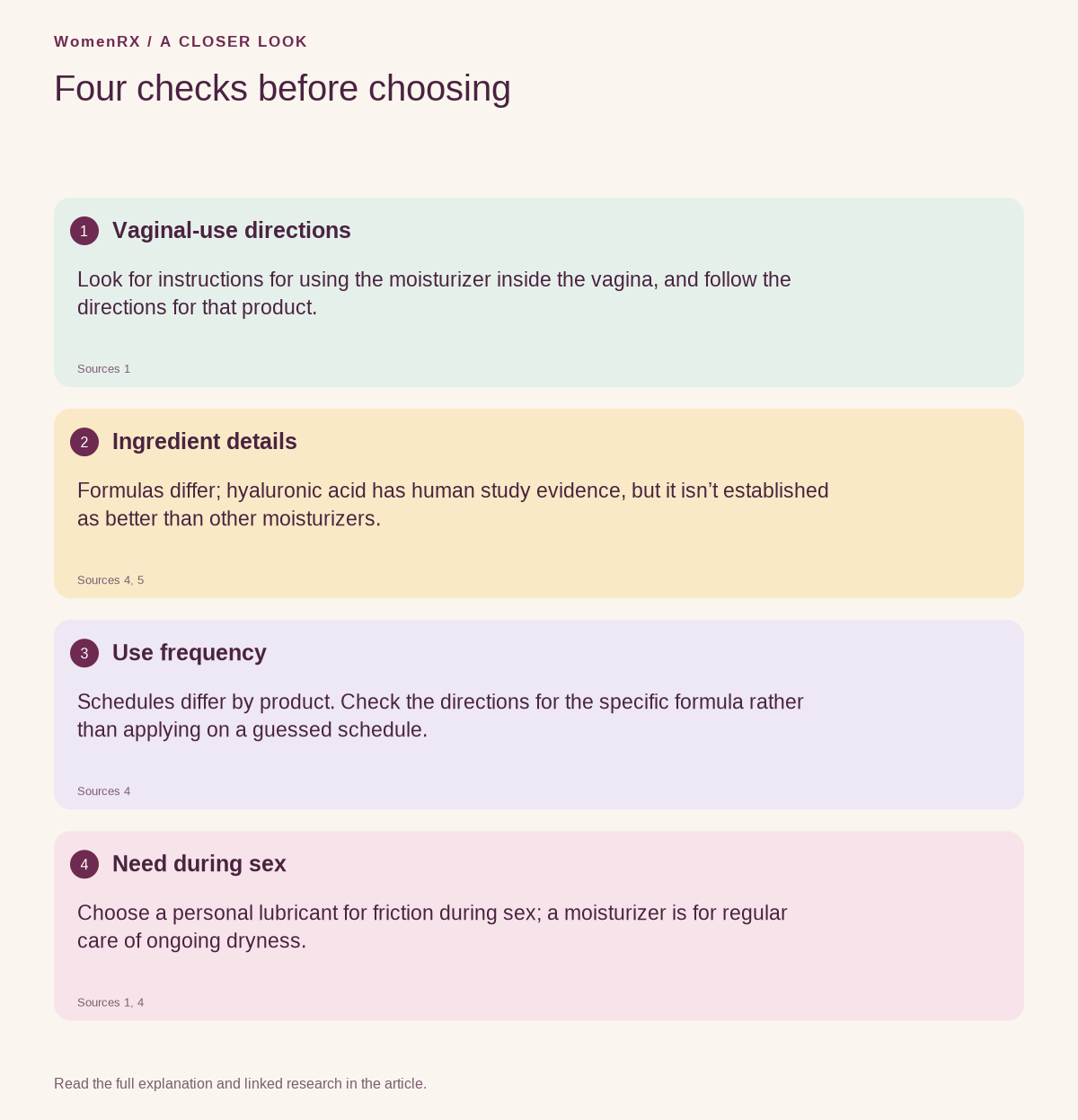
Four checks before choosing
Vaginal-use directions: Look for instructions for using the moisturizer inside the vagina, and follow the directions for that product.1
Ingredient details: Formulas differ; hyaluronic acid has human study evidence, but it isn’t established as better than other moisturizers.45
Use frequency: Schedules differ by product. Check the directions for the specific formula rather than applying on a guessed schedule.4
Need during sex: Choose a personal lubricant for friction during sex; a moisturizer is for regular care of ongoing dryness.14
Read the figure as text
Use the label to check vaginal-use directions and frequency, then match the product to whether you need ongoing moisture or help with friction during sex.- Vaginal-use directions: Look for instructions for using the moisturizer inside the vagina, and follow the directions for that product.1
- Ingredient details: Formulas differ; hyaluronic acid has human study evidence, but it isn’t established as better than other moisturizers.45
- Use frequency: Schedules differ by product. Check the directions for the specific formula rather than applying on a guessed schedule.4
- Need during sex: Choose a personal lubricant for friction during sex; a moisturizer is for regular care of ongoing dryness.14
More questions, answered
Can I use a vaginal moisturizer just before sex?
A moisturizer is intended for regular care of ongoing dryness, while lubricant is used around sex to reduce friction. Use a lubricant labeled for that purpose if you need help during sex, and follow each product’s directions. 14
Does a product with hyaluronic acid work better?
The available review found encouraging results for hyaluronic-acid products but called for better-designed trials. It doesn’t establish that this ingredient works better than other moisturizers. 5
Sources you can check
- Vaginal dryness - NHSAccessed 2026-09-25Return to first citation
- Comparison of the effect of noninvasive radiofrequency with vaginal estrogen and vaginal moisturizer in the treatment of vulvovaginal atrophy in postmenopausal women: a randomized clinical trial.Gueldini de Moraes AV, Costa-Paiva L, da Costa Machado H, Maciel TF, Mariano FV, Pedro AO. · Menopause (New York, N.Y.) · 2024Return to first citation
- Vaginal estrogen for genitourinary syndrome of menopause: a systematic review.Rahn DD, Carberry C, Sanses TV, Mamik MM, Ward RM, Meriwether KV, Olivera CK, Abed H, Balk EM, Murphy M, Society of Gynecologic Surgeons Systematic Review Group. · Obstetrics and gynecology · 2014Return to first citation
- Treating vulvovaginal atrophy/genitourinary syndrome of menopause: how important is vaginal lubricant and moisturizer composition?Edwards D, Panay N. · Climacteric : the journal of the International Menopause Society · 2016Return to first citation
- Hyaluronic acid in vulvar and vaginal administration: evidence from a literature systematic review.Buzzaccarini G, Marin L, Noventa M, Vitagliano A, Riva A, Dessole F, Capobianco G, Bordin L, Andrisani A, Ambrosini G. · Climacteric : the journal of the International Menopause Society · 2021Return to first citation