Hyaluronic Acid After 40: What the Evidence Actually Shows
One trial found skin-hydration changes in both younger and older women, but it doesn’t show that turning 40 makes supplements more useful.
Age alone doesn’t make oral hyaluronic acid a better-supported choice. A randomized trial in 129 healthy women reported improved skin hydration in both younger and older groups, but it doesn’t establish that women over 40 benefit more or define a clear 40-plus threshold. The reported results don’t give a menopause-stage comparison. The trial tested oral HA, not topical products. 1
The age cutoff is not a biological tipping point
There’s no clear evidence here that being over 40, by itself, changes the case for taking oral hyaluronic acid (HA). One randomized, double-blind trial included 129 healthy women divided into younger and older age groups. The researchers reported improved skin hydration in both groups. That’s a useful sign that the reported effect wasn’t limited to older participants, but it doesn’t show that older women improved more. 1
The study describes “young” and “elderly” groups rather than a specific over-40 group. The reported results describe age and skin-type groupings but don’t give a perimenopause or menopause comparison. So an age label shouldn’t be treated as proof that HA supplements address a particular hormonal change or a special need after 40. 1
What the oral-supplement study can tell you
The trial followed skin measures for up to 12 weeks. The researchers reported hydration improvements in both age groups, with changes appearing during the study’s early weeks. They also reported changes in skin tone and epidermal thickness at later measurements. These findings are a signal worth knowing about, not a guarantee of a noticeable cosmetic difference for you. 1
There are limits to what the results answer. The study involved healthy women in Shanghai, and some reported skin outcomes were analyzed with age-group data combined. The information reported does not establish how large or lasting a benefit might be for women over 40 specifically. Participants were also screened for health conditions and normal liver and kidney function, so these findings don’t establish safety for every person or health situation. 1
In practical terms, the study may make oral HA a consideration if your goal is skin hydration, but it doesn’t make age over 40 a reason on its own to start a supplement. The trial also doesn’t establish that an improvement will matter enough to you to justify the cost or daily routine.
Oral HA and topical products are different questions
The oral trial tested oral HA. It did not compare it with a cream or serum, so its results can’t tell you whether topical HA works as well, better, or less well. Treat the routes as separate choices rather than assuming evidence for one applies to another. 1
A separate small study examined HA injections, not a cream or serum. Neither that study nor the oral trial tested topical HA or compared oral and topical use. Their results therefore cannot establish the effects of topical HA or tell you which route works better for skin hydration. 1 2
A useful way to make the decision
If you’re considering a supplement for skin hydration, focus on the goal rather than the birthday: the trial offers an early signal for women in both age groups, not proof of extra benefit after 40. If you’re considering a topical product, assess it as a separate option; the oral findings don’t answer that question. And if you have a health condition, remember that the trial’s participants were screened healthy women, so its results may not apply to your situation. 1
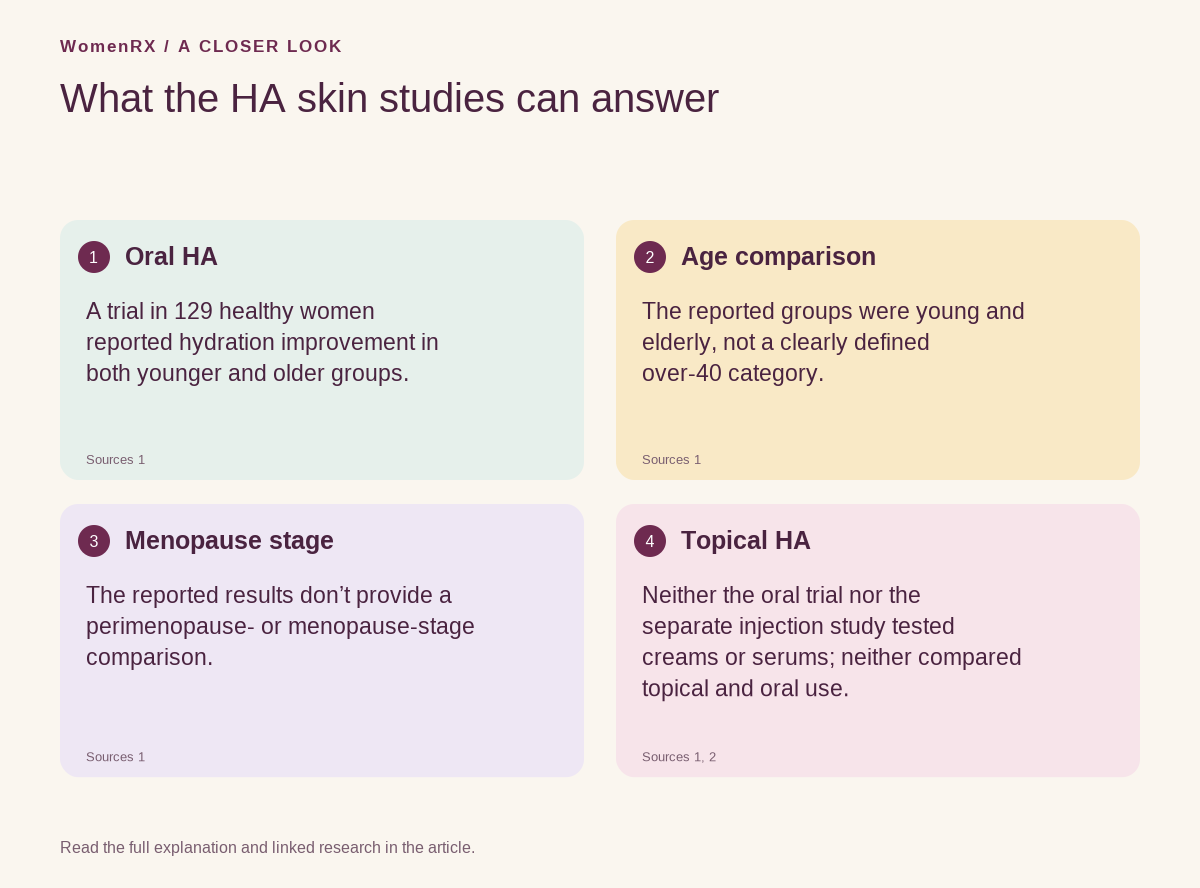
What the HA skin studies can answer
Oral HA: A trial in 129 healthy women reported hydration improvement in both younger and older groups.1
Age comparison: The reported groups were young and elderly, not a clearly defined over-40 category.1
Menopause stage: The reported results don’t provide a perimenopause- or menopause-stage comparison.1
Topical HA: Neither the oral trial nor the separate injection study tested creams or serums; neither compared topical and oral use.12
Read the figure as text
The oral trial informs a skin-hydration question, but its age groups and treatment route leave other decisions open.- Oral HA: A trial in 129 healthy women reported hydration improvement in both younger and older groups.1
- Age comparison: The reported groups were young and elderly, not a clearly defined over-40 category.1
- Menopause stage: The reported results don’t provide a perimenopause- or menopause-stage comparison.1
- Topical HA: Neither the oral trial nor the separate injection study tested creams or serums; neither compared topical and oral use.12
More questions, answered
Did the study show a benefit specific to menopause?
The reported results don’t give a perimenopause- or menopause-stage comparison. They describe younger and older age groups, which doesn’t establish whether life stage affected the findings. 1
Do these findings show that oral HA works better than topical HA?
No. The oral trial did not test creams or serums, and the separate injection study did not compare oral and topical use. These findings cannot rank the two routes. 1 2
Sources you can check
- Oral administration of hyaluronic acid to improve skin conditions via a randomized double-blind clinical test.Gao YR, Wang RP, Zhang L, Fan Y, Luan J, Liu Z, Yuan C. · Skin research and technology : official journal of International Society for Bioengineering and the Skin (ISBS) [and] International Society for Digital Imaging of Skin (ISDIS) [and] International Society for Skin Imaging (ISSI) · 2023Return to first citation
- Efficacy and Safety of Non-cross-Linked Hyaluronic Acid Injections for Facial Skin Biorevitalization: A Single-Center, Open-Label, Single-Arm, Uncontrolled, Post-marketing Study.Chahine S, Marozzi B, Valle A, Michellini L, Lazzari T. · Cureus · 2025Return to first citation