Oral Hyaluronic Acid for Skin: What Studies Actually Measure
Small clinical trials have measured skin hydration and appearance over weeks, but results from combination products can’t show what hyaluronic acid alone does.
Oral hyaluronic acid has shown measurable skin-hydration changes in small randomized studies lasting several weeks, including one trial in women of different ages. Other trials tested formulas that combined hyaluronic acid with ingredients such as collagen or wheat oil, so their results can’t be credited to hyaluronic acid alone. Menopause-specific effects and benefits that last after stopping weren’t established. 1 2 3
What the oral studies found
There is some direct human evidence that taking hyaluronic acid by mouth can change skin measurements. In a randomized, double-blind trial of 129 healthy women in Shanghai, researchers reported improved skin hydration within two to eight weeks in both younger and older groups. They also reported changes in skin tone over four to eight weeks and measured epidermal thickness at 12 weeks. These are measured outcomes, not proof that every participant noticed a visible difference or that results would last. 1
A separate 12-week randomized, placebo-controlled study tested a hyaluronic acid matrix containing other substances, including collagen-related ingredients, in women aged 35 to 65. Of 60 women randomized, 50 were included in the per-protocol analysis. The researchers reported differences from placebo in some appearance measures, including wrinkles and smoothness, and reported hydration and brightness changes from baseline. Because this was a combination formula, the study can’t tell us which ingredient produced a change. 2
A third trial illustrates the same problem: its oral supplement combined hyaluronic acid with wheat oil extract. In 63 randomized healthy adults, the researchers reported improvements in some wrinkle, smoothness, hydration, and elasticity measures over 12 weeks. The hydration and elasticity findings concerned the leg; wrinkle and smoothness findings concerned facial skin measures. The findings apply to that combination as tested, not to hyaluronic acid by itself. The abstract does not report a women-only result. 3
The product route matters
These findings concern oral supplements. They don’t establish what a topical hyaluronic acid product or an injection does, because those are different routes of use and weren’t tested in these oral trials. If you’re comparing products, check whether the study tested hyaluronic acid alone or a blend, and whether it measured the outcome you care about, such as hydration or wrinkle appearance.
Even within oral products, formulas and study outcomes differ. A result for a matrix containing hyaluronic acid and other ingredients isn’t evidence that any product labeled “hyaluronic acid” will have the same effect. Nor does a change in an instrument-measured hydration reading automatically mean a noticeable or lasting improvement for you.
What the studies don’t settle
The trials were short, measuring outcomes over periods from weeks to about three months. They don’t establish whether any changes continue after a supplement is stopped or what happens with longer-term use. One study included women described as younger and elderly, and another enrolled women up to age 65, but neither report establishes a benefit specific to perimenopause or menopause. Age categories aren’t a substitute for reporting menopause stage. 1 2
Safety evidence is also limited to the products and time periods studied. The 12-week matrix trial reported no serious adverse events associated with its tested product; that finding doesn’t establish long-term safety or apply to every formula. 2
Does the capsule match the skin study?
If you’re considering a product for dry skin, treat oral hyaluronic acid as an option with early, product-specific evidence, not a proven fix. The most relevant question is whether the formula closely matches one tested in a human trial and whether that trial measured the outcome you want. If the label combines several ingredients, the study may support that blend as a whole, but it won’t show that hyaluronic acid was responsible. The available studies don’t tell us whether effects are menopause-specific or how long they persist.
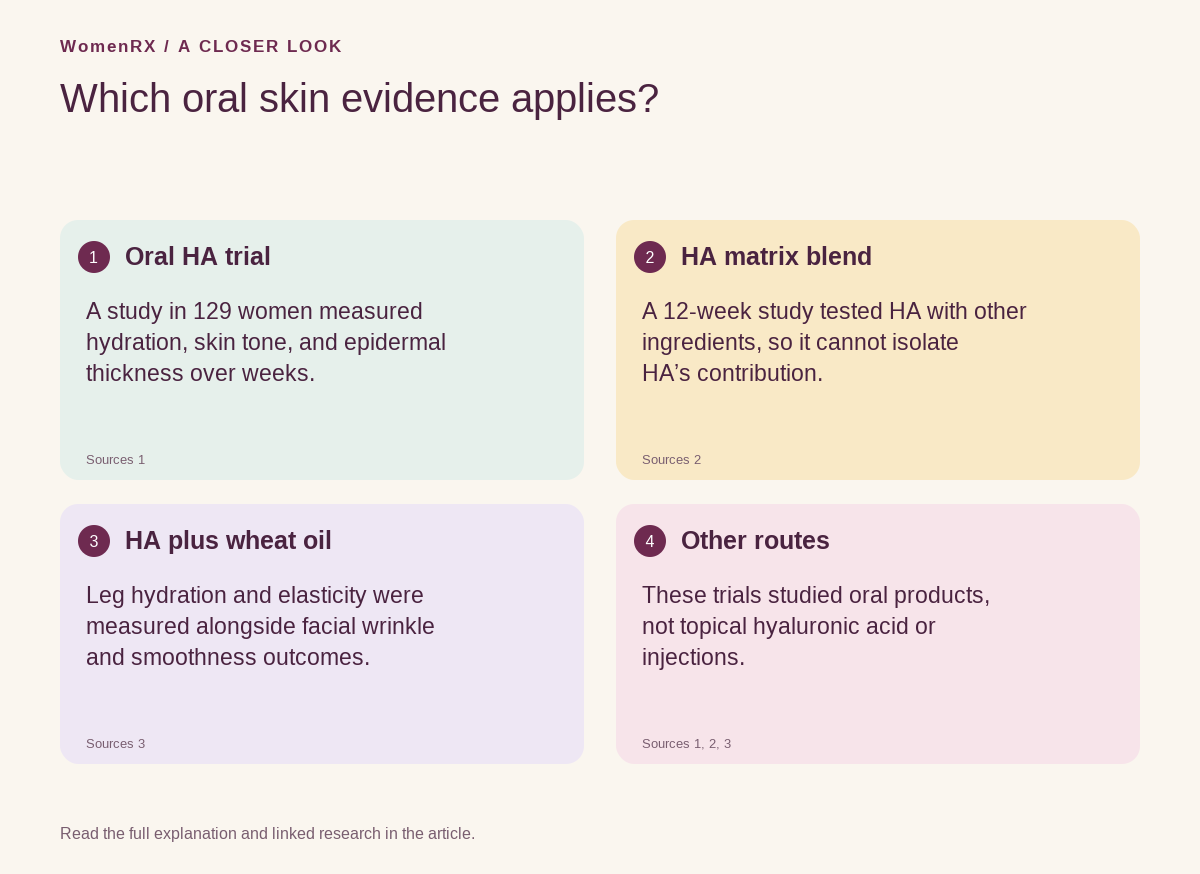
Which oral skin evidence applies?
Oral HA trial: A study in 129 women measured hydration, skin tone, and epidermal thickness over weeks.1
HA matrix blend: A 12-week study tested HA with other ingredients, so it cannot isolate HA’s contribution.2
HA plus wheat oil: Leg hydration and elasticity were measured alongside facial wrinkle and smoothness outcomes.3
Other routes: These trials studied oral products, not topical hyaluronic acid or injections.123
Read the figure as text
The study formula and route determine what each result can tell you.- Oral HA trial: A study in 129 women measured hydration, skin tone, and epidermal thickness over weeks.1
- HA matrix blend: A 12-week study tested HA with other ingredients, so it cannot isolate HA’s contribution.2
- HA plus wheat oil: Leg hydration and elasticity were measured alongside facial wrinkle and smoothness outcomes.3
- Other routes: These trials studied oral products, not topical hyaluronic acid or injections.123
More questions, answered
Is there evidence that oral hyaluronic acid works differently after menopause?
The cited trials included women across age ranges, but they don’t report results by menopause stage. An age-based comparison can’t establish a menopause-specific effect. 1 2
Do the studies show that benefits last after stopping?
No. The reported assessments took place during studies lasting weeks to about three months; they don’t establish whether changes persist after supplementation ends. 1 2 3
Sources you can check
- Oral administration of hyaluronic acid to improve skin conditions via a randomized double-blind clinical test.Gao YR, Wang RP, Zhang L, Fan Y, Luan J, Liu Z, Yuan C. · Skin research and technology : official journal of International Society for Bioengineering and the Skin (ISBS) [and] International Society for Digital Imaging of Skin (ISDIS) [and] International Society for Skin Imaging (ISSI) · 2023Return to first citation
- Oral Supplementation with a New Hyaluronic Acid Matrix Ingredient Improves Skin Brightness, Hydration, Smoothness, and Roughness: Results from a Randomized, Double-Blinded, Placebo-Controlled Study.Montero-Vilchez T, Gálvez-Martín P, Sanabria-de la Torre R, Cuenca-Barrales C, Molina-Leyva A, Martinez-Puig D, Velasco-Alvarez J, Arias-Santiago S. · Dermatology and therapy · 2025Return to first citation
- Efficacy of an Oral Skincare Supplement on Skin Aging: A 12-Week Randomized, Double-Blind, Placebo-Controlled Trial.Grier-Welch AM, Vance AY, Alamdari N, Sharafi M. · Dermatology and therapy · 2025Return to first citation