Oral Hyaluronic Acid: How to Compare Labels and Evidence
Skin trials have tested different oral formulas and measured different changes, so a useful comparison starts with the ingredient, outcome, and timeframe.
Oral hyaluronic acid has been studied for skin hydration, tone, wrinkles, and smoothness, but the trials used different formulas and amounts. Compare a label with the ingredient and outcome actually tested, not just the words “hyaluronic acid.” These skin findings don’t establish a benefit for joints or a menopause-specific effect. 1 2 3
Start with the change you care about
Skin hydration, wrinkle depth, smoothness, brightness, and skin thickness are different outcomes. A study measuring one doesn’t show that a supplement will improve all of them, or that an instrument-measured change will be noticeable to everyone.
For example, a randomized, double-blind study of 129 healthy women in Shanghai reported increased skin hydration after two to eight weeks of oral hyaluronic acid, changes in skin tone after four to eight weeks, and an epidermal-thickness finding at 12 weeks. The study included 100 mg/day and 200 mg/day groups. Those amounts describe what was studied, not a recommended dose or a standard for other products. 1
A separate placebo-controlled trial tested 200 mg/day of a full-spectrum hyaluronan product for 28 days in 60 adult women with mild-to-moderate signs of skin aging. The researchers reported changes in measures including hydration, wrinkle depth and volume, elasticity, and firmness. That result belongs to the formula tested; the words “hyaluronic acid” on another label don’t establish a match. 2
The formula changes what a trial can tell you
A 2025 trial studied a hyaluronic acid matrix, not hyaluronic acid alone. The matrix ingredient included hyaluronic acid, other sulfated glycosaminoglycans, and collagen. The tested amount was 60 mg daily of the matrix ingredient, which shouldn’t be read as 60 mg of hyaluronic acid by itself. 3
The trial randomized 60 women aged 35-65, with results analyzed for 50 participants. Compared with placebo, the study reported improvements in wrinkles and smoothness at six weeks and roughness at 12 weeks. Other reported changes, including hydration and brightness, were compared with participants’ own starting measurements. That distinction matters: a change from baseline doesn’t by itself show that the change was greater than with placebo. 3
These trials offer some evidence for particular skin measures, but they don’t establish that a different blend, amount, or product will have the same effects.
Make a label-to-study comparison
If you’re weighing an oral supplement for a skin concern, use these four checks:
- Amount per serving: First identify what the number measures. The studies above included 100 and 200 mg/day oral HA groups, a 200 mg/day full-spectrum product, and a 60 mg/day matrix ingredient. Those are different formulations, not interchangeable amounts of HA. 1 2 3
- The full ingredient list: Is the product HA alone or a blend? A study of a matrix containing collagen and other components can’t tell you which component caused a reported change, or whether HA alone would do the same thing. 3
- The outcome: Match the finding to your goal. If dryness is what bothers you, a hydration measure is more relevant than a finding about skin tone or thickness. 1 2 3
- The study period and comparison: Check whether the finding came after 28 days or 12 weeks, and whether it was measured against placebo or the group’s own baseline. Neither study period establishes what happens with longer use. 2 3
A closer label match helps you judge how relevant a study might be. It doesn’t prove that two products are equivalent, verify a brand’s quality, or identify a “best” brand.
Keep skin and joint claims separate
These trials measured skin outcomes, not joint pain or function. They therefore can’t answer whether taking oral hyaluronic acid would help a joint concern. Findings about products applied to the skin or injected into a joint also can’t be transferred to a supplement taken by mouth: the route and the question being studied are different.
What the studies tell women about menopause
Several of these skin trials enrolled women, so their findings are relevant to the women and skin concerns studied. That doesn’t establish a special benefit at a particular life stage. One trial divided participants into age groups around age 55, but an age-based analysis cannot establish whether an effect differs by menopause status. 1 2 3
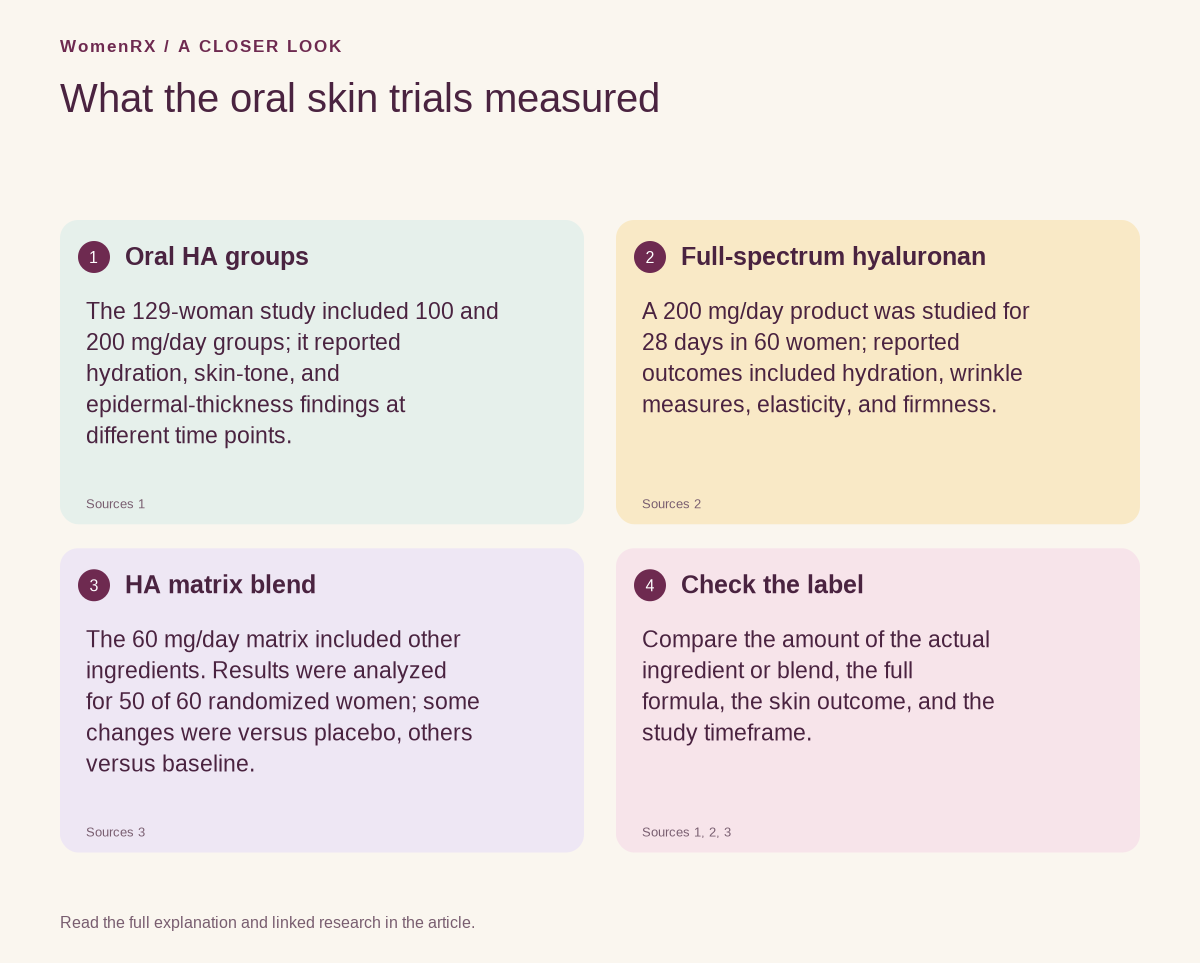
What the oral skin trials measured
Oral HA groups: The 129-woman study included 100 and 200 mg/day groups; it reported hydration, skin-tone, and epidermal-thickness findings at different time points.1
Full-spectrum hyaluronan: A 200 mg/day product was studied for 28 days in 60 women; reported outcomes included hydration, wrinkle measures, elasticity, and firmness.2
HA matrix blend: The 60 mg/day matrix included other ingredients. Results were analyzed for 50 of 60 randomized women; some changes were versus placebo, others versus baseline.3
Check the label: Compare the amount of the actual ingredient or blend, the full formula, the skin outcome, and the study timeframe.123
Read the figure as text
Compare each formula with its amount, study population, outcomes, and the type of comparison reported.- Oral HA groups: The 129-woman study included 100 and 200 mg/day groups; it reported hydration, skin-tone, and epidermal-thickness findings at different time points.1
- Full-spectrum hyaluronan: A 200 mg/day product was studied for 28 days in 60 women; reported outcomes included hydration, wrinkle measures, elasticity, and firmness.2
- HA matrix blend: The 60 mg/day matrix included other ingredients. Results were analyzed for 50 of 60 randomized women; some changes were versus placebo, others versus baseline.3
- Check the label: Compare the amount of the actual ingredient or blend, the full formula, the skin outcome, and the study timeframe.123
More questions, answered
Does a 60 mg matrix label mean 60 mg of hyaluronic acid?
Not necessarily. In the cited trial, 60 mg was the daily amount of a matrix ingredient containing hyaluronic acid along with other components. It wasn’t described as 60 mg of hyaluronic acid alone. 3
Do studies in women show a menopause-specific skin benefit?
Not on the basis of these findings. The trials included women, but an analysis that groups participants by age cannot show whether results differ between perimenopausal and postmenopausal women. 1 2 3
Sources you can check
- Oral administration of hyaluronic acid to improve skin conditions via a randomized double-blind clinical test.Gao YR, Wang RP, Zhang L, Fan Y, Luan J, Liu Z, Yuan C. · Skin research and technology : official journal of International Society for Bioengineering and the Skin (ISBS) [and] International Society for Digital Imaging of Skin (ISDIS) [and] International Society for Skin Imaging (ISSI) · 2023Return to first citation
- Oral intake of a new full-spectrum hyaluronan improves skin profilometry and ageing: a randomized, double-blind, placebo-controlled clinical trial.Michelotti A, Cestone E, De Ponti I, Pisati M, Sparta E, Tursi F. · European journal of dermatology : EJD · 2021Return to first citation
- Oral Supplementation with a New Hyaluronic Acid Matrix Ingredient Improves Skin Brightness, Hydration, Smoothness, and Roughness: Results from a Randomized, Double-Blinded, Placebo-Controlled Study.Montero-Vilchez T, Gálvez-Martín P, Sanabria-de la Torre R, Cuenca-Barrales C, Molina-Leyva A, Martinez-Puig D, Velasco-Alvarez J, Arias-Santiago S. · Dermatology and therapy · 2025Return to first citation