Oral Hyaluronic Acid: What Safety Studies Tell You
A small, short-term knee study offers limited reassurance, not proof that every oral hyaluronic acid product is safe or effective.
Oral hyaluronic acid has been studied in a small, four-week knee osteoarthritis trial, but the supplement also contained Boswellia. The study’s abstract describes a limited number of adverse events without listing their types or counts. That leaves long-term safety and safety in pregnancy, breastfeeding, and menopause unclear. Compare the product’s ingredients and form with what the study tested. 2
What the human safety study actually tested
A randomized, single-blind pilot trial enrolled 51 people with mild-to-moderate knee osteoarthritis. Seventeen received a daily tablet containing 300 mg of hyaluronic acid plus 100 mg of Boswellia for four weeks. The study’s abstract describes a limited number of treatment-emergent adverse events but doesn’t specify their types or counts there. A study this small and brief can’t establish long-term safety or rule out uncommon problems. 2
The hyaluronic-acid-plus-Boswellia group’s mean pain scores fell over four weeks: pain at rest went from 2.8 to 1.9 on a 0-to-10 scale, and pain during movement went from 3.7 to 2.7. The study also reported greater improvement in these pain measures than with the comparison product containing glucosamine, chondroitin, and curcuminoids. These are findings from a small pilot trial, not proof that hyaluronic acid alone relieves knee pain. 2
Because participants took hyaluronic acid alongside Boswellia, the study can’t separate the effects or side effects of the two ingredients. Twelve of the 17 people in that group were women, but the group-level findings presented aren’t broken down by sex, so they don’t establish women-specific effects. The trial also doesn’t establish how its findings apply during pregnancy, breastfeeding, or menopause. 2
Skin findings in mice aren’t human supplement evidence
A 2025 study tested oral hyaluronic acid in mice with chemically induced skin aging. It reported skin-related findings in that animal model, not evidence that a supplement improves women’s skin or is safe for people. Mouse findings can help researchers decide what to study next, but they don’t establish a human benefit or safety profile. 1
Match the product to the evidence
The study’s 300 mg figure describes one specific combination product used in one short trial. It is not a recommended dose, and it doesn’t establish that a different amount, formulation, or product will have the same effects or risks. Before considering a supplement, check the Supplement Facts panel and full ingredient list. Note the amount of hyaluronic acid and any added ingredients, then compare those details with what was actually studied. 2
Also keep the route clear. The knee trial was of an oral tablet; it does not answer questions about hyaluronic acid applied to skin or injected into a joint. Findings from one route shouldn’t be treated as proof of safety or benefit for another. For an injected product, this oral study is not the relevant safety evidence.
If you’re pregnant, breastfeeding, or choosing a supplement during menopause, don’t assume this small study applies to you. Those life stages weren’t the focus of the trial. The same goes if your product combines hyaluronic acid with other active ingredients. The useful question is not just “Does it contain hyaluronic acid?” but “Is this the same kind of product, and was it studied in people like me, for the outcome I care about?”
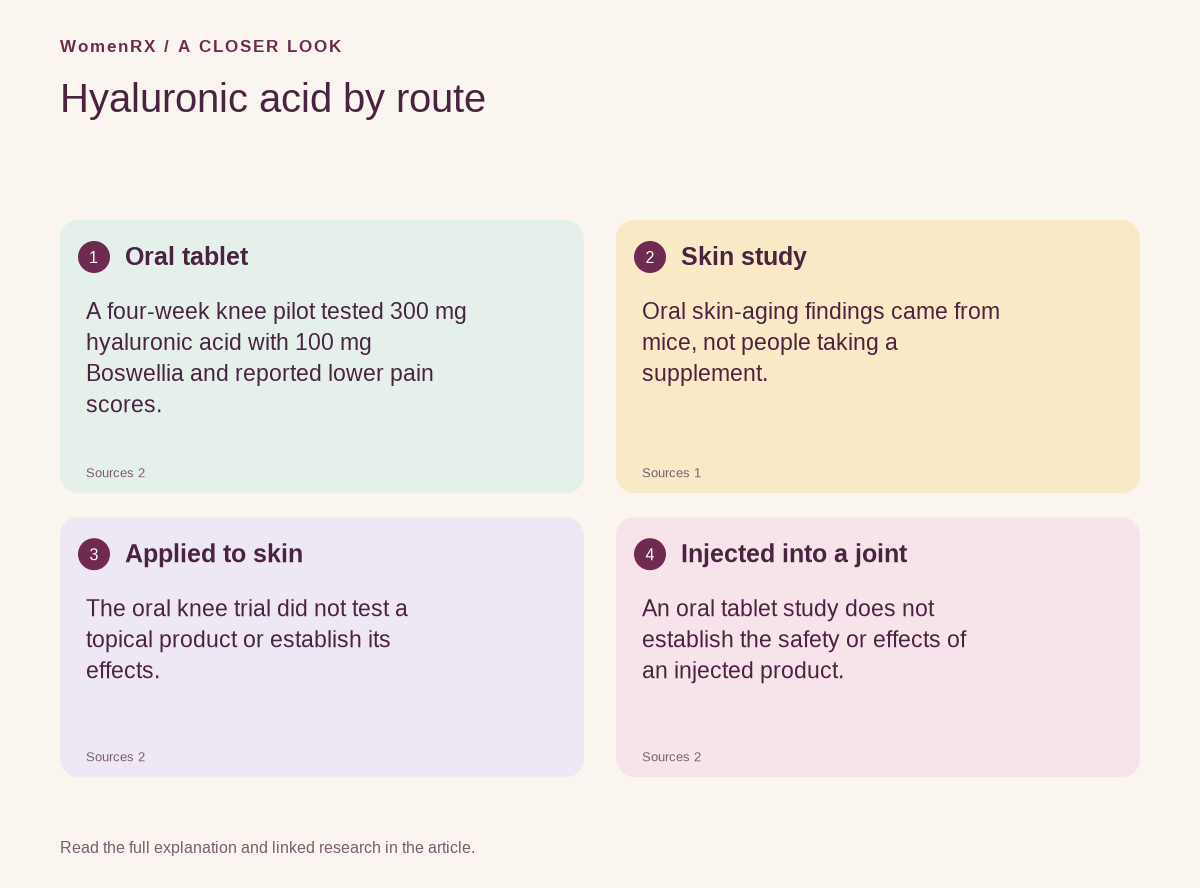
Hyaluronic acid by route
Oral tablet: A four-week knee pilot tested 300 mg hyaluronic acid with 100 mg Boswellia and reported lower pain scores.2
Skin study: Oral skin-aging findings came from mice, not people taking a supplement.1
Applied to skin: The oral knee trial did not test a topical product or establish its effects.2
Injected into a joint: An oral tablet study does not establish the safety or effects of an injected product.2
Read the figure as text
The oral knee trial offers a narrow view of one combination tablet; it does not establish what other routes do.- Oral tablet: A four-week knee pilot tested 300 mg hyaluronic acid with 100 mg Boswellia and reported lower pain scores.2
- Skin study: Oral skin-aging findings came from mice, not people taking a supplement.1
- Applied to skin: The oral knee trial did not test a topical product or establish its effects.2
- Injected into a joint: An oral tablet study does not establish the safety or effects of an injected product.2
More questions, answered
Did the knee study test hyaluronic acid by itself?
No. The tablet also contained Boswellia, so the study can’t separate the effects or side effects of the two ingredients. 2
Does the evidence show that oral hyaluronic acid is safe during pregnancy or breastfeeding?
This knee trial doesn’t establish safety in pregnancy or breastfeeding, and it doesn’t establish menopause-specific effects. 2
Sources you can check
- Oral Supplementation of Medium-Molecular-Weight Hyaluronic Acid (200-600 kDa) As a Functional Food Ingredient Alleviates D-Galactose-Induced Skin Aging.Guo S, Wang B, Mao B, Zhang T, Tang X, Zhang Q, Zhao J, Chen W, Cui S. · Biomacromolecules · 2025Return to first citation
- Efficacy and Safety of Two Chondroprotective Supplements in Patients With Knee Osteoarthritis: A Randomized, Single-Blind, Pilot Study.Minoretti P, Santiago Sáez A, Liaño Riera M, Gómez Serrano M, García Martín Á. · Cureus · 2024Return to first citation