How Much Is Known About Long-Term Oral Hyaluronic Acid?
Some oral studies lasted up to a year, but they don’t establish safety for every product, purpose, or person.
Oral hyaluronic acid has been studied in small, varied groups, mainly for joint symptoms, with follow-up ranging from four weeks to 12 months. Nine of 11 studies in a 2024 review reported improvements in joint-related measures, but nine tested combinations, so the benefits can’t be attributed to HA alone. Reported side effects were rare and mild, but the evidence doesn’t establish safety beyond a year or in pregnancy and breastfeeding. That uncertainty isn’t proof of harm. 1
The short answer depends on the product and purpose
Human studies offer some reassurance about oral hyaluronic acid (HA) over weeks to months, but they don’t answer whether it’s safe to take indefinitely. A 2024 systematic review found 11 studies involving 597 people with osteoarthritis or low back pain. Follow-up ranged from four weeks to 12 months. Nine of the 11 studies reported improvements in measures including pain and joint function, though most tested HA with other ingredients. The review described adverse effects as rare and mild. Those findings are useful, but they aren’t the same as long-term safety evidence for every supplement on the shelf. 1
The studies were small and varied in what they tested. Doses ranged from 30 to 300 mg a day, and nine of the 11 studies combined HA with other ingredients. So the review can’t tell you which dose or combination is best for ongoing use. Results from those nine combination studies can’t show which effects or side effects came from HA rather than the other ingredients; two studies tested HA alone. 1
Oral, topical, and injected HA aren’t interchangeable
A study of HA taken by mouth answers a different question from a study of HA applied to skin or injected into a joint. Injected HA is delivered directly into the joint; results from that route don’t establish what happens when HA is swallowed. Likewise, skin results from oral supplements don’t establish the effects or safety of a topical product. 23
The purpose matters, too. The oral joint studies reviewed in 2024 focused on osteoarthritis and low back pain, while a 2025 meta-analysis looked at skin outcomes across seven randomized trials. That meta-analysis reported improvements in hydration, elasticity, and wrinkle depth, but noted limited sample sizes and differences among studies. Those skin findings don’t establish long-term safety or identify a suitable product and dose for ongoing use. 13
What one 12-week trial can, and can’t, tell you
One randomized trial followed 100 Korean participants with mild knee or hip osteoarthritis for 12 weeks. It tested a combination of krill oil, astaxanthin, and oral HA, not HA by itself. At week 12, the combination group had a greater reduction in joint pain on the trial’s primary pain scale than the placebo group; the result can’t isolate HA’s contribution. Adverse events were reported in 4% of the combination group and 16% of the placebo group; gastrointestinal disorders were the most common type in both groups. This is a short-term finding about that specific combination, not proof that HA alone is safe for years. 2
The study authors said longer-term studies were needed for additional safety information. A 12-week trial can help identify common problems that appear during that period, but it can’t rule out uncommon effects or answer what happens with continued use beyond the study. 2
What the evidence means for women
Women made up 43% to 75% of participants across the studies in the 2024 review. That means women were included, but their participation percentages alone don’t show whether results or side effects differed by sex. It also doesn’t establish safety during pregnancy or breastfeeding. The age range reported was 40 to 70, so these findings don’t settle questions for younger adults either. 1
If you’re considering a supplement for a particular goal, check whether the research tested HA alone or a combination, and whether the study’s purpose matches yours. A product containing several ingredients can’t be assumed to have the same evidence as HA alone. If you’re pregnant or breastfeeding, these studies don’t provide a basis for concluding that oral HA is safe in those situations.
A practical way to judge an ongoing-use claim
Look for three details before treating a product claim as evidence about long-term use: the route (oral, topical, or injected), the exact formulation (HA alone or combined with other ingredients), and how long people were followed. For oral HA, the available joint research reaches as far as 12 months in the 2024 review, but much of it involved combinations, and it doesn’t establish safety for indefinite use. 1
That boundary doesn’t mean oral HA is known to cause harm. It means a reassuring short-term record and a few studies lasting up to a year can’t answer every question about a different product, a different purpose, or longer use.
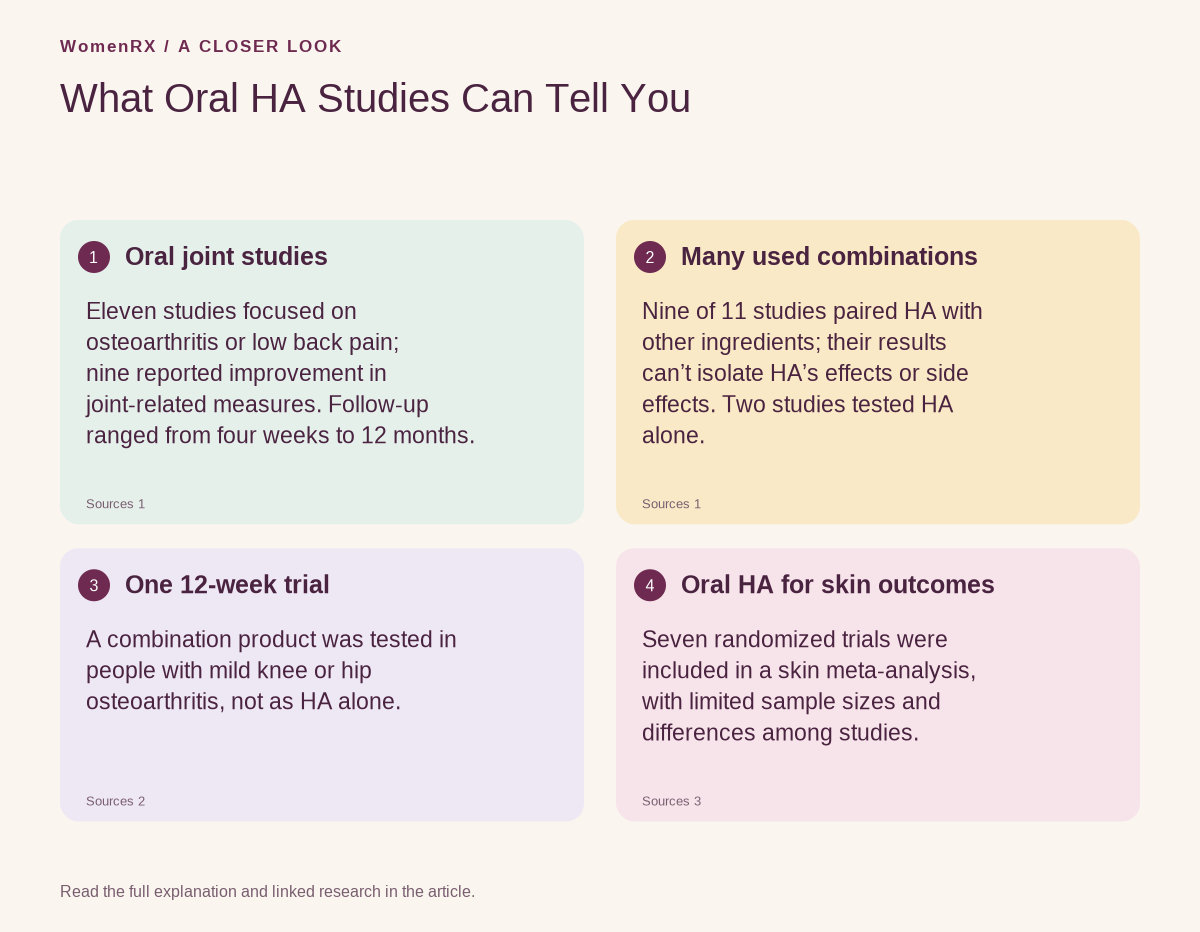
What Oral HA Studies Can Tell You
Oral joint studies: Eleven studies focused on osteoarthritis or low back pain; nine reported improvement in joint-related measures. Follow-up ranged from four weeks to 12 months.1
Many used combinations: Nine of 11 studies paired HA with other ingredients; their results can’t isolate HA’s effects or side effects. Two studies tested HA alone.1
One 12-week trial: A combination product was tested in people with mild knee or hip osteoarthritis, not as HA alone.2
Oral HA for skin outcomes: Seven randomized trials were included in a skin meta-analysis, with limited sample sizes and differences among studies.3
Read the figure as text
Route, study length, and formulation shape how much a finding says about continued use.- Oral joint studies: Eleven studies focused on osteoarthritis or low back pain; nine reported improvement in joint-related measures. Follow-up ranged from four weeks to 12 months.1
- Many used combinations: Nine of 11 studies paired HA with other ingredients; their results can’t isolate HA’s effects or side effects. Two studies tested HA alone.1
- One 12-week trial: A combination product was tested in people with mild knee or hip osteoarthritis, not as HA alone.2
- Oral HA for skin outcomes: Seven randomized trials were included in a skin meta-analysis, with limited sample sizes and differences among studies.3
More questions, answered
Do oral HA studies establish a best dose for long-term use?
No. The 2024 review found doses ranging from 30 to 300 mg a day across studies, many of which tested HA with other ingredients. It didn’t establish a best dose for ongoing use. 1
Does evidence about HA injections apply to supplements?
No. An injection delivers HA into a joint, while an oral supplement is swallowed. Evidence about one route doesn’t establish effects or safety for the other. 2
Sources you can check
- Oral Hyaluronic Acid in Osteoarthritis and Low Back Pain: A Systematic Review.de Carvalho JF, Davidson J. · Mediterranean journal of rheumatology · 2024Return to first citation
- A Multicenter, Randomized, Double-Blinded, Placebo-Controlled Clinical Trial to Evaluate the Efficacy and Safety of a Krill Oil, Astaxanthin, and Oral Hyaluronic Acid Complex on Joint Health in People with Mild Osteoarthritis.Hill WS, Dohnalek MH, Ha Y, Kim SJ, Jung JC, Kang SB. · Nutrients · 2023Return to first citation
- Oral Hyaluronic Acid Supplement: Efficacy in Skin Hydration, Elasticity, and Wrinkle Depth Reduction.Amin P, Sarabi A, Choe S, Scott S, Suh S, Mesinkovska NA. · Journal of drugs in dermatology : JDD · 2025Return to first citation