How to Choose an Oral Hyaluronic Acid Supplement
Start with the outcome you want, then check whether the human research matches the product’s ingredient and amount.
Oral hyaluronic acid has been studied for some skin-aging signs and joint symptoms, but the research is varied and doesn’t establish one best product or dose. Match the label to studies on the outcome you care about, check how much hyaluronic acid it provides and in what form, and treat testing disclosures as information about product checks, not proof the supplement works. 3 6
First, match the supplement to your goal
“Skin support” and “joint support” are different claims, with different studies behind them. Evidence for an oral supplement also can’t be assumed to apply to a cream or an injection. Before comparing products, decide which outcome matters to you, such as a measured skin-aging change or knee osteoarthritis symptoms. Then look for human research on that outcome, not just a general claim that hyaluronic acid is a body component.
For skin, a review of oral supplements and systemic treatments found clinical trials suggesting oral hyaluronic acid may help some signs of skin aging. The authors also described important limits: studies were often small and short, methods and outcome measures varied, and samples were predominantly female. The review does not establish a specific benefit around menopause or show that results differ by life stage. 3
For joints, a systematic review found 11 studies involving 597 people, with studies of osteoarthritis and one of low back pain. Across those studies, the reported daily amounts ranged from 30 to 300 mg, and follow-up ranged from four weeks to 12 months. Nine studies reported improvement in at least one outcome, but the review included varied preparations and outcomes. It doesn’t identify one amount or formulation as best for everyone. 6
Women were included in the joint research, but that is not the same as evidence of a women-specific effect. The review reported that women made up 43% to 75% of participants across studies; it did not establish different results by sex or life stage. 6
Read the amount as study context, not a target
The range of amounts used in joint studies is a description of what researchers tested, not a recommended dose. Check whether the label states the amount of hyaluronic acid itself per serving. If the ingredient is listed as sodium hyaluronate, look for a stated amount of that ingredient and avoid assuming that a product with the same number of milligrams is equivalent to a differently formulated product.
Also check whether hyaluronic acid is the only active ingredient. In a 12-week trial in people with mild knee or hip osteoarthritis, the tested supplement combined hyaluronic acid with krill oil and astaxanthin. Among 75 per-protocol participants, the combination group had a greater mean reduction in the primary K-VAS pain score than the placebo group: 20.8 mm versus 10.6 mm. That result is for the combination, so it can’t show how much, if any, of the difference came from hyaluronic acid alone. 5
The same trial’s corrected results matter when you compare outcomes: the K-WOMAC physical-function score differed significantly between groups at week 12, but the corrected analysis found no significant between-group difference in the K-WOMAC pain score. The K-VAS pain measure and K-WOMAC pain subscale are separate measures, and the trial reported different results for them. 4 5
Treat testing disclosures as a separate question
A clear label helps you understand what you would be taking, but it doesn’t establish that the product has the same formulation used in a study. Look for the ingredient name, amount per serving, other active ingredients, and serving size. If the company makes a testing claim, ask what was tested, who performed the testing, and whether it provides results tied to the product or a specific lot. These are practical comparison questions, not a certification standard. A testing statement by itself doesn’t demonstrate a health benefit.
If the product is a blend, compare the whole formula with the studied product. A trial of a hyaluronic-acid combination doesn’t establish the effect of hyaluronic acid by itself, and a study of one combination doesn’t automatically apply to a different blend. 5 6
Keep the safety evidence in perspective
The joint-study review described adverse effects as rare and mild in the studies it included. That offers some reassurance about the products and study periods represented, but it doesn’t establish long-term safety for every formulation or for every person. The skin-aging review likewise noted that oral supplements can have adverse effects. 3 6
If joint pain is new, worsening, recurring, or interfering with sleep or usual activities, don’t let a supplement label stand in for figuring out the cause. Joint pain can have different causes, including injury and arthritis; pain with a hot, swollen joint and feeling generally unwell can need urgent assessment. 1 2
A quick label check
Before buying, see whether you can answer four questions: What result am I looking for? Does human research study that result? Does the label disclose the hyaluronic acid form and amount, and is the product a blend? What does the testing disclosure actually say about the product? If key details are missing, you have less basis for comparing the product with the research.
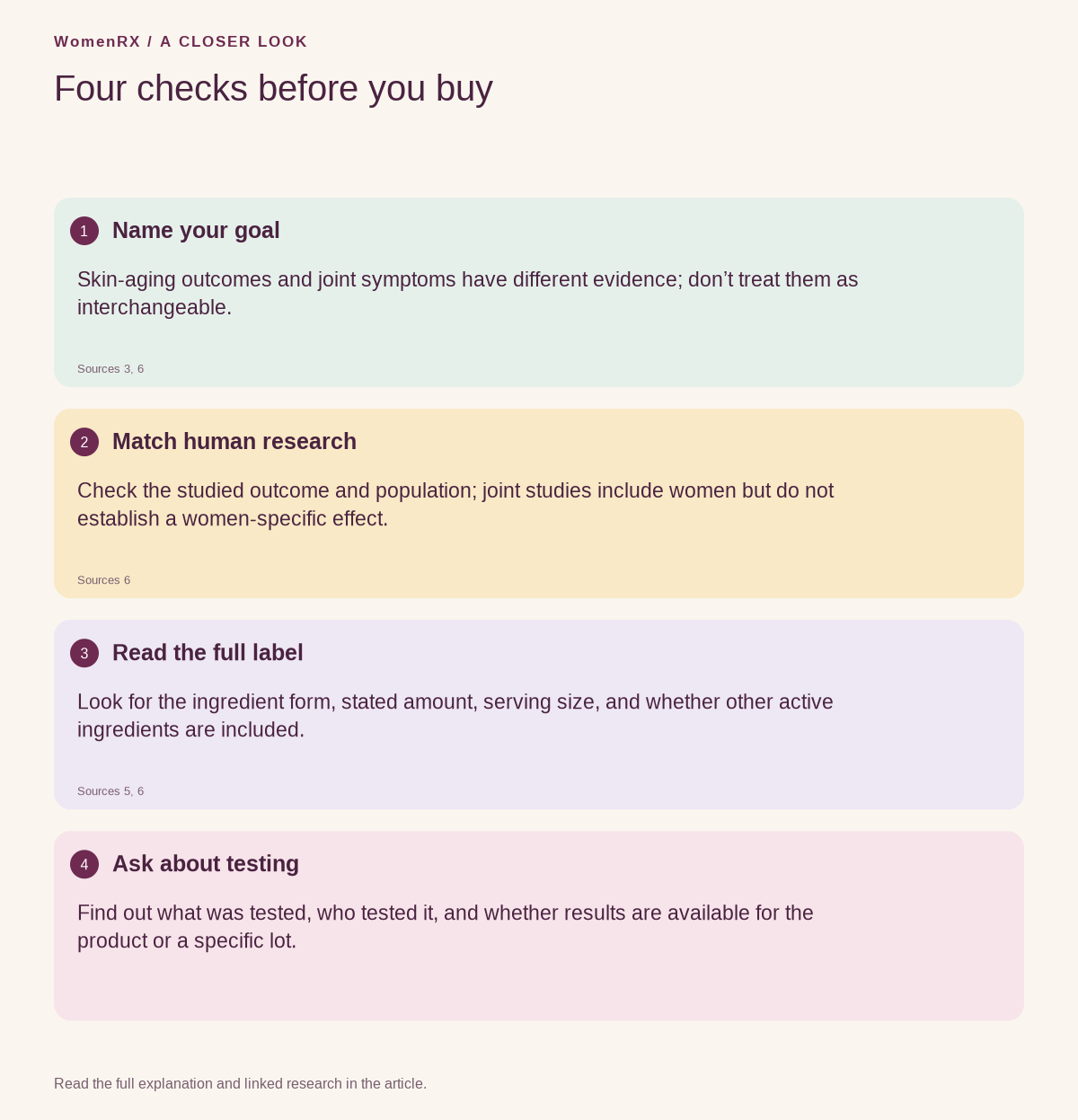
Four checks before you buy
Name your goal: Skin-aging outcomes and joint symptoms have different evidence; don’t treat them as interchangeable.36
Match human research: Check the studied outcome and population; joint studies include women but do not establish a women-specific effect.6
Read the full label: Look for the ingredient form, stated amount, serving size, and whether other active ingredients are included.56
Ask about testing: Find out what was tested, who tested it, and whether results are available for the product or a specific lot.
Read the figure as text
Use these questions to compare the intended outcome, relevant human evidence, label details, and what a testing disclosure actually tells you.- Name your goal: Skin-aging outcomes and joint symptoms have different evidence; don’t treat them as interchangeable.36
- Match human research: Check the studied outcome and population; joint studies include women but do not establish a women-specific effect.6
- Read the full label: Look for the ingredient form, stated amount, serving size, and whether other active ingredients are included.56
- Ask about testing: Find out what was tested, who tested it, and whether results are available for the product or a specific lot.
More questions, answered
Does evidence in women mean the supplement is proven for menopause-related skin changes?
No. The skin-aging review described samples as predominantly female, but that does not establish a menopause-specific effect or show that results differ across life stages. 3
Does a joint study of a combination prove hyaluronic acid reduces pain?
Not by itself. In the cited trial, hyaluronic acid was combined with krill oil and astaxanthin, so the study cannot separate the effect of each ingredient. 5
Sources you can check
- Joint pain - NHSAccessed 2026-09-25Return to first citation
- Pain | MedlinePlusAccessed 2026-09-25Return to first citation
- Oral Supplementation and Systemic Drugs for Skin Aging: A Narrative Review.Morgado-Carrasco D, Gil-Lianes J, Jourdain E, Piquero-Casals J. · Actas dermo-sifiliograficas · 2023Return to first citation
- Correction: Hill et al. A Multicenter, Randomized, Double-Blinded, Placebo-Controlled Clinical Trial to Evaluate the Efficacy and Safety of a Krill Oil, Astaxanthin, and Oral Hyaluronic Acid Complex on Joint Health in People with Mild Osteoarthritis. Nutrients 2023, 15, 3769.Hill WS, Dohnalek MH, Ha Y, Kim SJ, Jung JC, Kang SB. · Nutrients · 2024Return to first citation
- A Multicenter, Randomized, Double-Blinded, Placebo-Controlled Clinical Trial to Evaluate the Efficacy and Safety of a Krill Oil, Astaxanthin, and Oral Hyaluronic Acid Complex on Joint Health in People with Mild Osteoarthritis.Hill WS, Dohnalek MH, Ha Y, Kim SJ, Jung JC, Kang SB. · Nutrients · 2023Return to first citation
- Oral Hyaluronic Acid in Osteoarthritis and Low Back Pain: A Systematic Review.de Carvalho JF, Davidson J. · Mediterranean journal of rheumatology · 2024Return to first citation