Oral Hyaluronic Acid: Skin Trial Doses, Not Joint Doses
Skin trials have tested several oral hyaluronic acid formulations, but their doses and timelines aren’t interchangeable, and these skin trials don’t establish a dose for joint symptoms.
For skin, trials have tested oral hyaluronic acid at 100 or 200 mg daily for up to 12 weeks, as well as combination products with different amounts and ingredients. Results were measured over weeks, not overnight. These study doses aren’t an established daily requirement, and skin findings don’t establish an oral dose for joint pain. 1 2 3
The dose depends on the product studied
There isn’t one trial-tested dose that applies to every oral hyaluronic acid supplement. Studies have used different forms, molecular weights, and sometimes added ingredients. That means a product’s milligrams alone don’t tell you whether it matches a clinical trial.
For example, a 2023 randomized, double-blind study tested high-molecular-weight hyaluronic acid in 129 women. Participants received 100 or 200 mg daily, and researchers assessed skin measures over 12 weeks. The study reported improvements in skin hydration within 2-8 weeks, skin tone measures within 4-8 weeks, and epidermal thickness at 12 weeks. These are measured skin outcomes, not proof that every product at those amounts will produce the same results. 1
A separate, smaller randomized, placebo-controlled study tested 200 mg daily of a full-spectrum hyaluronan product for 28 days in 60 adult women with mild-to-moderate signs of skin aging. The product contained hyaluronans with a range of molecular weights. Researchers reported improvements in skin measures including hydration, wrinkle depth, and elasticity after four weeks. Its formulation differs from the high-molecular-weight product in the other trial. 2
A third trial tested 60 mg daily of a hyaluronic acid matrix for 12 weeks in 60 women aged 35-65. This wasn’t hyaluronic acid alone: the ingredient also contained sulfated glycosaminoglycans and collagen. The reported results therefore apply to that combined ingredient, not necessarily to a plain hyaluronic acid capsule. The analysis included 50 participants; some improvements were reported compared with placebo at six or 12 weeks. 3
Give the outcome time to be measured
If you’re comparing a product label with a study, look at the exact formulation and the study’s measurement schedule. The trials above assessed skin outcomes after about four weeks, at intervals across eight weeks, or through 12 weeks. A result measured at one point doesn’t establish when you personally would notice a change, or whether a different formulation would work on the same schedule. 1 2 3
Also check whether the study tested hyaluronic acid alone. One skin trial, for instance, tested a supplement containing hyaluronic acid alongside wheat oil extract, so its results can’t show which ingredient contributed to the changes. Another tested a combination of hyaluronic acid, L-carnosine, and methylsulfonylmethane. Improvement with a multi-ingredient product doesn’t establish the effect of hyaluronic acid by itself. 4 5
Skin results aren’t joint results
The trials described above measured skin hydration, texture, wrinkles, or related skin properties. They don’t establish an oral hyaluronic acid dose for joint pain or show that a product studied for skin will improve joint symptoms. If your goal is joint relief, a skin-focused dose is not a trial-based answer to that question.
Oral supplements are also a different route from creams and injections. A result from swallowing a particular product doesn’t show that a topical product or an injected product has the same effect. The route, formulation, and goal all matter when comparing evidence.
What the women’s studies can, and can’t, tell you
Some of the skin evidence is directly from women: the 2023 trial enrolled women across younger and older age groups, and the 28-day and 12-week studies likewise enrolled women. That makes these findings relevant to the participants studied, but it doesn’t establish a specific benefit for perimenopause or menopause. Age group isn’t the same thing as menopausal status, and the studies don’t provide a pregnancy or postpartum dose. 1 2 3
A practical comparison starts with three questions: Is the study product the same kind of formulation? Was it hyaluronic acid alone or a blend? And were the measured outcomes relevant to your goal? For skin, the studies offer examples of doses and timelines worth comparing on a label. For joints, they don’t provide a supported oral dose.
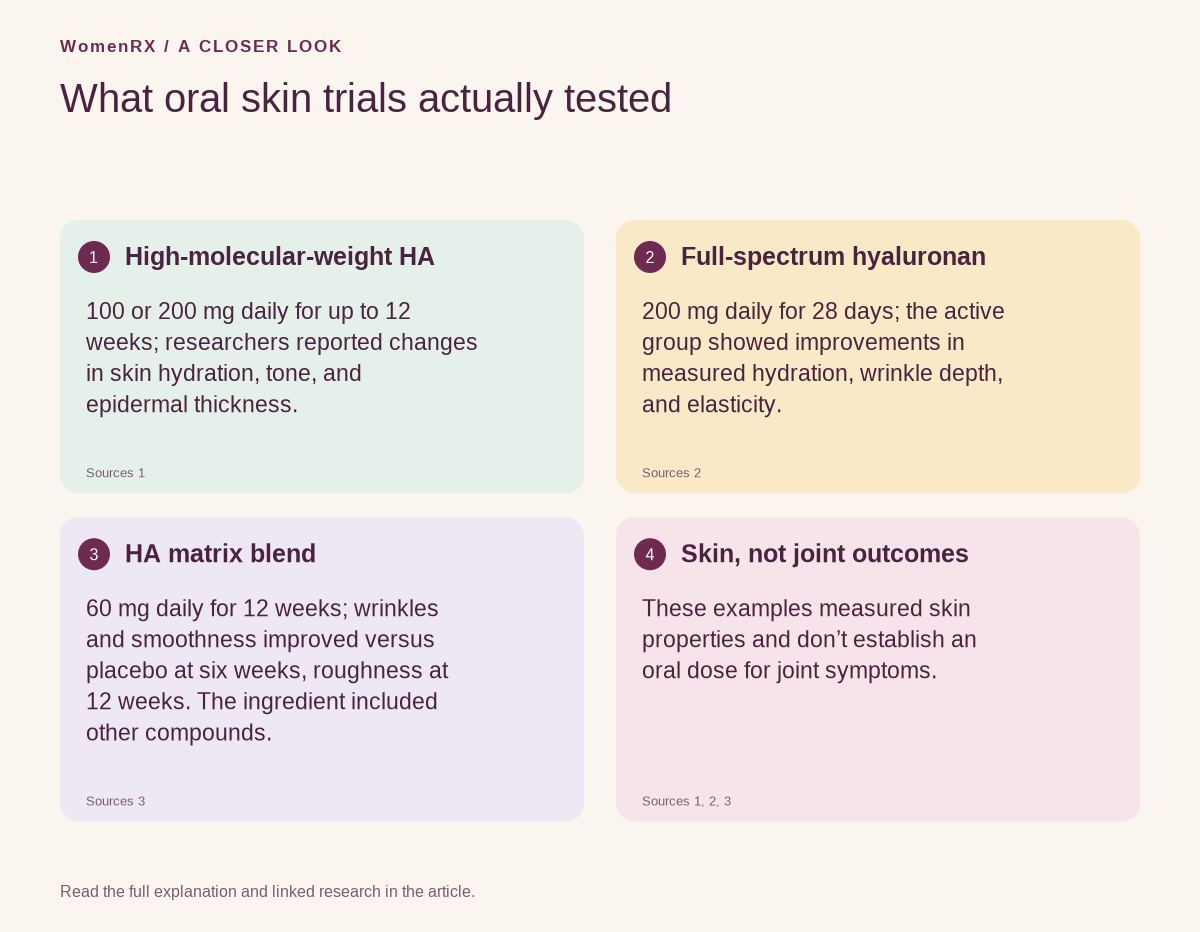
What oral skin trials actually tested
High-molecular-weight HA: 100 or 200 mg daily for up to 12 weeks; researchers reported changes in skin hydration, tone, and epidermal thickness.1
Full-spectrum hyaluronan: 200 mg daily for 28 days; the active group showed improvements in measured hydration, wrinkle depth, and elasticity.2
HA matrix blend: 60 mg daily for 12 weeks; wrinkles and smoothness improved versus placebo at six weeks, roughness at 12 weeks. The ingredient included other compounds.3
Skin, not joint outcomes: These examples measured skin properties and don’t establish an oral dose for joint symptoms.123
Read the figure as text
Compare formulation, study duration, and measured goal before treating doses from different trials as equivalent.- High-molecular-weight HA: 100 or 200 mg daily for up to 12 weeks; researchers reported changes in skin hydration, tone, and epidermal thickness.1
- Full-spectrum hyaluronan: 200 mg daily for 28 days; the active group showed improvements in measured hydration, wrinkle depth, and elasticity.2
- HA matrix blend: 60 mg daily for 12 weeks; wrinkles and smoothness improved versus placebo at six weeks, roughness at 12 weeks. The ingredient included other compounds.3
- Skin, not joint outcomes: These examples measured skin properties and don’t establish an oral dose for joint symptoms.123
Sources you can check
- Oral administration of hyaluronic acid to improve skin conditions via a randomized double-blind clinical test.Gao YR, Wang RP, Zhang L, Fan Y, Luan J, Liu Z, Yuan C. · Skin research and technology : official journal of International Society for Bioengineering and the Skin (ISBS) [and] International Society for Digital Imaging of Skin (ISDIS) [and] International Society for Skin Imaging (ISSI) · 2023Return to first citation
- Oral intake of a new full-spectrum hyaluronan improves skin profilometry and ageing: a randomized, double-blind, placebo-controlled clinical trial.Michelotti A, Cestone E, De Ponti I, Pisati M, Sparta E, Tursi F. · European journal of dermatology : EJD · 2021Return to first citation
- Oral Supplementation with a New Hyaluronic Acid Matrix Ingredient Improves Skin Brightness, Hydration, Smoothness, and Roughness: Results from a Randomized, Double-Blinded, Placebo-Controlled Study.Montero-Vilchez T, Gálvez-Martín P, Sanabria-de la Torre R, Cuenca-Barrales C, Molina-Leyva A, Martinez-Puig D, Velasco-Alvarez J, Arias-Santiago S. · Dermatology and therapy · 2025Return to first citation
- Efficacy of an Oral Skincare Supplement on Skin Aging: A 12-Week Randomized, Double-Blind, Placebo-Controlled Trial.Grier-Welch AM, Vance AY, Alamdari N, Sharafi M. · Dermatology and therapy · 2025Return to first citation
- Randomized, Placebo-controlled Study of a Nutraceutical Based on Hyaluronic Acid, L-carnosine, and Methylsulfonylmethane in Facial Skin Aesthetics and Well-being.Guaitolini E, Cavezzi A, Cocchi S, Colucci R, Urso SU, Quinzi V. · The Journal of clinical and aesthetic dermatology · 2019Return to first citation