Does Oral Hyaluronic Acid Help Skin, Hair, or Nails?
Small trials suggest some oral hyaluronic acid products may improve measured skin features, but they don’t establish benefits for hair or nails.
Oral hyaluronic acid has some promising, limited evidence for skin hydration and appearance. Small randomized trials tested specific products and measured particular skin features, so their findings don’t apply automatically to every supplement. Hair benefits aren’t established: one combination-product study reported a slight improvement in hair appearance on a questionnaire, but couldn’t isolate hyaluronic acid’s effect. The cited studies don’t establish a nail benefit. 1 2 5
The skin evidence is promising, but product-specific
If you’re considering a hyaluronic acid (HA) supplement for dry-looking skin, there is a reason to look beyond the marketing: randomized human studies have measured skin changes after oral use. The useful question is what changed, compared with what, and with which product.
One double-blind trial randomized 129 healthy women in Shanghai across oral HA dose groups, including a 0 mg/day group. It reported improved skin hydration over 2 to 8 weeks in both younger and older groups, as well as skin-tone findings over 4 to 8 weeks and an epidermal-thickness finding at 12 weeks. Those are specific measured outcomes. They don’t mean that all 129 participants took HA or that everyone would notice a visible difference. 1
In another placebo-controlled trial, 60 women with mild-to-moderate signs of skin aging received either a full-spectrum hyaluronan product or placebo for 28 days. The abstract reports improvements in measured hydration, wrinkle depth and volume, elasticity, and firmness in the active group. That’s encouraging for the formulation studied, but a short trial can’t tell you whether changes last or whether a different HA supplement would perform the same way. 2
Why the ingredient list changes the answer
Some studies test HA alongside other ingredients. A 12-week trial randomized 60 women aged 35 to 65 to an HA matrix containing collagen and other compounds or placebo. Its per-protocol analysis included 50 participants and found differences from placebo in some wrinkle and texture measures. Because the ingredients were given together, the study can’t tell how much, if any, of that result came from HA alone. 3
A separate 12-week study tested low-molecular-weight sodium hyaluronate with wheat oil extract in healthy adults. It reported improvements in some skin measures compared with placebo. Here, too, the result belongs to the combined product. The abstract doesn’t report results separately for women. 4
That distinction matters when you’re reading a label. “Contains HA” isn’t the same as “matches a product tested in a trial.” And a change in an instrument-measured hydration value, wrinkle score, or smoothness rating isn’t a promise that you’ll see a particular change in the mirror. Across these small studies, formulations, follow-up periods, and outcomes differ. 1 2 3 4
Swallowed, applied, and injected HA answer different questions
The skin trials discussed here tested supplements people swallowed. They do not test an HA serum applied to the skin or an injectable product, and they do not compare those routes. A result for an oral product therefore can’t establish how a topical or injectable product works, or vice versa. 1 2 3
When you encounter a claim, match the route, full ingredient list, and measured outcome to the study behind it. For example, a trial of an oral HA-and-collagen blend measuring facial roughness cannot, by itself, support a claim about a plain HA capsule strengthening nails. 3
Hair and nails need their own results
Skin hydration findings don’t measure hair growth, hair strength, or nail changes. One small placebo-controlled study in women tested a supplement combining HA, L-carnosine, and methylsulfonylmethane. After two months, participants taking the combination reported a slight improvement in hair appearance on a questionnaire. That is a subjective finding for the blend, not evidence that HA alone grows or strengthens hair. The reported results don’t establish a nail benefit. 5
So if hair or nails are your main reason for buying oral HA, the skin trials aren’t a sound basis for expecting that result. That’s a limit of what these studies measured, not proof that an effect could never be found.
What this means for women at different ages
Several trials enrolled women, which makes their findings directly relevant to the women studied. One included younger and older age groups; another studied women aged 35 to 65. Neither age grouping establishes whether a supplement works differently during cycling years, perimenopause, or postmenopause. The reported findings don’t identify a menopause-specific benefit or show that any effect is unique to women. 1 3
For a skin claim, the fairest takeaway is modest: particular oral formulations have produced improvements in selected measures during short trials. For hair and nails, look for direct outcomes rather than borrowing a skin result.
Which Claim Did the Study Test?
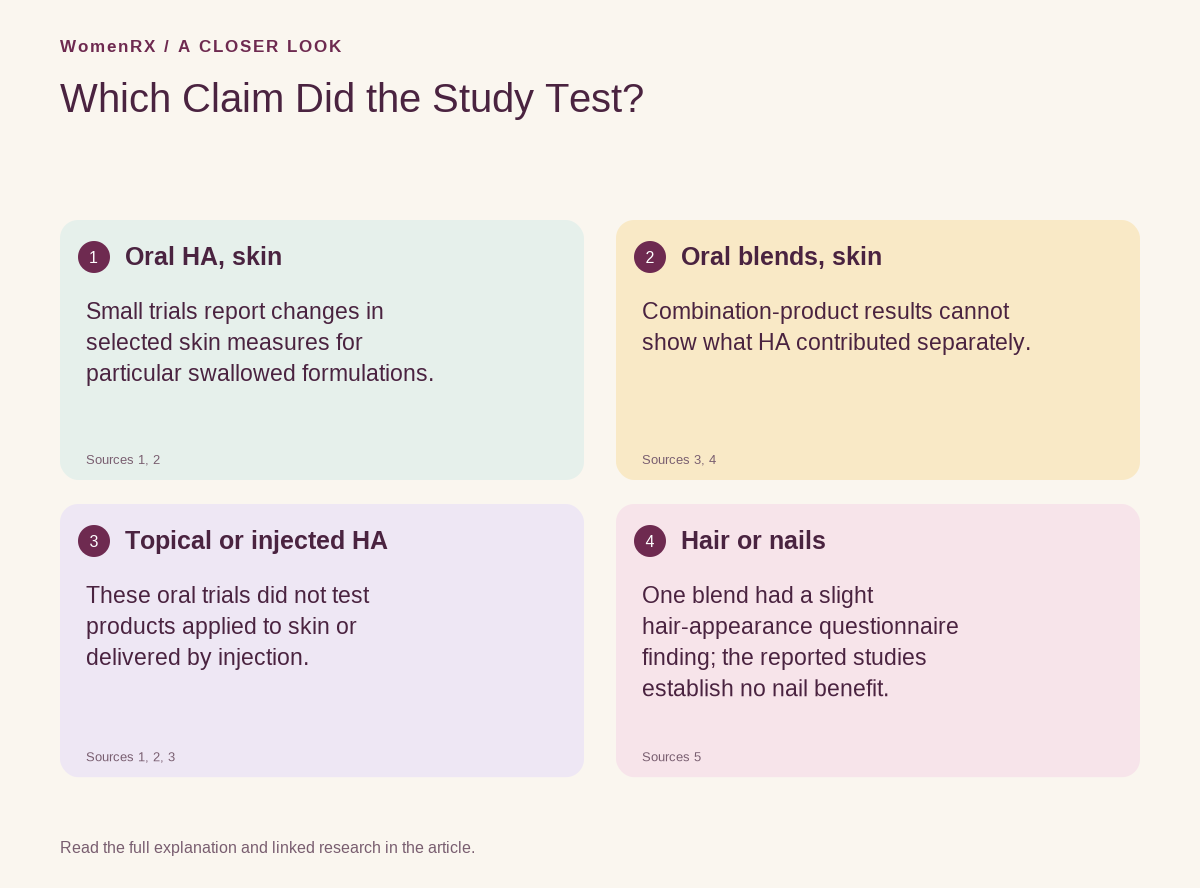
Oral HA, skin: Small trials report changes in selected skin measures for particular swallowed formulations.12
Oral blends, skin: Combination-product results cannot show what HA contributed separately.34
Topical or injected HA: These oral trials did not test products applied to skin or delivered by injection.123
Hair or nails: One blend had a slight hair-appearance questionnaire finding; the reported studies establish no nail benefit.5
Read the figure as text
Compare the product route and the outcome before applying a study result to a supplement claim.- Oral HA, skin: Small trials report changes in selected skin measures for particular swallowed formulations.12
- Oral blends, skin: Combination-product results cannot show what HA contributed separately.34
- Topical or injected HA: These oral trials did not test products applied to skin or delivered by injection.123
- Hair or nails: One blend had a slight hair-appearance questionnaire finding; the reported studies establish no nail benefit.5
Sources you can check
- Oral administration of hyaluronic acid to improve skin conditions via a randomized double-blind clinical test.Gao YR, Wang RP, Zhang L, Fan Y, Luan J, Liu Z, Yuan C. · Skin research and technology : official journal of International Society for Bioengineering and the Skin (ISBS) [and] International Society for Digital Imaging of Skin (ISDIS) [and] International Society for Skin Imaging (ISSI) · 2023Return to first citation
- Oral intake of a new full-spectrum hyaluronan improves skin profilometry and ageing: a randomized, double-blind, placebo-controlled clinical trial.Michelotti A, Cestone E, De Ponti I, Pisati M, Sparta E, Tursi F. · European journal of dermatology : EJD · 2021Return to first citation
- Oral Supplementation with a New Hyaluronic Acid Matrix Ingredient Improves Skin Brightness, Hydration, Smoothness, and Roughness: Results from a Randomized, Double-Blinded, Placebo-Controlled Study.Montero-Vilchez T, Gálvez-Martín P, Sanabria-de la Torre R, Cuenca-Barrales C, Molina-Leyva A, Martinez-Puig D, Velasco-Alvarez J, Arias-Santiago S. · Dermatology and therapy · 2025Return to first citation
- Efficacy of an Oral Skincare Supplement on Skin Aging: A 12-Week Randomized, Double-Blind, Placebo-Controlled Trial.Grier-Welch AM, Vance AY, Alamdari N, Sharafi M. · Dermatology and therapy · 2025Return to first citation
- Randomized, Placebo-controlled Study of a Nutraceutical Based on Hyaluronic Acid, L-carnosine, and Methylsulfonylmethane in Facial Skin Aesthetics and Well-being.Guaitolini E, Cavezzi A, Cocchi S, Colucci R, Urso SU, Quinzi V. · The Journal of clinical and aesthetic dermatology · 2019Return to first citation