Oral Hyaluronic Acid: What Skin and Joint Trials Show
Small trials have studied different oral formulas for skin measures and knee symptoms, so the product and outcome matter more than the ingredient name alone.
Oral hyaluronic acid has been studied in a few small trials, mostly for measured skin characteristics and, in one pilot study, knee osteoarthritis symptoms. Skin studies tested different formulas, including a full-spectrum hyaluronan preparation and a multi-ingredient matrix. The joint pilot did not find a difference in its primary pain outcome between supplement and placebo. These results don’t establish a predictable benefit or timeline for other products. 1 2 3
Start with the exact product and outcome
“Hyaluronic acid” on a label doesn’t tell you whether a study tested that product, that route, or the result you care about. The oral trials discussed here used different preparations: one used a full-spectrum hyaluronan product, another used a formula combining hyaluronic acid with other components, and a knee study tested a chicken-comb extract rich in hyaluronic acid. Their results can’t simply be pooled as if they tested one interchangeable supplement. 1 2 3
When comparing a product with research, look for three matches: the route (swallowed, applied to skin, or injected), the formulation (including added ingredients), and the outcome (such as skin hydration, wrinkle measures, or knee pain). A result for one doesn’t establish a result for the others.
Skin: promising measurements, different formulas
A randomized, double-blind, placebo-controlled trial enrolled 60 adult women with mild-to-moderate signs of skin aging. It tested a full-spectrum hyaluronan supplement for 28 days. The investigators reported improvements in the active group across the measured skin-aging parameters, including hydration, wrinkle depth and volume, elasticity, and firmness. The reported changes describe the active group; without corresponding between-group differences, they don’t quantify an advantage over placebo. 1
A separate randomized, double-blind, placebo-controlled study enrolled 60 healthy women aged 35-65 and tested a hyaluronic acid matrix containing hyaluronic acid, sulfated glycosaminoglycans, and collagen. Assessments were made at 6 and 12 weeks, and the reported per-protocol analysis included 50 participants. Compared with placebo, the matrix group had improvements in wrinkle and smoothness measures at 6 weeks and roughness at 12 weeks. Other reported changes, including hydration and brightness, were described relative to the group’s own baseline, so they shouldn’t be treated as placebo-adjusted effects. And because this was a blend, the results can’t show which ingredient contributed what. 3
These studies measured particular skin characteristics over a few weeks. They don’t establish how long a benefit lasts, whether someone will notice a visible difference, or whether another oral product will produce the same result. The women-only studies also don’t show that any effect is specific to women. The reported results don’t establish a benefit by menopause status.
Joints: a small pilot with a neutral primary result
For knee osteoarthritis, a double-blind pilot trial assigned 20 adults to an oral chicken-comb extract containing hyaluronic acid or placebo for 8 weeks. The primary outcome was WOMAC knee pain. Pain scores were similar between the groups, and the reported difference was not statistically significant. Some measures changed from baseline in both groups, but improvement over time within a group doesn’t establish that the supplement caused the change. The authors described the study as a pilot and called for larger trials. 2
That study is not evidence that every oral hyaluronic acid product helps, or cannot help, joint symptoms. It tested one particular extract in a very small group. Its results also shouldn’t be substituted for evidence about hyaluronic acid given by injection: swallowing a product and placing it into a joint are different interventions.
A practical way to read a claim
If a supplement’s label or advertisement points to a study, check whether it matches the product’s full formula, not just one ingredient. Then check what researchers actually measured and when. An instrument-measured change in skin hydration is not the same outcome as a visible wrinkle change or a person’s own assessment. For joints, a change from baseline is not the same as a demonstrated advantage over placebo.
The fairest summary is that oral hyaluronic acid has some early human research for skin measurements, while the joint evidence described here rests on a small pilot whose primary pain result did not distinguish supplement from placebo. Neither set of findings supports promising a particular result by a set date.
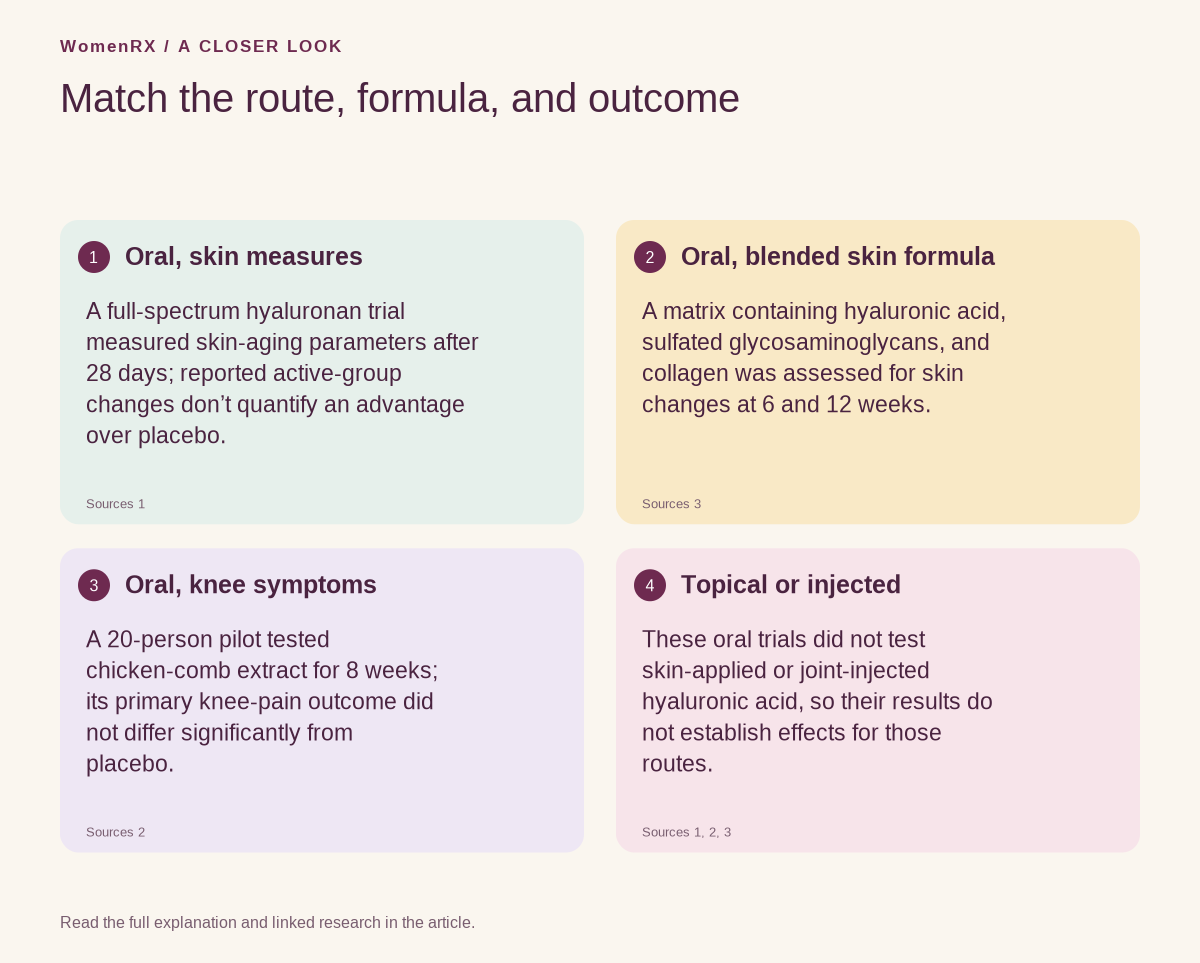
Match the route, formula, and outcome
Oral, skin measures: A full-spectrum hyaluronan trial measured skin-aging parameters after 28 days; reported active-group changes don’t quantify an advantage over placebo.1
Oral, blended skin formula: A matrix containing hyaluronic acid, sulfated glycosaminoglycans, and collagen was assessed for skin changes at 6 and 12 weeks.3
Oral, knee symptoms: A 20-person pilot tested chicken-comb extract for 8 weeks; its primary knee-pain outcome did not differ significantly from placebo.2
Topical or injected: These oral trials did not test skin-applied or joint-injected hyaluronic acid, so their results do not establish effects for those routes.123
Read the figure as text
The oral trials tested distinct formulas and measured different outcomes. Their findings should not be transferred to another route or product without matching evidence.- Oral, skin measures: A full-spectrum hyaluronan trial measured skin-aging parameters after 28 days; reported active-group changes don’t quantify an advantage over placebo.1
- Oral, blended skin formula: A matrix containing hyaluronic acid, sulfated glycosaminoglycans, and collagen was assessed for skin changes at 6 and 12 weeks.3
- Oral, knee symptoms: A 20-person pilot tested chicken-comb extract for 8 weeks; its primary knee-pain outcome did not differ significantly from placebo.2
- Topical or injected: These oral trials did not test skin-applied or joint-injected hyaluronic acid, so their results do not establish effects for those routes.123
Sources you can check
- Oral intake of a new full-spectrum hyaluronan improves skin profilometry and ageing: a randomized, double-blind, placebo-controlled clinical trial.Michelotti A, Cestone E, De Ponti I, Pisati M, Sparta E, Tursi F. · European journal of dermatology : EJD · 2021Return to first citation
- Effect of a natural extract of chicken combs with a high content of hyaluronic acid (Hyal-Joint) on pain relief and quality of life in subjects with knee osteoarthritis: a pilot randomized double-blind placebo-controlled trial.Kalman DS, Heimer M, Valdeon A, Schwartz H, Sheldon E. · Nutrition journal · 2008Return to first citation
- Oral Supplementation with a New Hyaluronic Acid Matrix Ingredient Improves Skin Brightness, Hydration, Smoothness, and Roughness: Results from a Randomized, Double-Blinded, Placebo-Controlled Study.Montero-Vilchez T, Gálvez-Martín P, Sanabria-de la Torre R, Cuenca-Barrales C, Molina-Leyva A, Martinez-Puig D, Velasco-Alvarez J, Arias-Santiago S. · Dermatology and therapy · 2025Return to first citation