Hyaluronic Acid: Morning or Night?
Studies of oral hyaluronic acid discussed here don’t establish a morning-or-night advantage, so start with your product’s directions.
The human studies discussed here don’t show whether taking oral hyaluronic acid in the morning works better than taking it at night. They examine outcomes such as skin or joint measures, not a comparison of clock times. If your product gives meal or water directions, follow those; if it leaves the time open, choose one that’s easy to remember. 123
What the research can and can’t tell you about timing
Studies of oral hyaluronic acid ask a different question from the one on your mind. A review of seven randomized trials examined skin outcomes, including hydration and elasticity. A separate study examined joint-related outcomes over a period of weeks. Neither establishes that a morning dose is better absorbed or produces better results than an evening dose. That’s a gap in these findings, not proof that the two times are identical. 23
The same distinction matters if you’re taking hyaluronic acid for a particular goal. A finding about skin hydration or knee symptoms doesn’t tell you what time of day to swallow a capsule. Nor should advice about an injection, filler, or skin-care product be treated as instructions for an oral supplement: those are different ways of using hyaluronic acid.
Read the directions before choosing a time
Start with the container in your hand. Does it say to take the product before or during a meal, or with water? Those are practical directions you can fit into breakfast, lunch, or dinner. They aren’t evidence that breakfast has a special benefit.
For example, a published pilot-study protocol specified taking its oral supplement before or during meals with plenty of water. That product contained both hyaluronic acid and Boswellia. The protocol followed that product’s instructions; it did not compare morning with evening use, and its directions should not be copied onto a different formula. 1
If your label names no time of day, picking a repeatable moment is a matter of convenience. Breakfast may fit one person’s routine; an evening meal may fit another’s. A claim that bedtime works better because you’re asleep, or that morning improves absorption, needs a direct comparison. The human studies discussed here don’t provide one. 123
Don’t mistake a study procedure for a daily instruction
Research reports can mention fasting or a time of day for reasons unrelated to when participants normally took a supplement. In one oral hyaluronic acid study, participants were told to avoid food and drinks other than water for six hours before a blood collection, and not to take the test food during that pre-test period. That was a testing instruction, not evidence that taking hyaluronic acid on an empty stomach improves its effects. 2
These reports also don’t establish a separate morning-or-night schedule for women. One pilot protocol explicitly included men and women but did not report a women-specific timing comparison. That leaves the same practical choice: follow your own product’s directions, then choose a workable time if the label leaves the clock time open. 1
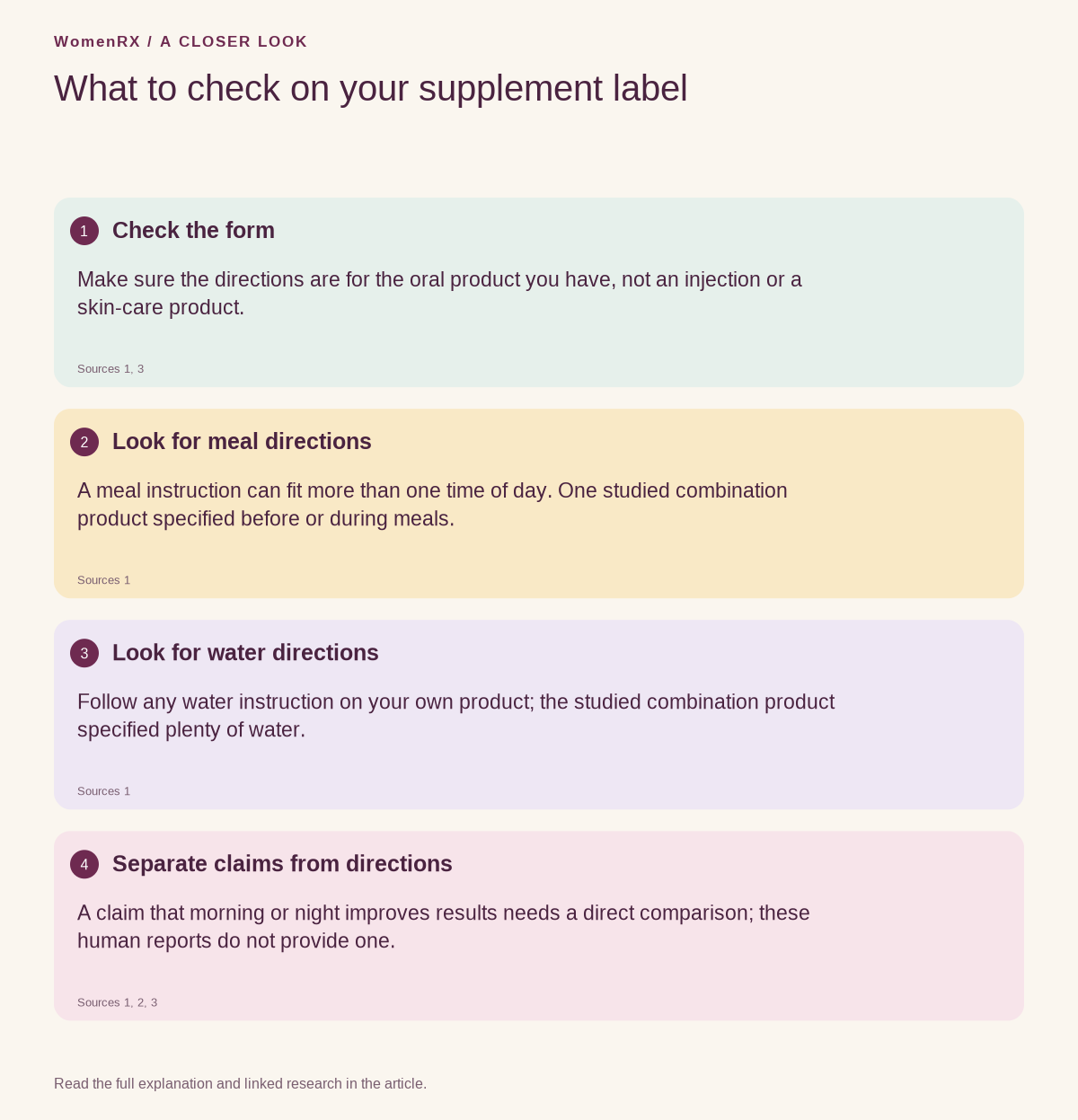
What to check on your supplement label
Check the form: Make sure the directions are for the oral product you have, not an injection or a skin-care product.13
Look for meal directions: A meal instruction can fit more than one time of day. One studied combination product specified before or during meals.1
Look for water directions: Follow any water instruction on your own product; the studied combination product specified plenty of water.1
Separate claims from directions: A claim that morning or night improves results needs a direct comparison; these human reports do not provide one.123
Read the figure as text
Use these distinctions to decide what the directions actually ask you to do; this is not a test of which dosing time works best.- Check the form: Make sure the directions are for the oral product you have, not an injection or a skin-care product.13
- Look for meal directions: A meal instruction can fit more than one time of day. One studied combination product specified before or during meals.1
- Look for water directions: Follow any water instruction on your own product; the studied combination product specified plenty of water.1
- Separate claims from directions: A claim that morning or night improves results needs a direct comparison; these human reports do not provide one.123
More questions, answered
Does “with food” mean I have to take it at breakfast?
No. A food instruction and a morning instruction are different things. If your product says to take it with a meal but doesn’t name a time of day, choose a meal that fits your routine. A published protocol used meal-related directions for its particular combination product without testing whether breakfast beat dinner. 1
Sources you can check
- Assessment of the Feasibility of Objective Parameters as Primary End Points for Patients Affected by Knee Osteoarthritis: Protocol for a Pilot, Open Noncontrolled Trial (:SMILE:).Dogaru DE, Rosu S, Barattini DF, Guadagna S, Barattini L, Andor B. · JMIR research protocols · 2024Return to first citation
- Role of oral hyaluronic acid for joint health: insights from rat models and clinical trials.Wang B, Wang F, Zhang T, Bai J, Cui S, Shi H. · Frontiers in nutrition · 2025Return to first citation
- Oral Hyaluronic Acid Supplement: Efficacy in Skin Hydration, Elasticity, and Wrinkle Depth Reduction.Amin P, Sarabi A, Choe S, Scott S, Suh S, Mesinkovska NA. · Journal of drugs in dermatology : JDD · 2025Return to first citation