Does Food Timing Matter for Oral Hyaluronic Acid?
The oral hyaluronic acid trials cited here don’t establish an absorption advantage from taking a supplement on an empty stomach, so start with your product’s directions.
The oral hyaluronic acid trials cited here don’t establish whether taking a supplement with food or fasting changes absorption or results. Check the directions for the product you have. If they don’t specify meal timing, these trials give no reason to favor an empty stomach; choosing a time you can remember is a practical choice, not a proven absorption benefit. 13
What these trials don’t answer
If your bottle doesn’t say whether to take hyaluronic acid with food, an empty stomach might seem like the more effective choice. But that would be a guess. To find out whether a meal changes absorption, researchers would need to compare the same oral product taken with and without food and measure what happens. To find out whether timing changes a benefit you might notice, they’d need to compare outcomes too.
The human trials cited here did neither. An eight-week randomized trial gave people with mild knee osteoarthritis a daily liquid containing hyaluronic acid, glucosamine, and chondroitin or a placebo. It measured knee symptoms, not fed-versus-fasting use or absorption. Because the ingredients were combined, its findings also can’t isolate what hyaluronic acid contributed. 1
A separate 16-week randomized trial enrolled women aged 40 to 65. It compared a syrup containing collagen and vitamin C, the same combination with added hyaluronic acid, and a placebo. Adding hyaluronic acid did not show a superior effect on the skin measures studied. The trial did not compare meal timing, so that finding tells us nothing about whether breakfast, another meal, or an empty stomach changes how the syrup works. 3
That distinction matters: a trial can test whether a product affects a symptom without testing how much hyaluronic acid is absorbed or whether food changes its effects. Neither trial shows that food blocks absorption. Neither shows that fasting improves it. 13
Let the directions settle the practical question
Look at the instructions for the oral product you actually have. If they specify taking it with food or without food, use those directions rather than transferring a rule from another supplement. The trials used particular liquid and syrup combinations; they don’t establish one meal-timing rule for every oral hyaluronic acid product. 13
If your directions say nothing about meals, these trials offer no reason to favor taking it before breakfast over taking it alongside a meal. A time you can remember is a practical choice, not a proven way to boost absorption. This answer applies to supplements you swallow, not hyaluronic acid used on skin or given by injection.
Does the answer change across women’s life stages?
The skin trial included women aged 40 to 65, but did not report a food-timing comparison or results by menopausal stage. A retrospective study in pregnant women looked at a supplement combining hyaluronic acid with several other ingredients; it also did not compare use with food against fasting. Neither study establishes a different meal-timing rule for pregnancy, perimenopause, or postmenopause. 23
The useful takeaway is narrow: check the bottle, and don’t add an empty-stomach rule in hopes of a proven benefit. Whether food makes a meaningful difference for a particular oral hyaluronic acid formulation remains unanswered by these trials. 13
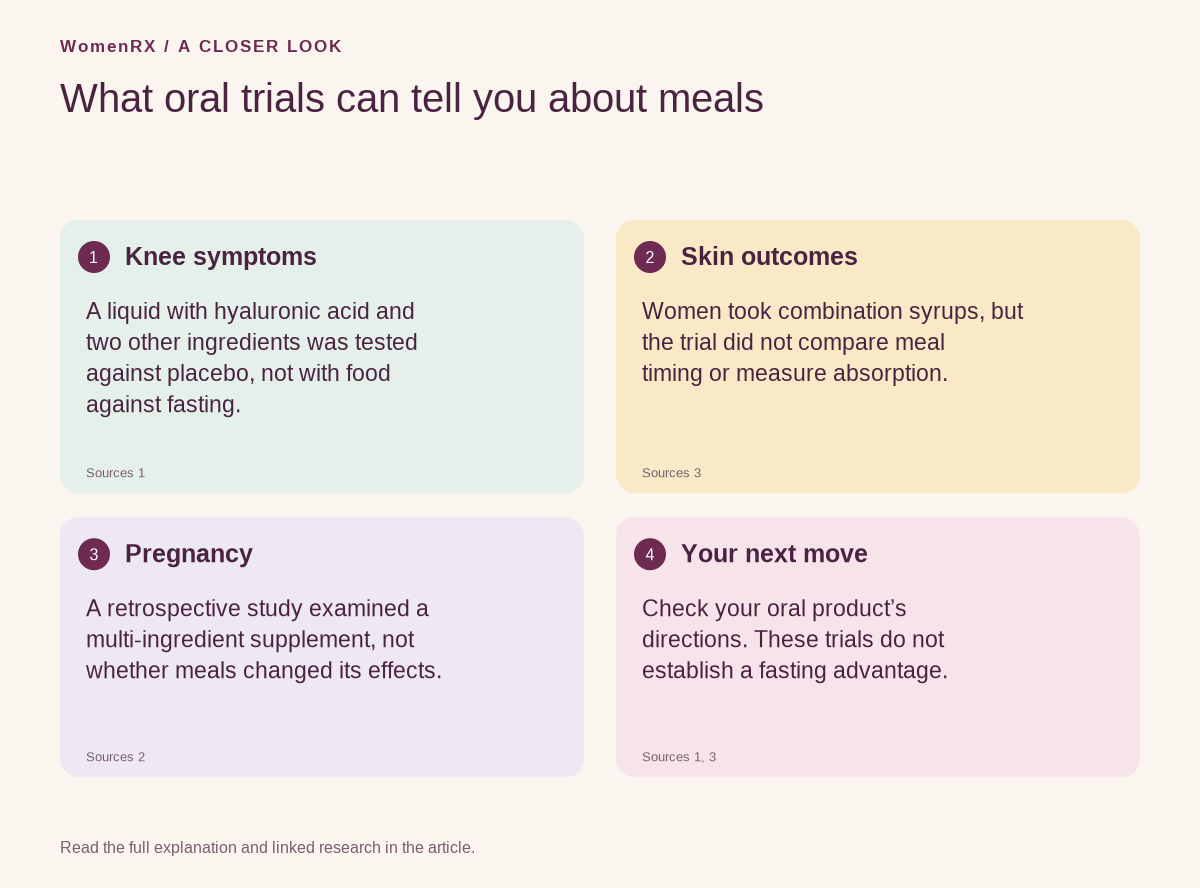
What oral trials can tell you about meals
Knee symptoms: A liquid with hyaluronic acid and two other ingredients was tested against placebo, not with food against fasting.1
Skin outcomes: Women took combination syrups, but the trial did not compare meal timing or measure absorption.3
Pregnancy: A retrospective study examined a multi-ingredient supplement, not whether meals changed its effects.2
Your next move: Check your oral product’s directions. These trials do not establish a fasting advantage.13
Read the figure as text
Different research questions need different comparisons; a supplement-outcome trial cannot answer a food-timing question on its own.- Knee symptoms: A liquid with hyaluronic acid and two other ingredients was tested against placebo, not with food against fasting.1
- Skin outcomes: Women took combination syrups, but the trial did not compare meal timing or measure absorption.3
- Pregnancy: A retrospective study examined a multi-ingredient supplement, not whether meals changed its effects.2
- Your next move: Check your oral product’s directions. These trials do not establish a fasting advantage.13
Sources you can check
- The effect of oral low molecular weight liquid hyaluronic acid combination with glucosamine and chondroitin on knee osteoarthritis patients with mild knee pain: An 8-week randomized double-blind placebo-controlled trial.Wang SJ, Wang YH, Huang LC. · Medicine · 2021Return to first citation
- Effect of Oral High Molecular Weight Hyaluronic Acid (HMWHA), Alpha Lipoic Acid (ALA), Magnesium, Vitamin B6 and Vitamin D Supplementation in Pregnant Women: A Retrospective Observational Pilot Study.Parente E, Colannino G, Bilotta G, Espinola MSB, Proietti S, Oliva MM, Neri I, Aragona C, Unfer V. · Clinics and practice · 2023Return to first citation
- The Effects of Dietary Supplementation with Collagen and Vitamin C and Their Combination with Hyaluronic Acid on Skin Density, Texture and Other Parameters: A Randomised, Double-Blind, Placebo-Controlled Trial.Žmitek K, Žmitek J, Hristov H, Rogl Butina M, Keršmanc P, Pogačnik T. · Nutrients · 2024Return to first citation