How Much Is Known About Long-Term Saffron Safety?
Short studies offer some reassurance, but they don’t settle whether a concentrated saffron supplement is suitable for years of use.
Most human safety findings come from short studies. A six-week mood trial reported minimal adverse effects, while some studies lasting about a year involved people with age-related macular degeneration. Neither tells you whether your particular product is suitable for years of use. Pregnancy needs a separate safety check, and food use doesn’t establish supplement safety. 2 3 5 6
What study length can tell you
If you’re deciding whether to keep taking saffron, start with four details: what’s in your product, how much you take, why you take it, and how long you’ve used it. A short trial can tell you what researchers observed during that trial. It can’t settle what happens with years of use.
In one randomized trial, 180 participants with mild-to-moderate depressive symptoms were assigned to saffron extract, scutellaria extract, a combination, or placebo for six weeks. Researchers reported minimal adverse effects across the groups during that period. A review of depression research likewise describes many saffron studies as lasting about six weeks and says long-term outcomes remain unclear. 2 4
There is some longer follow-up, but it answers a narrower question. A review of saffron research for age-related macular degeneration describes studies lasting roughly 11 to 14 months, including an open-label extension. Those studies involved people with an eye condition and particular study preparations. They don’t establish safety for every product, purpose, or population over many years. 6
The label matters as much as the name
Saffron used as a spice isn’t evidence that a concentrated supplement is safe for sustained use. Research products also vary: studies have used preparations from different parts of the plant, including stigma and petal, and products differ in how they’re standardized. A result for one preparation may not carry over to the bottle in your hand. 4 5
Before deciding to continue, check the serving amount, the type of saffron preparation if named, and the full ingredient list. If it’s a blend, a saffron study can’t tell you the effects of the other ingredients. Keep a photo of the label so you can review the actual product rather than relying on the word “saffron.”
Questions that change the decision
- Does the research match your reason for taking it? A six-week mood trial and a year-long eye-condition study address different uses. Neither establishes indefinite use for another purpose. 2 6
- What medicines and other supplements do you take? Bring the full list and the product label to a pharmacist or clinician for a review of your combination. Reviews raise possible interaction concerns with higher supplement doses, but don’t establish one interaction that applies to every medicine. Don’t assume either that your combination has been tested or that an interaction is proven for a particular drug. 5
- Are you pregnant, planning pregnancy, or breastfeeding? Pregnancy evidence for saffron is limited and inconclusive. A review raises concern about uterine effects with higher exposure, and MedlinePlus advises checking before taking herbs or supplements during pregnancy. 1 3 The pregnancy findings don’t answer whether saffron supplements are safe while breastfeeding.
The useful distinction is between tolerated during a study and shown safe for your ongoing use. If you take saffron for mood, the mainly short-term depression findings don’t establish it as a long-term substitute for an existing treatment. 4 Review the product, your reason for taking it, and your medication list together before treating continued use as a settled decision.
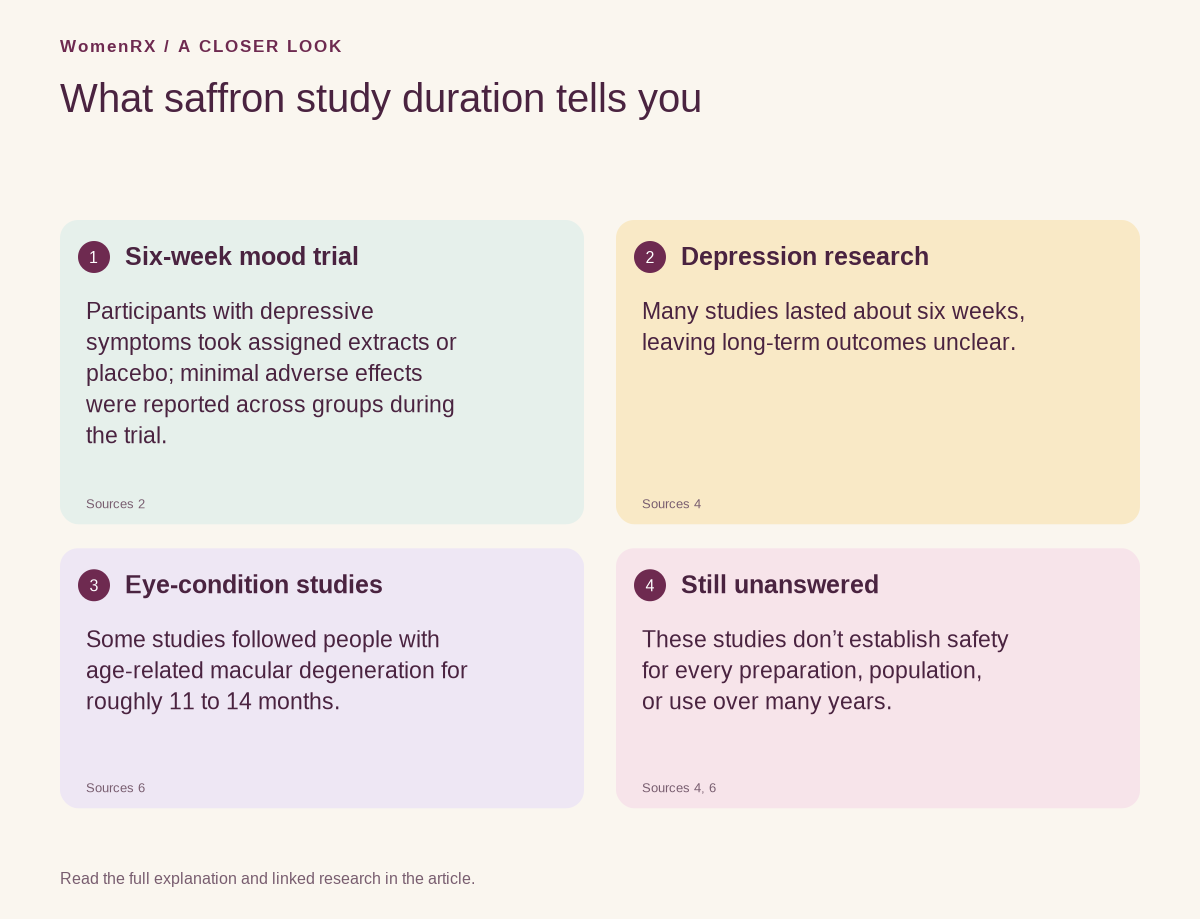
What saffron study duration tells you
Six-week mood trial: Participants with depressive symptoms took assigned extracts or placebo; minimal adverse effects were reported across groups during the trial.2
Depression research: Many studies lasted about six weeks, leaving long-term outcomes unclear.4
Eye-condition studies: Some studies followed people with age-related macular degeneration for roughly 11 to 14 months.6
Still unanswered: These studies don’t establish safety for every preparation, population, or use over many years.46
Read the figure as text
Follow-up time matters, but so do the product and the people studied. These examples show why longer follow-up in one setting doesn’t settle every safety question.- Six-week mood trial: Participants with depressive symptoms took assigned extracts or placebo; minimal adverse effects were reported across groups during the trial.2
- Depression research: Many studies lasted about six weeks, leaving long-term outcomes unclear.4
- Eye-condition studies: Some studies followed people with age-related macular degeneration for roughly 11 to 14 months.6
- Still unanswered: These studies don’t establish safety for every preparation, population, or use over many years.46
Sources you can check
- Pregnancy and Medicines | MedlinePlusAccessed 2026-09-25Return to first citation
- The Effects of Combined Scutellaria and Saffron Supplementation on Mood Regulation in Participants with Mild-to-Moderate Depressive Symptoms: A Randomized, Double-Blind, Placebo-Controlled Study.Dormal V, Suchareau M, Copine S, Simar L, Deldicque L. · Nutrients · 2025Return to first citation
- Saffron and Pregnancy: Cultural Practices, Beliefs, and Safety Evidence: An Integrative Review.Alshdefat A, Ayed A, Aqtam I, Ibitoye O, Vincent S, Furqani AA. · Journal of evidence-based integrative medicine · 2026Return to first citation
- The Role of Saffron in the Treatment of Depression: A Literature Review.Dimech L. · Cureus · 2026Return to first citation
- Exploring the Potential of Saffron as a Therapeutic Agent in Depression Treatment: A Comparative Review.Chauhan S, Tiwari A, Verma A, Padhan PK, Verma S, Gupta PC. · The Yale journal of biology and medicine · 2024Return to first citation
- Crocus sativus (saffron) and age-related macular degeneration.Shamabadi A, Asadigandomani H, Kazemzadeh K, Farahmand K, Arabzadeh Bahri R, Akhondzadeh S. · Medical hypothesis, discovery & innovation ophthalmology journal · 2024Return to first citation