Saffron for Mood or Sleep: What the Evidence Shows
Saffron has a more promising, though still limited, signal for mood symptoms than for sleep, and the trial results apply to specific extracts rather than saffron used in cooking.
Some human trials suggest specific saffron extracts may improve mood symptoms, including a 12-week trial in adults with subclinical depressive symptoms. Sleep findings are less consistent: pooled reviews suggest possible benefit, but the larger trial found no overall difference in sleep outcomes. The studied extracts and amounts aren’t interchangeable with culinary saffron or every supplement, and the research doesn’t establish pregnancy safety. 235
Mood has the clearer, but limited, signal
The most encouraging evidence is about changes in measured mood symptoms, not proof that saffron treats depression. In a 2025 randomized, placebo-controlled trial, 202 adults with subclinical depressive symptoms took a specific saffron extract or placebo for 12 weeks. The extract group had a greater improvement on the study’s main depression measure. A reduction of at least seven points on that measure occurred in 72.3% of the saffron group and 54.3% of the placebo group. The sizable improvement in the placebo group is worth keeping in mind when weighing the result. 5
An earlier four-week trial studied 128 adults who reported low mood but did not have a depression diagnosis. It compared a standardized saffron stigma extract at 22 mg and 28 mg per day with placebo. The reported difference on the main mood measure was seen with 28 mg per day, not 22 mg per day. These are regimens tested in that particular study, not recommended amounts or evidence that another product will have the same effect. 4
Pooled findings offer a broader, but not entirely consistent, picture. A 2020 meta-analysis of 21 trials found lower scores on the Beck Depression Inventory, but not on the Hamilton Depression Rating Scale. That difference between measures makes the overall signal less settled than a simple claim that saffron improves depression would suggest. 3
These findings concern symptom scores in study participants. They don’t establish saffron as a treatment for diagnosed depression or as a replacement for care. Depression can affect daily life and may need treatment; a supplement trial doesn’t settle which treatment is right for you. 145
Sleep results are harder to interpret
Reviews have reported possible improvements in sleep measures. In the 2020 meta-analysis, three studies contributed sleep-quality results that favored saffron. A 2024 systematic review and meta-analysis also reported a pooled benefit for sleep disorders. But its 46 trials covered varied populations and conditions, with trial durations ranging from four to 48 weeks. Those broad results don’t show that saffron reliably helps a particular problem, such as ongoing difficulty falling asleep. 23
The larger 2025 trial provides an important counterpoint: it found no overall between-group difference on its secondary outcomes, including sleep measures. An exploratory analysis suggested improvement among participants who had more severe sleep disturbance at the start. Because that finding came from a subgroup analysis, it doesn’t establish an overall sleep benefit. 5
So, if sleep is your main reason for considering saffron, the evidence is less convincing than it is for mood symptoms. Neither the pooled results nor the individual trial establish saffron as a treatment for a sleep disorder. 235
A studied extract isn’t the same as a spice or another capsule
The two individual trials described above tested specific extracts. The 2017 study used a standardized saffron stigma extract, while the 2025 study tested Affron at 28 mg per day for 12 weeks. These are study details, not dosing advice. A different product, amount, or extract can’t be assumed to produce the same result just because its label says “saffron.” 45
The pooled studies don’t establish that ordinary culinary saffron has the same effects. Their abstracts describe saffron or saffron extracts but don’t provide enough consistent preparation detail to treat cooking amounts as equivalent to studied supplements. If you’re comparing products, the useful question is whether the product and preparation match the extract tested, not simply whether both contain saffron. Even a close match wouldn’t guarantee the same result for you. 2345
What the research says about women and safety
The trial summaries don’t report the participants’ sex in enough detail to establish how many women were included, or whether results differed by sex. They also don’t report findings by menstrual or reproductive stage. That leaves questions about cycling years, perimenopause, and postmenopause unanswered by these results. 45
The studies don’t establish whether saffron supplements are safe during pregnancy. They also don’t verify particular medication interactions or show that every product is safe for every person. Don’t treat the mood findings as a medication-interaction check or as a reason to replace prescribed mental-health treatment. 145
The practical takeaway: the mood evidence is promising but limited, while the sleep evidence is mixed. The amounts tested in individual trials help identify what those researchers studied; they aren’t general supplement recommendations, and they don’t make culinary saffron or other products equivalent.
Saffron findings by outcome and preparation
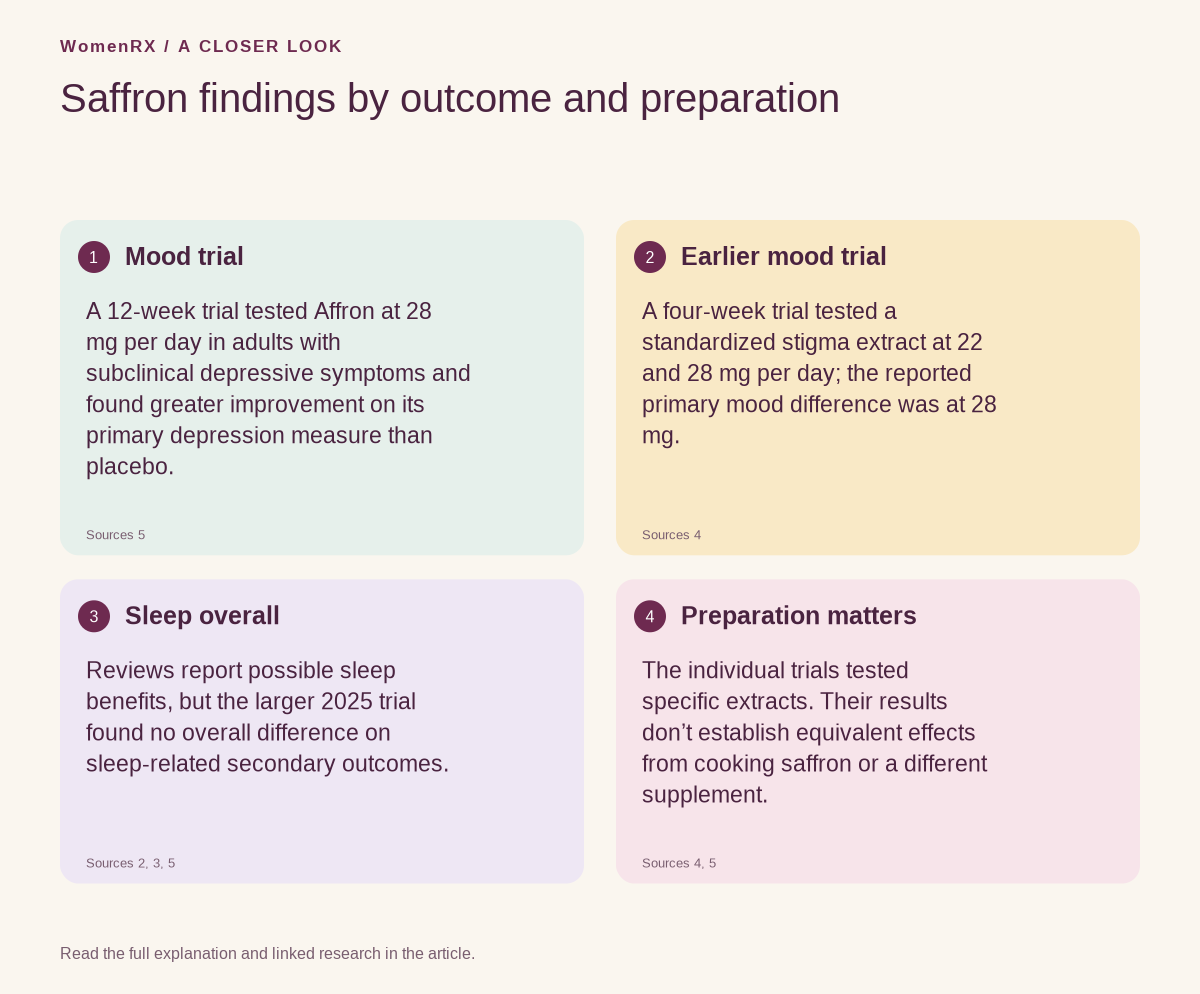
Mood trial: A 12-week trial tested Affron at 28 mg per day in adults with subclinical depressive symptoms and found greater improvement on its primary depression measure than placebo.5
Earlier mood trial: A four-week trial tested a standardized stigma extract at 22 and 28 mg per day; the reported primary mood difference was at 28 mg.4
Sleep overall: Reviews report possible sleep benefits, but the larger 2025 trial found no overall difference on sleep-related secondary outcomes.235
Preparation matters: The individual trials tested specific extracts. Their results don’t establish equivalent effects from cooking saffron or a different supplement.45
Read the figure as text
The mood and sleep results differ, and the product tested matters when interpreting either one.- Mood trial: A 12-week trial tested Affron at 28 mg per day in adults with subclinical depressive symptoms and found greater improvement on its primary depression measure than placebo.5
- Earlier mood trial: A four-week trial tested a standardized stigma extract at 22 and 28 mg per day; the reported primary mood difference was at 28 mg.4
- Sleep overall: Reviews report possible sleep benefits, but the larger 2025 trial found no overall difference on sleep-related secondary outcomes.235
- Preparation matters: The individual trials tested specific extracts. Their results don’t establish equivalent effects from cooking saffron or a different supplement.45
More questions, answered
Does the research establish a dose of saffron for mood or sleep?
No. Individual studies tested specific products and regimens, including 22 mg and 28 mg per day in a four-week mood trial and 28 mg per day for 12 weeks in a later trial. Those are study details, not a general dose recommendation or proof that another product is equivalent. 45
Do these studies show saffron is safe during pregnancy?
No pregnancy-specific safety findings are reported in these trial summaries, so they can’t establish that saffron supplements are safe during pregnancy. 45
Sources you can check
- Depression: MedlinePlusAccessed 2026-09-25Return to first citation
- New horizons for the study of saffron (Crocus sativus L.) and its active ingredients in the management of neurological and psychiatric disorders: A systematic review of clinical evidence and mechanisms.Han S, Cao Y, Wu X, Xu J, Nie Z, Qiu Y. · Phytotherapy research : PTR · 2024Return to first citation
- The effects of saffron (Crocus sativus L.) on mental health parameters and C-reactive protein: A meta-analysis of randomized clinical trials.Ghaderi A, Asbaghi O, Reiner Ž, Kolahdooz F, Amirani E, Mirzaei H, Banafshe HR, Maleki Dana P, Asemi Z. · Complementary therapies in medicine · 2020Return to first citation
- affron® a novel saffron extract (Crocus sativus L.) improves mood in healthy adults over 4 weeks in a double-blind, parallel, randomized, placebo-controlled clinical trial.Kell G, Rao A, Beccaria G, Clayton P, Inarejos-García AM, Prodanov M. · Complementary therapies in medicine · 2017Return to first citation
- An Examination into the Effects of a Saffron Extract (Affron) on Mood and General Wellbeing in Adults Experiencing Low Mood: A Randomized, Double-Blind, Placebo-Controlled Trial.Lopresti AL, Smith SJ, Marx W, Díez-Municio M, Morán-Valero MI. · The Journal of nutrition · 2025Return to first citation