What Saffron Supplement Research Really Shows
Some saffron extracts have improved low-mood scores in trials, but results vary by study, outcome, and the people studied.
Saffron supplements show some promise for low mood: several placebo-controlled trials found improvements with particular saffron extracts, while another small trial missed its main mood measure. Sleep results are less consistent, and low-mood findings don’t establish a benefit for premenstrual symptoms. These supplement trials don’t show that culinary saffron works the same way or establish safety in pregnancy or with medicines. 1245
If you’re considering saffron for low mood, the most useful takeaway is that a few trials of specific extracts found benefits, but this isn’t proof that every saffron product works, or that it treats depression. What was tested matters: the studies used measured supplement preparations, not saffron sprinkled into food.
Low mood: encouraging results, not a settled answer
In a 12-week placebo-controlled trial, 202 adults with depressive symptoms received 28 mg daily of an Affron saffron extract or placebo. The saffron group had a greater average improvement on the trial’s depression measure. A clinically significant improvement was reported for 72.3% of the saffron group and 54.3% of the placebo group. That difference is worth noticing, alongside the substantial improvement in the placebo group. The study did not find between-group differences on its other secondary outcomes. 2
Other trials don’t line up perfectly. In a four-week trial of 128 adults with self-reported low mood but no diagnosed depression, the 28 mg standardized Affron extract group improved on the main mood measure compared with placebo; the lower-dose group did not. The study relied on self-reported symptoms and outcomes. 1 In a smaller, eight-week trial of 56 healthy adults, saffron did not improve the primary mood measure, though the researchers found a difference on a depression subscale. 4
Taken together, these results suggest a possible benefit for some people with low mood using particular extracts. They don’t establish saffron as a treatment for diagnosed depression or show that all preparations have the same effect. The trials also differ in participants, duration, extract, and the measures used.
Sleep and other outcomes need their own evidence
A mood result isn’t automatically a sleep result. In the 2025 trial, researchers found no overall between-group difference on secondary sleep outcomes. An exploratory analysis suggested improvement in sleep disturbance among a subset with more severe sleep disturbance, but that narrower finding needs confirmation. 2
A separate trial specifically enrolled 86 women aged 50 to 70 who reported both low mood and poor sleep. After 12 weeks, the saffron-extract group improved more than the placebo group on depression scores and sleep-related impairment. But there was no group difference in sleep disturbance itself. The researchers described the sleep-related findings as exploratory. This study speaks to the women it enrolled, not automatically to younger women or to sleep problems in general. 5
Results can also depend on health context. In a trial of 70 overweight or obese patients with type 2 diabetes, eight weeks of saffron supplementation at 100 mg daily produced better reported sleep scores than placebo; depression scores improved in the saffron group. That finding applies to a specific group and a different tested amount from the extract trials above. It can’t establish the same effect in people without diabetes. 3
Premenstrual symptoms are a separate question. Trials testing low mood, stress, or sleep don’t establish that saffron relieves premenstrual symptoms. Don’t treat a finding about low mood as proof of a PMS benefit.
Supplement extracts aren’t the same as food use
The mood trials tested particular extracts at measured amounts over several weeks. The four-week trial describes its Affron preparation as standardized; the report of the 2025 trial identifies Affron as a saffron extract but does not say that it was standardized. Neither trial compared its supplement with saffron used in food. So the results can’t tell you whether ordinary food use has the same effects, or whether concentrated supplements carry the same risks as culinary use. A product’s name, extract, and amount matter when comparing it with a study. 12
What to ask before adding it
The studies above are too limited to establish whether saffron supplements are safe during pregnancy or whether they interact with specific medicines. Some report no serious adverse events, but that does not answer those questions. 25 If you’re pregnant, trying to become pregnant, or take medicines, one question you could raise with a pharmacist or clinician, with the product label in hand, is: “What do we know about this exact supplement in my circumstances?”
A practical bottom line: the clearest signal in this evidence is for specific saffron extracts and low-mood measures, not a general promise for mood, sleep, PMS, or everyday saffron use. If you’re weighing a product, check whether its preparation matches one studied and whether the outcome you care about was actually tested.
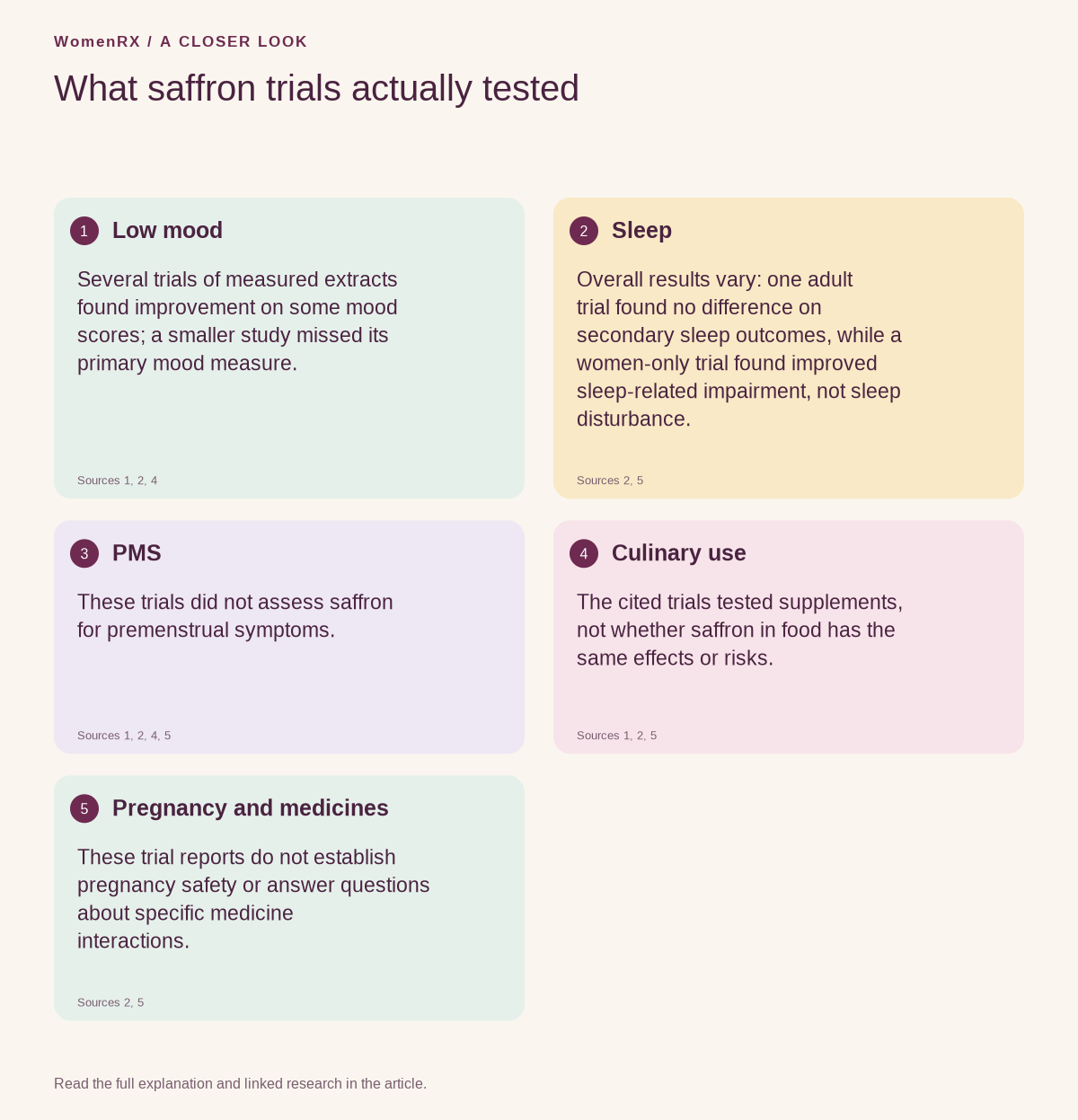
What saffron trials actually tested
Low mood: Several trials of measured extracts found improvement on some mood scores; a smaller study missed its primary mood measure.124
Sleep: Overall results vary: one adult trial found no difference on secondary sleep outcomes, while a women-only trial found improved sleep-related impairment, not sleep disturbance.25
PMS: These trials did not assess saffron for premenstrual symptoms.1245
Culinary use: The cited trials tested supplements, not whether saffron in food has the same effects or risks.125
Pregnancy and medicines: These trial reports do not establish pregnancy safety or answer questions about specific medicine interactions.25
Read the figure as text
The evidence differs by preparation, population, and outcome. A mood finding does not automatically apply to sleep, PMS, or culinary saffron.- Low mood: Several trials of measured extracts found improvement on some mood scores; a smaller study missed its primary mood measure.124
- Sleep: Overall results vary: one adult trial found no difference on secondary sleep outcomes, while a women-only trial found improved sleep-related impairment, not sleep disturbance.25
- PMS: These trials did not assess saffron for premenstrual symptoms.1245
- Culinary use: The cited trials tested supplements, not whether saffron in food has the same effects or risks.125
- Pregnancy and medicines: These trial reports do not establish pregnancy safety or answer questions about specific medicine interactions.25
More questions, answered
Does saffron in food have the same evidence as a supplement?
No direct comparison is described in these trials. They studied measured saffron extracts, so their results don’t establish that culinary saffron has the same effects or risks.
Does the research show saffron helps PMS?
The trials testing low mood, stress, or sleep did not assess premenstrual symptoms. Findings about those outcomes should not be taken as proof of a PMS benefit.
Sources you can check
- affron® a novel saffron extract (Crocus sativus L.) improves mood in healthy adults over 4 weeks in a double-blind, parallel, randomized, placebo-controlled clinical trial.Kell G, Rao A, Beccaria G, Clayton P, Inarejos-García AM, Prodanov M. · Complementary therapies in medicine · 2017Return to first citation
- An Examination into the Effects of a Saffron Extract (Affron) on Mood and General Wellbeing in Adults Experiencing Low Mood: A Randomized, Double-Blind, Placebo-Controlled Trial.Lopresti AL, Smith SJ, Marx W, Díez-Municio M, Morán-Valero MI. · The Journal of nutrition · 2025Return to first citation
- Saffron improves life and sleep quality, glycaemic status, lipid profile and liver function in diabetic patients: A double-blind, placebo-controlled, randomised clinical trial.Tajaddini A, Roshanravan N, Mobasseri M, Aeinehchi A, Sefid-Mooye Azar P, Hadi A, Ostadrahimi A. · International journal of clinical practice · 2021Return to first citation
- Effects of Saffron Extract Supplementation on Mood, Well-Being, and Response to a Psychosocial Stressor in Healthy Adults: A Randomized, Double-Blind, Parallel Group, Clinical Trial.Jackson PA, Forster J, Khan J, Pouchieu C, Dubreuil S, Gaudout D, Moras B, Pourtau L, Joffre F, Vaysse C, Bertrand K, Abrous H, Vauzour D, Brossaud J, Corcuff JB, Capuron L, Kenned... · Frontiers in nutrition · 2020Return to first citation
- The effects of a saffron extract (Affron®) on mood, sleep, self-esteem, and exploratory measures of physical appearance in women aged 50 to 70 years experiencing low mood and poor sleep: a randomised, double-blind, placebo-controlled trial.Lopresti AL, Smith SJ. · Frontiers in nutrition · 2026Return to first citation