Does a Saffron Supplement Need Food?
It’s unclear whether taking saffron supplements with food changes their effects, but stomach symptoms are worth paying attention to.
The reported findings from a depression trial and a safety review do not establish an empty-stomach advantage for saffron supplements. They also do not show whether taking saffron with food changes its effects or digestive symptoms.24 Follow your product’s directions. If it upsets your stomach, note when symptoms happen rather than assuming meal timing is the cause.
What the studies can tell you about timing
If you’re deciding between taking saffron with breakfast or before eating, the distinction is simpler than it may sound: a study showing that saffron has an effect does not show that an empty stomach makes it work better.
For example, a 12-week randomized trial enrolled 73 women with overweight and mild-to-moderate depression. Depression scores improved more in the saffron group than in the placebo group among those who completed the study. The reported results show a saffron-versus-placebo difference, but do not establish whether food changes that result.4 It also wasn’t a study of menopause symptoms.
You may see claims about saffron compounds being absorbed by the body. Absorption is a different question from whether a particular supplement works better before or after a meal. A review discusses the bioavailability of saffron constituents, but does not establish whether taking a supplement with food changes their absorption in people.5 Likewise, directions printed on a bottle tell you how that product’s maker intends it to be used. They aren’t, by themselves, evidence that one timing produces better mood or symptom outcomes.
If saffron bothers your stomach
Digestive symptoms are plausible with saffron supplements. A systematic review of human studies of saffron-only preparations found that gastrointestinal problems were the most frequently reported side effects; they were minor and self-limiting in most reported cases. Whether taking saffron with a meal prevents these symptoms remains unclear.2
Check the directions and ingredient list on your particular product first. If you notice nausea, consider whether it began after starting the supplement, whether it recurs when you take it, and whether anything else changed around the same time. Taking it with food may be a reasonable comfort experiment if the product directions allow it.
Nausea has many possible causes, including pregnancy. If you’re vomiting and have signs of dehydration, such as a dry mouth, infrequent urination, or dark urine, seek prompt medical advice rather than trying to solve it by changing supplement timing.1
Mood goals, menopause symptoms, and pregnancy are different questions
If you’re considering saffron for mood, the women’s depression trial offers a more relevant starting point than a claim about when to swallow a capsule. Its participants had mild-to-moderate depression and overweight; the result doesn’t establish what will happen for every woman or whether meal timing matters.4 A broader review of meta-analyses reported improvements in depression symptoms across studies, while also calling for stronger trials.3
If your goal is relief from menopause symptoms, don’t substitute that depression finding for evidence about hot flashes, sleep disruption, or other menopause concerns. For pregnancy, the safety review covers varied study populations but does not establish that medicinal saffron supplements are safe during pregnancy.2
For everyday use, follow your product’s directions and pay attention to how you feel. Taking saffron with food isn’t a proven way to prevent nausea.2
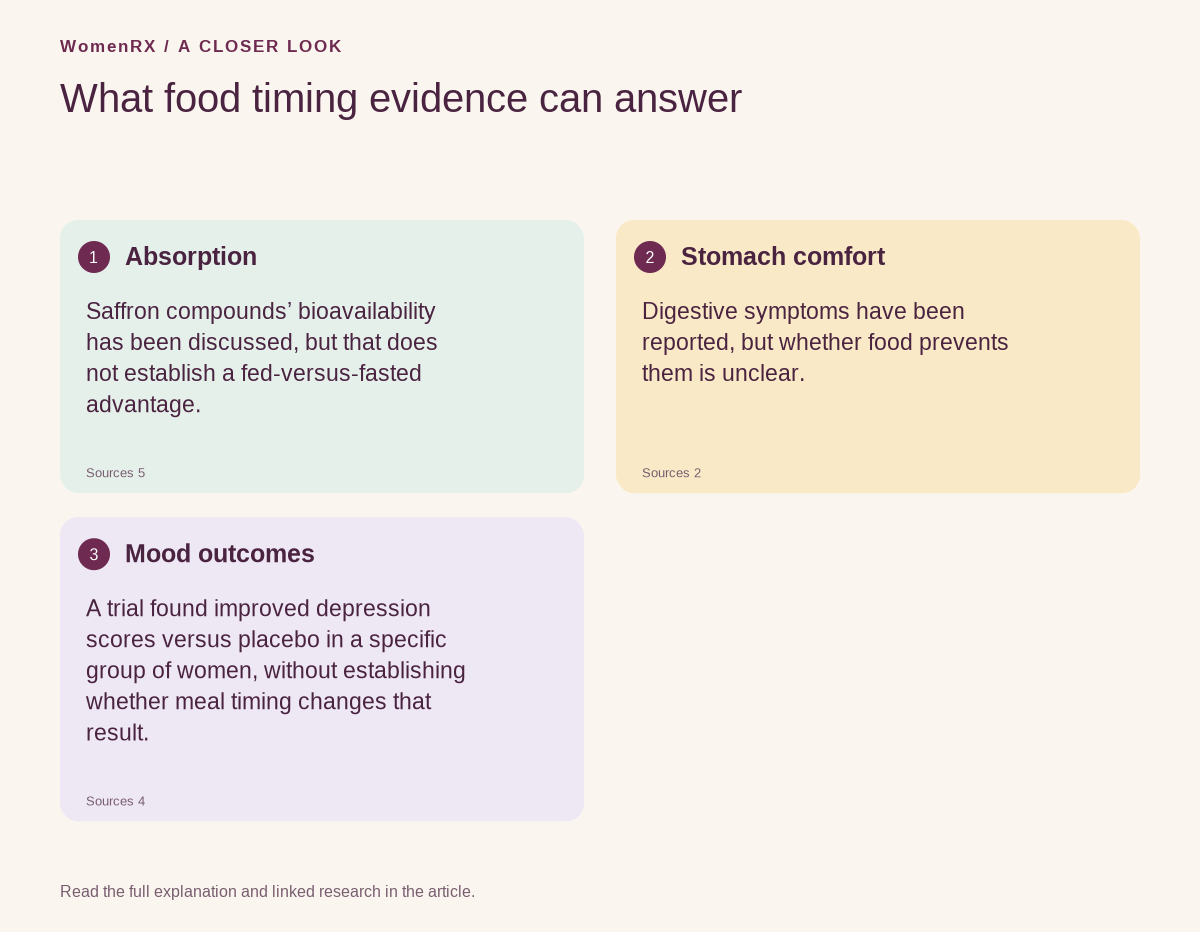
What food timing evidence can answer
Absorption: Saffron compounds’ bioavailability has been discussed, but that does not establish a fed-versus-fasted advantage.5
Stomach comfort: Digestive symptoms have been reported, but whether food prevents them is unclear.2
Mood outcomes: A trial found improved depression scores versus placebo in a specific group of women, without establishing whether meal timing changes that result.4
Read the figure as text
A finding about one question cannot stand in for a finding about another.- Absorption: Saffron compounds’ bioavailability has been discussed, but that does not establish a fed-versus-fasted advantage.5
- Stomach comfort: Digestive symptoms have been reported, but whether food prevents them is unclear.2
- Mood outcomes: A trial found improved depression scores versus placebo in a specific group of women, without establishing whether meal timing changes that result.4
Sources you can check
- Nausea | Vomiting | MedlinePlusAccessed 2026-09-25Return to first citation
- Adverse Events of Saffron (Crocus sativus L.): Systematic Review of Current Evidence.Hasheminasab FS, Hajimonfarednejad M, Najibi SM, Hashempur MH. · Health science reports · 2026Return to first citation
- Saffron (Crocus sativus L.) and health outcomes: a meta-research review of meta-analyses and an evidence mapping study.Lu C, Ke L, Li J, Zhao H, Lu T, Mentis AFA, Wang Y, Wang Z, Polissiou MG, Tang L, Tang H, Yang K. · Phytomedicine : international journal of phytotherapy and phytopharmacology · 2021Return to first citation
- A placebo controlled randomized clinical trial of Crocus sativus L. (saffron) on depression and food craving among overweight women with mild to moderate depression.Akhondzadeh S, Mostafavi SA, Keshavarz SA, Mohammadi MR, Hosseini S, Eshraghian MR. · Journal of clinical pharmacy and therapeutics · 2020Return to first citation
- Nutritional and health beneficial properties of saffron (Crocus sativus L): a comprehensive review.Abu-Izneid T, Rauf A, Khalil AA, Olatunde A, Khalid A, Alhumaydhi FA, Aljohani ASM, Sahab Uddin M, Heydari M, Khayrullin M, Shariati MA, Aremu AO, Alafnan A, Rengasamy KRR. · Critical reviews in food science and nutrition · 2022Return to first citation