How to Judge a Saffron Supplement’s Quality and Evidence
A useful saffron label tells you what’s in the capsule; a useful study tells you whether that kind of saffron was tested for your concern.
Look for the botanical name, the plant part, and a clear description of the extract, including any measured saffron compounds. If available, check a lot-specific independent test report and what it actually tested. Then compare the product and its format with human studies on your particular concern and life stage. A study of one preparation or outcome doesn’t establish that every saffron supplement works the same way. 1 2 5 6
Start with what the product actually is
The label should identify saffron as Crocus sativus, not simply use a general term such as “botanical blend.” If it gives the plant part, extract amount, extraction details, or standardization to compounds such as crocins or safranal, you can make a more meaningful comparison with a study. More label detail doesn’t prove that a supplement works, but it makes the ingredient easier to assess.
That distinction matters because “saffron” can refer to preparations that aren’t identical. A trial might use dried stigmas, a tea, or a particular extract. One saffron supplement study, for example, tested a named extract, while a trial in postmenopausal women tested saffron tea. Those results aren’t interchangeable just because both involve saffron. 4 7
Ask what the testing can verify
Saffron is a high-value ingredient, and testing has found mismatches between what some products declared and what analysis detected. In a laboratory study of 17 saffron-based food supplements, researchers found discrepancies between declared and measured contents in 65% of the samples. That result describes those samples, not the whole supplement market, but it shows why a label alone may not confirm composition. 1
If a company provides a certificate of analysis, check whether it applies to the product’s specific lot and names the tests performed. A useful report should make clear what was checked, such as saffron markers or possible undeclared plant ingredients. Different methods detect different problems: for example, DNA testing can help confirm botanical identity, but it may not detect DNA-free additives such as dyes or extracts. No single test should be treated as proof of every aspect of quality. 2 3
A test report addresses what was in the tested sample. It doesn’t show that the product has been studied for your concern or that it will have the same effect as a preparation used in a clinical trial.
Match the evidence to your concern
Look for human studies that name the outcome you care about, the participants’ life stage, and the preparation tested. A study measuring depression symptoms isn’t automatically evidence for food cravings; a study of postmenopausal women isn’t evidence for every symptom during perimenopause.
The differences show up in the saffron trials involving women. In one placebo-controlled trial, 73 overweight women with mild-to-moderate depression were assigned to saffron capsules or placebo; 52 completed the 12-week study. Depression scores improved more in the saffron group, while food craving did not differ significantly between groups. That finding is specific to the study population and outcomes, not proof that saffron treats depression generally or helps with cravings. 5
A separate trial enrolled 60 postmenopausal women who had hot flashes and major depressive disorder; 56 completed six weeks. It reported differences over time between saffron and placebo on hot-flash-related daily interference and depression scales. Because the participants had both concerns, and the trial was small and short, don’t assume this establishes a benefit for all menopause symptoms or for women without depression. 6
Another randomized trial studied a daily saffron tea in 72 postmenopausal women and measured happiness. That is a different outcome and format from a standardized capsule. For premenstrual symptoms, these studies don’t provide enough detail to assess a particular product or draw a conclusion about effectiveness. 4
Keep safety questions separate from quality
An accurately identified, tested ingredient isn’t automatically appropriate for everyone. The women’s trials described here don’t establish safety during pregnancy or breastfeeding; their findings shouldn’t be treated as reassurance for those situations. If pregnancy or breastfeeding is relevant to you, get advice specific to your circumstances before using a concentrated supplement.
A quick label-and-evidence check
Before choosing, see if you can answer four questions: Is the botanical identity clear? Does the label explain the plant part and extract? Is there a lot-specific test report, and does it say what was tested? Is there a human study for your particular concern, using a comparable preparation and women at a relevant life stage?
If the first questions have no clear answers, you can’t verify much about the product’s identity or composition. If the last question has no close match, the evidence may not tell you whether that product is likely to help with your concern. That’s a more useful distinction than a “best brand” ranking.
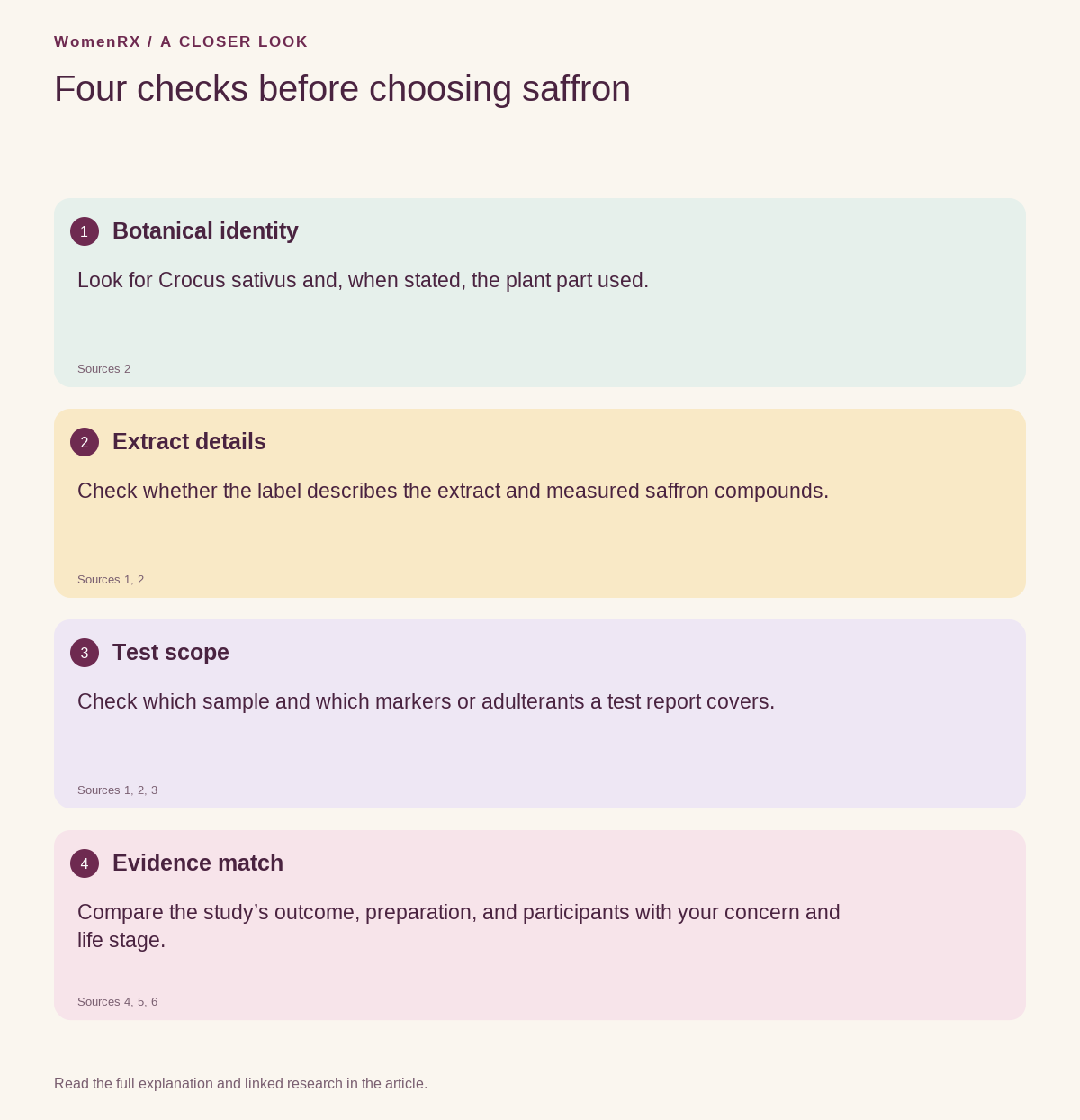
Four checks before choosing saffron
Botanical identity: Look for Crocus sativus and, when stated, the plant part used.2
Extract details: Check whether the label describes the extract and measured saffron compounds.12
Test scope: Check which sample and which markers or adulterants a test report covers.123
Evidence match: Compare the study’s outcome, preparation, and participants with your concern and life stage.456
Read the figure as text
Separate what the label identifies, what testing confirms, and what human research actually studied.- Botanical identity: Look for Crocus sativus and, when stated, the plant part used.2
- Extract details: Check whether the label describes the extract and measured saffron compounds.12
- Test scope: Check which sample and which markers or adulterants a test report covers.123
- Evidence match: Compare the study’s outcome, preparation, and participants with your concern and life stage.456
More questions, answered
Does a saffron study apply to every saffron supplement?
No. Studies may use a specific extract, capsule, or tea and measure a particular outcome. Check whether the product and concern you have in mind resemble what the researchers actually tested. 4 5 7
What does an independent test report tell me?
It can tell you what the tested sample was analyzed for, depending on the methods used. It does not establish that the product helps a health concern, and one method may not detect every kind of adulteration. 1 2
Sources you can check
- A Combined Gas and Liquid Chromatographic Approach for Quality Evaluation of Saffron-Based Food Supplements.Mena-García A, Sanz ML, Díez-Municio M, Ruiz-Matute AI. · Foods (Basel, Switzerland) · 2023Return to first citation
- Authentication of Iranian Saffron (Crocus sativus) Using Stable Isotopes δ13C and δ2H and Metabolites Quantification.Moras B, Pouchieu C, Gaudout D, Rey S, Anchisi A, Saupin X, Jame P. · Molecules (Basel, Switzerland) · 2022Return to first citation
- Detection of botanical adulterants in saffron powder.Ryparova Kvirencova J, Navratilova K, Hrbek V, Hajslova J. · Analytical and bioanalytical chemistry · 2023Return to first citation
- The effect of Crocus sativus L. (saffron) herbal tea on happiness in postmenopausal women: a randomized controlled trial.Delam H, Keshtkaran Z, Shokrpour N, Eidi A, Bazrafshan MR. · BMC complementary medicine and therapies · 2023Return to first citation
- A placebo controlled randomized clinical trial of Crocus sativus L. (saffron) on depression and food craving among overweight women with mild to moderate depression.Akhondzadeh S, Mostafavi SA, Keshavarz SA, Mohammadi MR, Hosseini S, Eshraghian MR. · Journal of clinical pharmacy and therapeutics · 2020Return to first citation
- Efficacy of Crocus sativus (saffron) in treatment of major depressive disorder associated with post-menopausal hot flashes: a double-blind, randomized, placebo-controlled trial.Kashani L, Esalatmanesh S, Eftekhari F, Salimi S, Foroughifar T, Etesam F, Safiaghdam H, Moazen-Zadeh E, Akhondzadeh S. · Archives of gynecology and obstetrics · 2018Return to first citation
- Satiereal, a Crocus sativus L extract, reduces snacking and increases satiety in a randomized placebo-controlled study of mildly overweight, healthy women.Gout B, Bourges C, Paineau-Dubreuil S. · Nutrition research (New York, N.Y.) · 2010Return to first citation