How to Compare a Saffron Supplement Dose With Research
A matching milligram number doesn’t make a supplement equivalent to what a study tested.
There isn’t one study dose that applies to every saffron product or purpose. Research has examined saffron, crocin, and crocetin in different amounts for specific conditions, while a small safety study tested saffron-stigma tablets for only seven days. Compare the product form, what its listed amount refers to, and who and what the study examined before treating the numbers as a match. 2 3
A supplement label may give you a precise amount, but that number is only one part of the comparison. A study’s findings apply to the preparation and people it examined, not automatically to every bottle with a similar milligram figure.
The useful question is: what exactly is in this product, and how closely does it match what researchers tested?
Start with the form, not just the number
A review of 10 human trials in eye conditions described studies of saffron at 20-50 mg per day, crocin at 5-15 mg per day, and crocetin at 7.5 mg per day. The studies lasted from 6 weeks to 12 months. These are amounts reported in research on particular eye conditions, not general-purpose recommendations or interchangeable doses. 2
Check whether a label names saffron, an extract, or a specific constituent such as crocin. Ask what the amount refers to: the whole ingredient, an extract, or a named compound? The review’s reported amounts distinguish saffron from crocin and crocetin; a similar number on a different product description doesn’t establish that the products are equivalent. 2
Also compare the study’s purpose and participants with your own question. For example, the eye studies don’t establish a dose for general wellness or another health concern. A separate saffron trial in men with erectile dysfunction used 30 mg twice daily for 12 weeks and did not find improvement in the measured sexual-function outcomes. That result describes a specific study in men, not a dose to borrow for another purpose. 1
What a short safety study can, and can’t, tell you
A placebo-controlled study included 30 healthy adults, with five women and five men in each of three groups. The groups received placebo, 200 mg saffron-stigma tablets, or 400 mg saffron-stigma tablets for seven days. The abstract doesn’t specify how often the tablets were taken, so those amounts shouldn’t be read as a daily schedule. 3
In the 400 mg group, standing systolic blood pressure and mean arterial pressure decreased significantly. The researchers also reported slight changes in some blood-cell and biochemical measures, which they described as within normal ranges and not clinically important. These results come from a small, short study; they don’t establish long-term safety or tell you what to expect from a different formulation. The study included women, but the reported results weren’t separated by sex. 3
A practical label-to-study check
Before you compare a bottle with a paper or study summary, see whether you can answer these questions:
- What form is named? Is it saffron, an extract, crocin, crocetin, or a blend?
- What does the number measure? Is it the amount per serving, the amount of an extract, or a named constituent? Don’t assume the label’s number can be compared directly with a study amount until you know what it represents.
- What else is included? Note other active ingredients. A study of saffron alone would not establish the effects of a multi-ingredient product.
- Who and what was studied? Check the population, health question, preparation, and study length. A study in healthy adults or a study aimed at a particular condition may not answer your own question.
- Is the label clear? If it doesn’t explain the ingredient form or amount, ask the manufacturer what the listed amount represents. You can bring the label to a pharmacist or clinician to discuss how it fits your health circumstances.
These questions help identify a mismatch; they can’t confirm that a product is safe or effective for you. The available short safety study doesn’t answer long-term safety questions or provide separate results for women. 3
Pregnancy deserves extra care
A review of saffron use in pregnancy described the clinical evidence as limited and inconclusive. It also reported concern that higher doses or occupational exposure were linked with uterine stimulation and increased miscarriage risk. That report does not establish a reliable dose threshold for risk, or a supplement amount proven safe in pregnancy. Discuss a concentrated saffron product with your pregnancy-care clinician rather than using an adult study amount as guidance. 4
The pregnancy review doesn’t answer whether saffron supplements are safe while breastfeeding. If you’re breastfeeding, ask a clinician or pharmacist about the specific product and your situation; pregnancy findings can’t settle that separate question.
Use studies as comparisons, not dosing instructions
A research dose is meaningful only alongside its preparation, purpose, study group, and timeframe. If those details don’t line up with the label and your circumstances, the study doesn’t provide a direct dose match. For saffron supplements, that’s a more useful way to read the number than looking for a single universal amount.
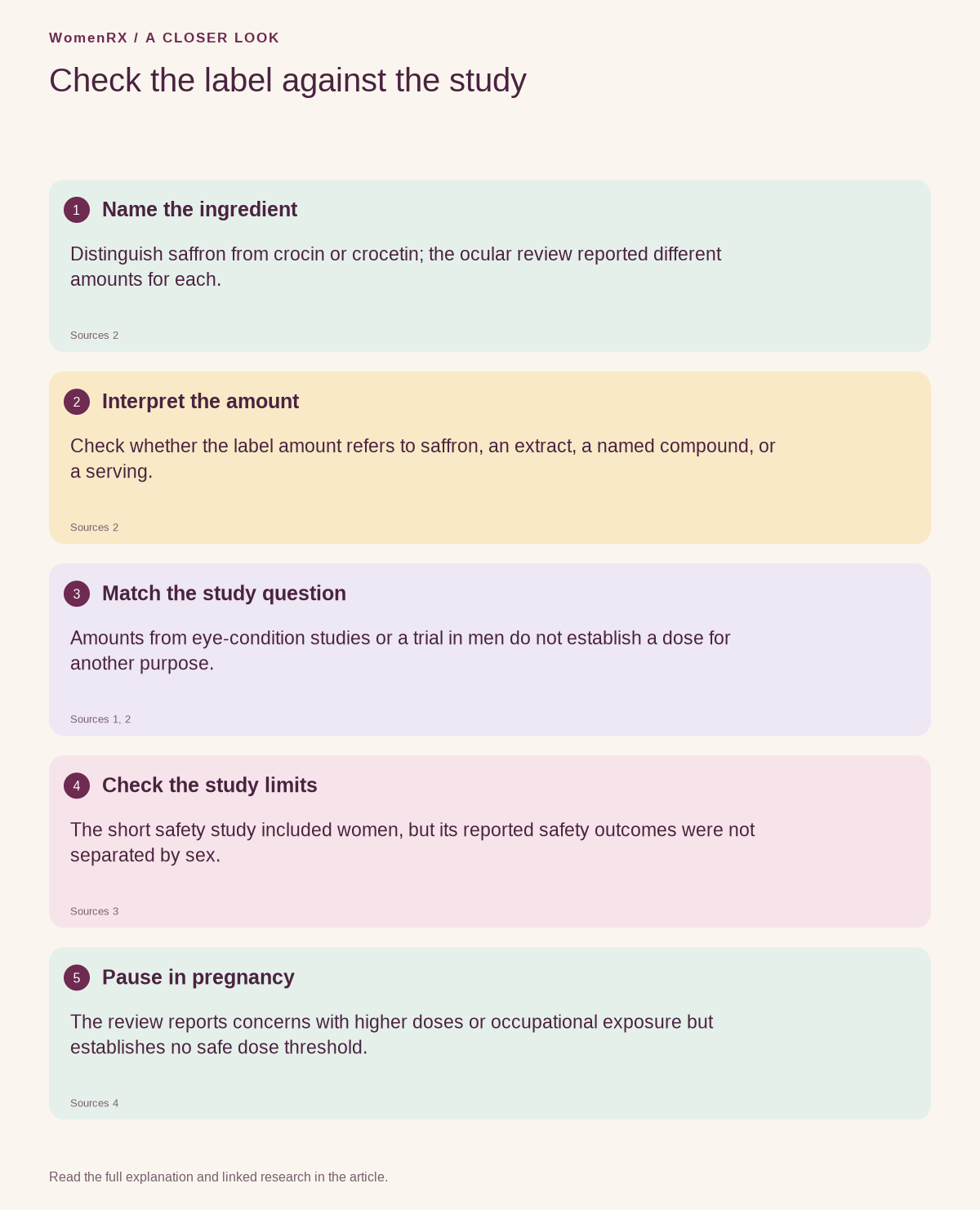
Check the label against the study
Name the ingredient: Distinguish saffron from crocin or crocetin; the ocular review reported different amounts for each.2
Interpret the amount: Check whether the label amount refers to saffron, an extract, a named compound, or a serving.2
Match the study question: Amounts from eye-condition studies or a trial in men do not establish a dose for another purpose.12
Check the study limits: The short safety study included women, but its reported safety outcomes were not separated by sex.3
Pause in pregnancy: The review reports concerns with higher doses or occupational exposure but establishes no safe dose threshold.4
Read the figure as text
A useful comparison looks beyond milligrams to the ingredient form, research question, and people studied.- Name the ingredient: Distinguish saffron from crocin or crocetin; the ocular review reported different amounts for each.2
- Interpret the amount: Check whether the label amount refers to saffron, an extract, a named compound, or a serving.2
- Match the study question: Amounts from eye-condition studies or a trial in men do not establish a dose for another purpose.12
- Check the study limits: The short safety study included women, but its reported safety outcomes were not separated by sex.3
- Pause in pregnancy: The review reports concerns with higher doses or occupational exposure but establishes no safe dose threshold.4
More questions, answered
Does the pregnancy evidence answer whether saffron is safe while breastfeeding?
No. The pregnancy review doesn’t establish breastfeeding safety. Ask about the specific product with a clinician or pharmacist rather than assuming the pregnancy findings apply. 4
Sources you can check
- An open label, randomized, fixed-dose, crossover study comparing efficacy and safety of sildenafil citrate and saffron (Crocus sativus Linn.) for treating erectile dysfunction in men naïve to treatment.Safarinejad MR, Shafiei N, Safarinejad S. · International journal of impotence research · 2010Return to first citation
- Does Crocus sativus (Saffron) Have an Influence or Effect on Ocular Health: A Systematic Literature Review.Ferrara S, Schloss J. · Journal of evidence-based integrative medicine · 2026Return to first citation
- Safety evaluation of saffron (Crocus sativus) tablets in healthy volunteers.Modaghegh MH, Shahabian M, Esmaeili HA, Rajbai O, Hosseinzadeh H. · Phytomedicine : international journal of phytotherapy and phytopharmacology · 2008Return to first citation
- Saffron and Pregnancy: Cultural Practices, Beliefs, and Safety Evidence: An Integrative Review.Alshdefat A, Ayed A, Aqtam I, Ibitoye O, Vincent S, Furqani AA. · Journal of evidence-based integrative medicine · 2026Return to first citation