Saffron for Mood: What One Postpartum Trial Studied
One small trial tested saffron stigma for postpartum depression, not PMS or general wellness.
In one 8-week trial, 60 breastfeeding mothers with mild-to-moderate postpartum depression were assigned saffron stigma at 15 mg twice daily or placebo. The saffron group’s depression scores fell more, but this single study does not establish a general dose, prove saffron treats PMS, or show that different extracts are interchangeable. 4
Start with the mood symptoms the study actually tested
One double-blind, placebo-controlled trial enrolled 60 new mothers with mild-to-moderate postpartum depression. Participants received saffron stigma at 15 mg twice daily or placebo for 8 weeks. The study focused on changes in Beck Depression Inventory-II (BDI-II) scores, a measure of depressive symptoms. 4
That is a specific study dose for a specific group and outcome. It isn’t an established daily recommendation for women generally.
How to compare the study with a product label
The trial describes saffron stigma and gives the amount used: 15 mg per dose, twice daily. If you’re looking at a product, check whether its label says saffron stigma or an extract, how much is in a serving, and whether it identifies any standardization details. The study used saffron stigma. A label that says “saffron extract” can’t be assumed to match it just because the milligram number looks similar. 4
The trial’s total of 30 mg per day is simply the amount used in that study, not a dose to copy. Its results don’t establish that a different preparation, amount, or schedule would have the same effect.
What changed, and what the result can’t promise
After 8 weeks, the mean BDI-II score in the saffron group fell from 20.3 to 8.4. In the placebo group, it fell from 19.8 to 15.1. The trial also reported remission in 96% of the saffron group and 43% of the placebo group at the final assessment. These are results from a small trial in mothers with postpartum depression, not a guarantee of benefit for an individual or a finding that applies to every saffron product. 4
The study is a reason to ask further questions about saffron, not a reason to treat it as a proven replacement for depression care. A review of supplements for perinatal depression also describes promising but limited evidence and notes that longer-term safety information and potential interactions remain concerns. 3
PMS is a different question
This postpartum trial did not study premenstrual syndrome (PMS) or premenstrual dysphoric disorder (PMDD). So its dose and mood-score results can’t establish that saffron helps symptoms that occur before a period. Keep the product’s claim matched to the outcome actually studied: postpartum depressive symptoms, rather than PMS, PMDD, or general “mood support.” 4
Pregnancy and breastfeeding deserve separate attention
The trial included breastfeeding mothers, but that alone does not establish that saffron products are safe for every breastfeeding parent or infant. A review of supplements for perinatal depression describes limited safety evidence, particularly for longer-term use. Pregnancy is a separate situation: a review focused on saffron in pregnancy characterized the clinical safety and efficacy evidence as limited and inconclusive. Don’t treat the postpartum mood trial as proof of safety during pregnancy. 3 2
When the supplement question should wait
If you think you may have postpartum depression, seek assessment rather than relying on saffron alone. Hallucinations, delusions, or manic symptoms after birth call for immediate psychiatric care. 3
If symptoms before your period are disrupting daily life, seek assessment rather than relying on a supplement. PMDD can affect everyday life much more than PMS; if you’re feeling suicidal, seek immediate help. 1
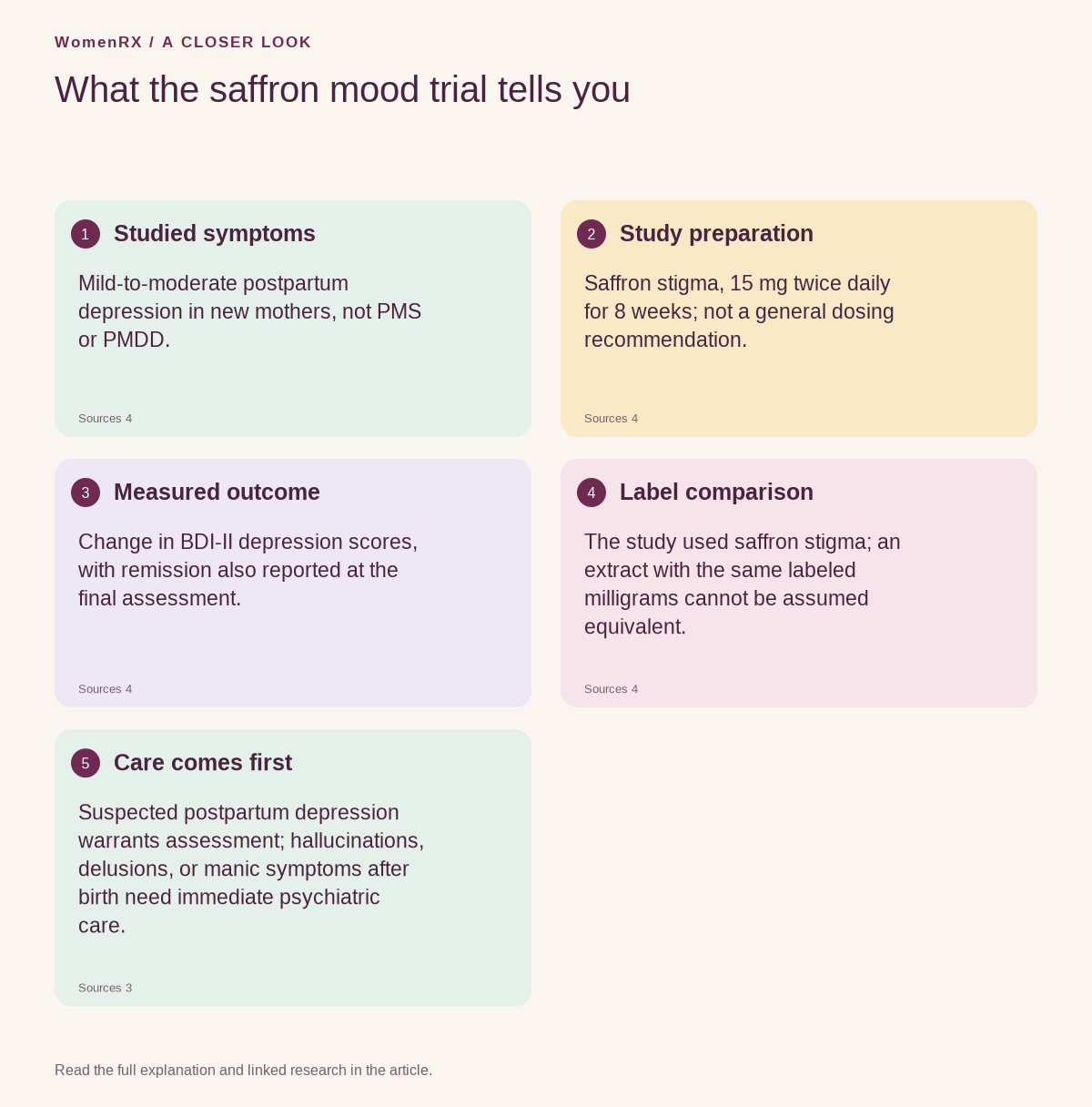
What the saffron mood trial tells you
Studied symptoms: Mild-to-moderate postpartum depression in new mothers, not PMS or PMDD.4
Study preparation: Saffron stigma, 15 mg twice daily for 8 weeks; not a general dosing recommendation.4
Measured outcome: Change in BDI-II depression scores, with remission also reported at the final assessment.4
Label comparison: The study used saffron stigma; an extract with the same labeled milligrams cannot be assumed equivalent.4
Care comes first: Suspected postpartum depression warrants assessment; hallucinations, delusions, or manic symptoms after birth need immediate psychiatric care.3
Read the figure as text
Separate the study population, preparation, measured outcome, and evidence limits before comparing a product with the trial.- Studied symptoms: Mild-to-moderate postpartum depression in new mothers, not PMS or PMDD.4
- Study preparation: Saffron stigma, 15 mg twice daily for 8 weeks; not a general dosing recommendation.4
- Measured outcome: Change in BDI-II depression scores, with remission also reported at the final assessment.4
- Label comparison: The study used saffron stigma; an extract with the same labeled milligrams cannot be assumed equivalent.4
- Care comes first: Suspected postpartum depression warrants assessment; hallucinations, delusions, or manic symptoms after birth need immediate psychiatric care.3
More questions, answered
Is 30 mg a day the recommended saffron dose?
No. It is the total amount used in one 8-week trial of saffron stigma for mild-to-moderate postpartum depression. The study does not establish a general recommended dose or show that other extracts are equivalent. 4
Does the postpartum trial show that saffron helps PMS?
No. The participants were mothers with postpartum depression, and the study measured depressive symptoms. It did not test PMS or PMDD. 4
Sources you can check
- PMS (premenstrual syndrome) - NHSAccessed 2026-09-25Return to first citation
- Saffron and Pregnancy: Cultural Practices, Beliefs, and Safety Evidence: An Integrative Review.Alshdefat A, Ayed A, Aqtam I, Ibitoye O, Vincent S, Furqani AA. · Journal of evidence-based integrative medicine · 2026Return to first citation
- Supplementary approaches to perinatal depression: a review of pathogenesis, herbal interventions, and dietary supplements.Yang Q, Lv Y, Gao S, Zhang Y, Zhai X. · Frontiers in psychology · 2025Return to first citation
- A double-blind, randomized, placebo-controlled trial of saffron stigma (Crocus sativus L.) in mothers suffering from mild-to-moderate postpartum depression.Tabeshpour J, Sobhani F, Sadjadi SA, Hosseinzadeh H, Mohajeri SA, Rajabi O, Taherzadeh Z, Eslami S. · Phytomedicine : international journal of phytotherapy and phytopharmacology · 2017Return to first citation