Saffron After 40: What Midlife Research Shows
A few studies include postmenopausal women, but the findings depend on what saffron was tested for and how it was prepared.
Some saffron research has included postmenopausal women, but it doesn’t establish saffron as a reliable treatment for menopause symptoms, sleep problems, or depression. One small trial measured happiness after saffron tea; another tested a blend of four herbs, so its results can’t be attributed to saffron alone. Other studies in women didn’t report menopause-specific results. 1 2 4
If you’re over 40 and considering saffron, age alone doesn’t tell you whether a study applies to you. The useful checks are your goal, the life stage researchers studied, and whether they tested saffron by itself or as part of a blend.
The direct postmenopause studies answer different questions
A randomized trial included 72 postmenopausal women and tested saffron tea. Researchers measured happiness scores. The saffron group’s average score rose over the study, and the groups differed after the intervention. That’s a finding about a measured happiness score, not proof that saffron treats clinical depression, hot flashes, or menopause-related sleep problems. 2
A different randomized trial included 80 postmenopausal women and reported improvement in menopause symptoms compared with placebo. But the product contained saffron, Tribulus, ginger, and cinnamon. The study can’t show which ingredient, if any, produced the difference, or whether saffron contributed at all. 4
These studies are direct evidence in postmenopausal women, but they don’t test the same preparation or measure the same thing. A result from saffron tea on a happiness questionnaire and a result from a four-herb blend on a menopause symptom scale aren’t interchangeable.
What broader studies in women can tell you
A placebo-controlled study tested saffron capsules in overweight women with mild-to-moderate depression. Fifty-two of the 73 women recruited completed the 12-week trial. Depression scores fell more in the saffron group than in the placebo group, but the study didn’t report whether participants were perimenopausal or postmenopausal. It therefore doesn’t answer whether saffron helps mood changes specifically related to menopause. 1
Another trial studied women aged 18 to 55 who had severe sexual dysfunction. It reported improvement on some measures of sexual function in the saffron group compared with placebo. But the results weren’t reported by menopausal status, so they don’t establish an effect on sexual concerns related to menopause. 3
A study can include women and still not answer a midlife-specific question. Age range, menopausal status, and the reason for a symptom all matter when you’re deciding how relevant a result is to your situation.
Match the evidence to your goal
- Mood or happiness: There’s a small postmenopause tea trial measuring happiness, and a separate depression trial in overweight women whose menopausal status wasn’t reported. Neither result establishes saffron as a treatment for menopause-related depression. 1 2
- Menopause symptoms overall: A postmenopause trial reported improvement with a four-herb blend. It can’t identify saffron’s contribution. 4
- Sleep: The tea trial measured happiness, while the reported results from the blend trial don’t identify a separate sleep outcome. These findings don’t establish saffron as a treatment for menopause-related sleep problems. 2 4
- Sexual function: One trial in women aged 18 to 55 is relevant to female sexual function generally, but it doesn’t provide a menopause-specific result. 3
When comparing a study with a product you’re considering, check whether it tested saffron alone or a blend, and whether it measured the concern you actually have. A tea study, a capsule study, and a multi-herb product are different interventions. The midlife research offers a few useful clues, but not a dependable, goal-specific answer for most menopause concerns.
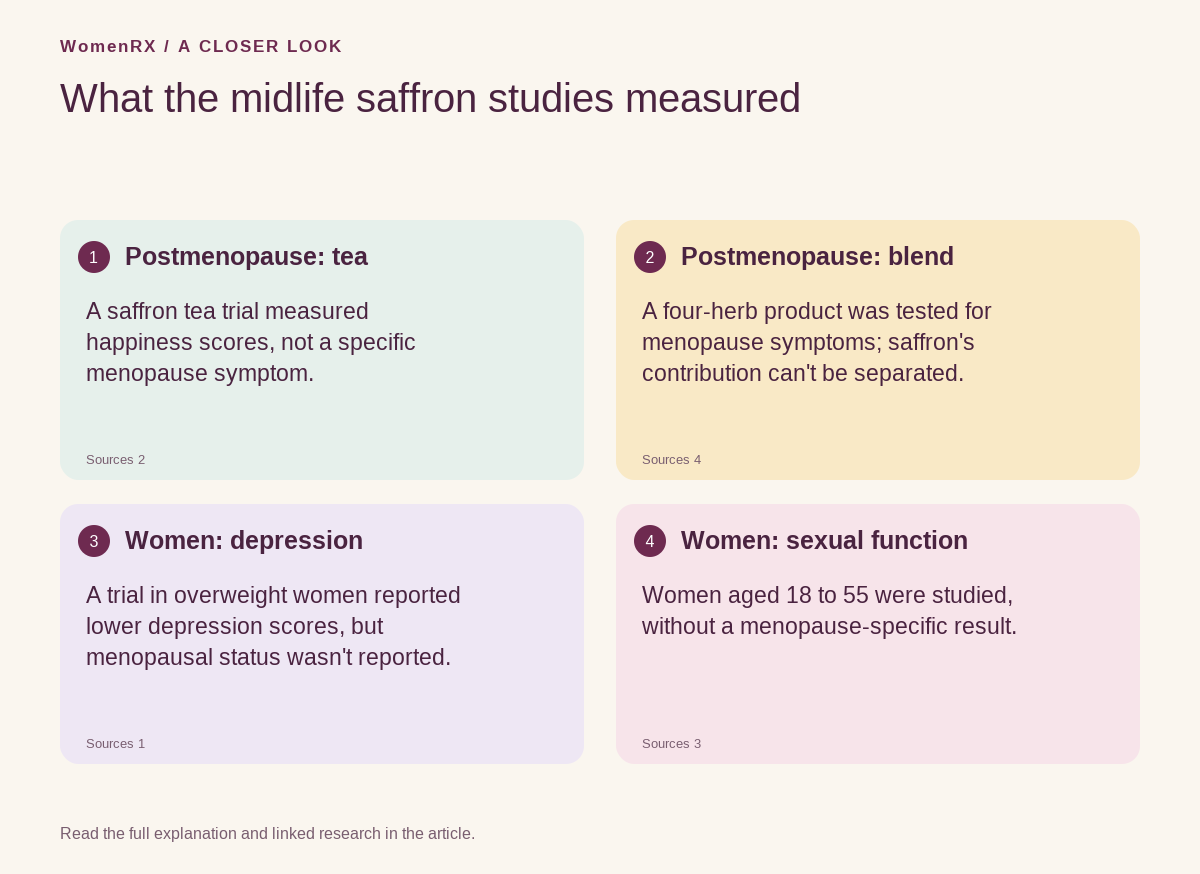
What the midlife saffron studies measured
Postmenopause: tea: A saffron tea trial measured happiness scores, not a specific menopause symptom.2
Postmenopause: blend: A four-herb product was tested for menopause symptoms; saffron's contribution can't be separated.4
Women: depression: A trial in overweight women reported lower depression scores, but menopausal status wasn't reported.1
Women: sexual function: Women aged 18 to 55 were studied, without a menopause-specific result.3
Read the figure as text
Compare the women studied, the preparation tested, and the limits of each result.- Postmenopause: tea: A saffron tea trial measured happiness scores, not a specific menopause symptom.2
- Postmenopause: blend: A four-herb product was tested for menopause symptoms; saffron's contribution can't be separated.4
- Women: depression: A trial in overweight women reported lower depression scores, but menopausal status wasn't reported.1
- Women: sexual function: Women aged 18 to 55 were studied, without a menopause-specific result.3
Sources you can check
- A placebo controlled randomized clinical trial of Crocus sativus L. (saffron) on depression and food craving among overweight women with mild to moderate depression.Akhondzadeh S, Mostafavi SA, Keshavarz SA, Mohammadi MR, Hosseini S, Eshraghian MR. · Journal of clinical pharmacy and therapeutics · 2020Return to first citation
- The effect of Crocus sativus L. (saffron) herbal tea on happiness in postmenopausal women: a randomized controlled trial.Delam H, Keshtkaran Z, Shokrpour N, Eidi A, Bazrafshan MR. · BMC complementary medicine and therapies · 2023Return to first citation
- Crocus sativus (saffron) in the treatment of female sexual dysfunction: a three-center, double-blind, randomized, and placebo-controlled clinical trial.Kashani L, Aslzadeh S, Shokraee K, Shamabadi A, Tadayon Najafabadi B, Jafarinia M, Esalatmanesh S, Akhondzadeh S. · Avicenna journal of phytomedicine · 2022Return to first citation
- Effect of Tribulus terrestris, ginger, saffron, and Cinnamomum on menopausal symptoms: a randomised, placebo-controlled clinical trial.Taavoni S, Ekbatani NN, Haghani H. · Przeglad menopauzalny = Menopause review · 2017Return to first citation