Saffron Benefits: What Human Studies Have Tested
Saffron has been studied for several different concerns, but results depend on the outcome, the preparation, and who took part.
Human studies have tested saffron for low mood, female sexual function, weight and metabolic measures, and symptoms such as sleep problems or fatigue in people with specific illnesses. Findings range from a modest mood benefit in one larger trial to preliminary results from smaller studies. These results don’t establish that saffron helps with menopause, pregnancy, or general wellness. 3 5 6 7 8
Saffron isn’t one treatment with one proven set of benefits. Studies have tested different preparations for different outcomes, often over a few weeks and in people with a particular condition. A result for low mood, for example, doesn’t show that saffron helps with menopause symptoms or ordinary sleep trouble. The form matters, too: a saffron extract, a product combining saffron with other ingredients, and isolated crocin aren’t interchangeable.
The most directly women-specific finding is about sexual function
A randomized, double-blind trial enrolled 74 married women ages 18 to 55 with severe sexual dysfunction. Participants received saffron or placebo for six weeks; 34 in each group completed the trial. Scores improved in both groups. The difference in change over time favored saffron at the threshold of statistical significance (p=0.050), and desire, lubrication, and satisfaction scores favored saffron. This is a useful early signal, not proof that saffron helps every cause of sexual difficulty. 7
The findings don’t establish whether results differ by menstrual-cycle stage or menopause status. They also don’t answer whether saffron helps with menopause-related sexual changes. 7
Low mood: a larger study, with a specific outcome
A 12-week placebo-controlled trial tested a named saffron extract in 202 adults with subclinical depressive symptoms. Compared with placebo, the saffron group had a greater improvement on the depression scale, with an average difference of 2.92 points (Cohen’s d=0.39). The groups didn’t differ on the other secondary outcomes. A sleep improvement appeared in an exploratory analysis of participants with more severe sleep disturbance, so it shouldn’t be read as evidence of a general sleep benefit. The reported findings don’t establish a women-specific effect. 8
This trial offers a stronger comparison than an uncontrolled study, but it tested one extract in adults experiencing low mood. It doesn’t establish saffron as a treatment for clinical depression or as a general-purpose sleep aid. 8
Weight and metabolic measures: different groups, different questions
A 12-week trial studied 74 adolescents with obesity and prediabetes. Saffron improved several weight measures compared with placebo, though the improvements were less pronounced than those with metformin. The trial found no change in glycemic markers. It also reported lower fasting triglycerides and higher HDL, but the reported results don’t specify that these lipid changes were differences between saffron and placebo. These adolescent findings can’t be assumed to apply to adult women. 6
A separate six-month trial enrolled 61 adults with type 1 diabetes, including 26 women. It tested a supplement containing saffron extract alongside probiotics, prebiotics, and magnesium. Only triglycerides differed significantly between groups at the end of the trial. Changes in HbA1c and triglycerides from the active group’s own starting measurements don’t isolate saffron’s effect, because the product had several ingredients. The study also doesn’t establish a women-specific result. 1
Taken together, these trials don’t establish saffron as a general weight-loss or blood-sugar supplement. One studied adolescents; the other tested a combination product in adults with type 1 diabetes. 1 6
Sleep and fatigue: results in people with lung conditions
In a 60-day study of pulmonary sarcoidosis, 72 adults completed a comparison of saffron plus sleep-hygiene counseling with counseling alone. Sleep quality, daytime sleepiness, fatigue, and some quality-of-life measures improved more in the saffron group. But this was single-blind and had no placebo group. A separate eight-week, double-blind, placebo-controlled trial in 71 people with COPD and chronic fatigue reported improvements in fatigue and overall quality of life, but not in its dyspnea measure. 3 5
The placebo-controlled COPD study provides a different kind of comparison from the sarcoidosis study, but both were short and focused on people with lung disease. Neither establishes that saffron improves fatigue or sleep in otherwise healthy women, and the reported findings don’t establish a women-specific effect. 3 5
Other outcomes have been explored, too
Researchers have tested isolated crocin, a compound from saffron, in people with Parkinson’s disease. In a randomized controlled study, 53 participants completed eight weeks; movement and daily-activity scores improved within the crocin group, while a marker of oxidative DNA damage did not significantly change. Because the reported results describe improvement from the group’s own baseline, they don’t establish that crocin outperformed the control group. 4
Another small randomized trial studied saffron alongside risperidone in 56 people with chronic schizophrenia and reported greater improvements in some symptom scores than placebo over eight weeks. That is an illness-specific adjunct study, not evidence that saffron has a general mental-health benefit. 2
A practical way to weigh a saffron claim
Match the claim to three details: the outcome measured, the people studied, and the preparation used. The women-specific study concerned sexual function; the weight study concerned adolescents with obesity and prediabetes; and the fatigue and sleep studies concerned people with lung conditions. Those results don’t automatically transfer to another group or concern.
These studies don’t establish benefits for pregnancy or menopause. Pregnant or breastfeeding participants were excluded from the type 1 diabetes and COPD fatigue trials, which means those trials can’t answer questions about use during those life stages. 1 5
What saffron studies actually tested
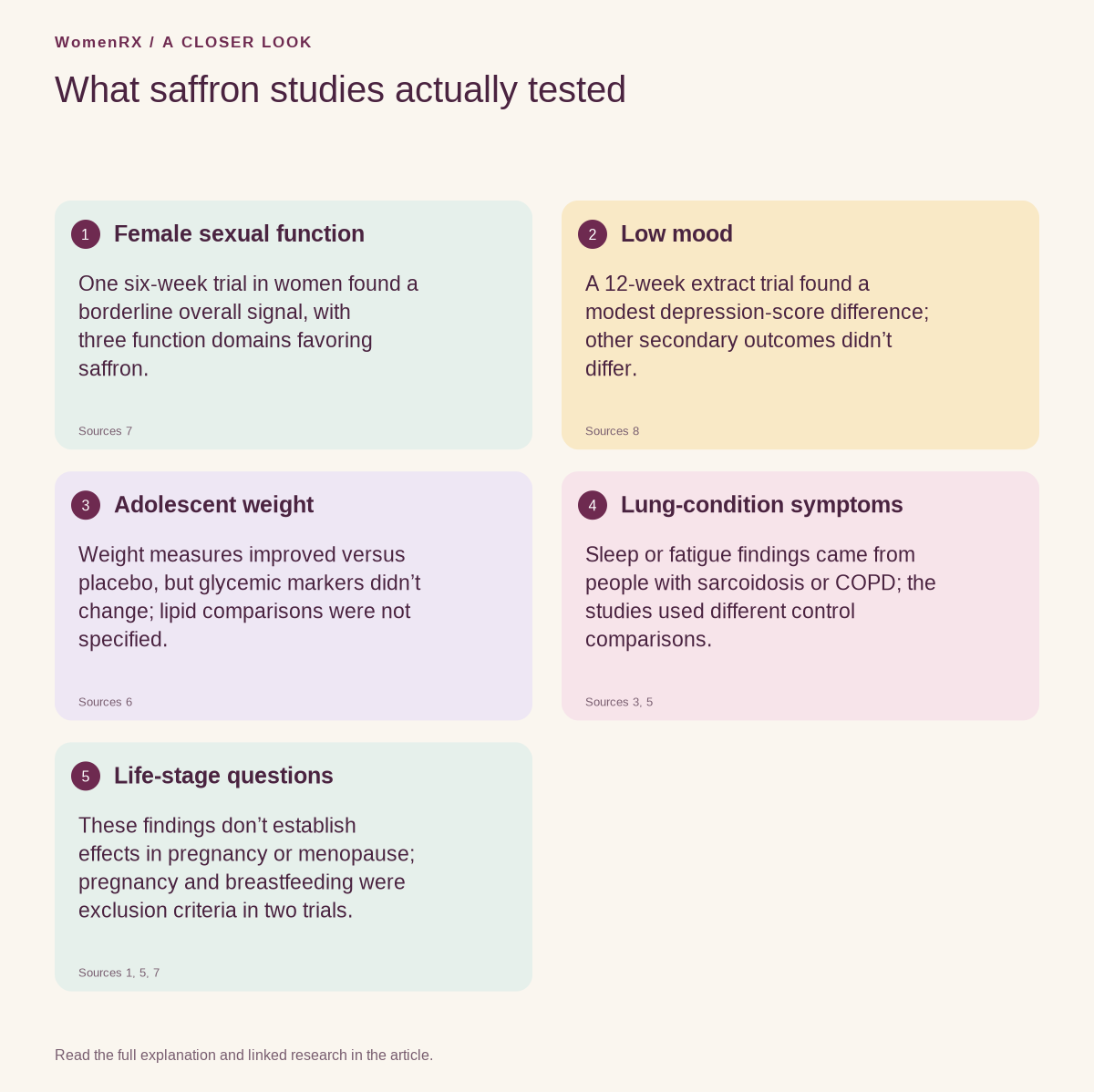
Female sexual function: One six-week trial in women found a borderline overall signal, with three function domains favoring saffron.7
Low mood: A 12-week extract trial found a modest depression-score difference; other secondary outcomes didn’t differ.8
Adolescent weight: Weight measures improved versus placebo, but glycemic markers didn’t change; lipid comparisons were not specified.6
Lung-condition symptoms: Sleep or fatigue findings came from people with sarcoidosis or COPD; the studies used different control comparisons.35
Life-stage questions: These findings don’t establish effects in pregnancy or menopause; pregnancy and breastfeeding were exclusion criteria in two trials.157
Read the figure as text
These studies differ in their outcomes, participants, and comparison groups. The map shows why results in one setting don’t automatically apply to another.- Female sexual function: One six-week trial in women found a borderline overall signal, with three function domains favoring saffron.7
- Low mood: A 12-week extract trial found a modest depression-score difference; other secondary outcomes didn’t differ.8
- Adolescent weight: Weight measures improved versus placebo, but glycemic markers didn’t change; lipid comparisons were not specified.6
- Lung-condition symptoms: Sleep or fatigue findings came from people with sarcoidosis or COPD; the studies used different control comparisons.35
- Life-stage questions: These findings don’t establish effects in pregnancy or menopause; pregnancy and breastfeeding were exclusion criteria in two trials.157
Sources you can check
- Effect of Crocus sativus Extract Supplementation in the Metabolic Control of People with Diabetes Mellitus Type 1: A Double-Blind Randomized Placebo-Controlled Trial.Giannoulaki P, Kotzakioulafi E, Nakas A, Kontoninas Z, Karlafti E, Evripidou P, Kantartzis K, Savopoulos C, Chourdakis M, Didangelos T. · Nutrients · 2024Return to first citation
- Crocus sativus (saffron) adjunct to risperidone for negative symptoms of schizophrenia: a randomized, double-blind, placebo-controlled trial.Mazhar S, Shamabadi A, Kazemzadeh K, Farahvash MA, Heidari Dalfard A, Fallahpour B, Khodaei Ardakani MR, Akhondzadeh S. · International clinical psychopharmacology · 2025Return to first citation
- Efficacy of a Saffron-Based (Crocus sativus L.) Herbal Supplement on Sleep Disturbances in Pulmonary Sarcoidosis: A Randomized Single-Blind Controlled Trial.Moghimi Dehkordi Z, Salamzadeh J, Tavakoli-Ardakani M, Abedini A, Dastan F. · Iranian journal of pharmaceutical research : IJPR · 2026Return to first citation
- The effect of crocin on movement disorders and oxidative DNA damage in Parkinson's disease: Insights from a randomized controlled trial.Mohammad Soleymani S, Assarzadegan F, Habibi SAH, Mahboubi A, Esmaily H. · Parkinsonism & related disorders · 2024Return to first citation
- Evaluating the Effects of Crocus sativus L. Herbal Product on Chronic Fatigue Syndrome in Patients with Chronic Obstructive Pulmonary Disease: A Randomized, Double-Blind, Placebo-Controlled Clinical Trial.Dastan F, Salamzadeh J, Heshmatnia J, Mahmoudian R. · Iranian journal of pharmaceutical research : IJPR · 2025Return to first citation
- The Effect of Saffron Kozanis (Crocus sativus L.) Supplementation on Weight Management, Glycemic Markers and Lipid Profile in Adolescents with Obesity: A Double-Blinded Randomized Placebo-Controlled Trial.Kotanidou EP, Tsinopoulou VR, Tsinopoulou VR, Giza S, Ntouma S, Angeli C, Chatziandreou M, Tsopelas K, Tseti I, Galli-Tsinopoulou A. · Children (Basel, Switzerland) · 2023Return to first citation
- Crocus sativus (saffron) in the treatment of female sexual dysfunction: a three-center, double-blind, randomized, and placebo-controlled clinical trial.Kashani L, Aslzadeh S, Shokraee K, Shamabadi A, Tadayon Najafabadi B, Jafarinia M, Esalatmanesh S, Akhondzadeh S. · Avicenna journal of phytomedicine · 2022Return to first citation
- An Examination into the Effects of a Saffron Extract (Affron) on Mood and General Wellbeing in Adults Experiencing Low Mood: A Randomized, Double-Blind, Placebo-Controlled Trial.Lopresti AL, Smith SJ, Marx W, Díez-Municio M, Morán-Valero MI. · The Journal of nutrition · 2025Return to first citation