Saffron Supplements: What Human Studies Support
Human research includes a premenstrual-symptom trial and depression studies, but those findings don’t establish benefits for menopause symptoms or safety in pregnancy.
A randomized trial in women with premenstrual syndrome (PMS) found better symptom and depression-rating scores with saffron than placebo over two menstrual cycles. A review also reports eight clinical trials for depression, but its summary doesn’t show whether those results apply to women or to your situation. Menopause benefits, pregnancy and breastfeeding safety, and specific supplement-medicine interactions aren’t established by these findings. 12
The evidence depends on the symptom
Saffron isn’t one proven treatment for a range of women’s health concerns. Human studies have looked at different outcomes in different groups, and a result for one symptom can’t be carried over to another.
For PMS, there is a direct trial in women. A randomized, placebo-controlled study enrolled women aged 20 to 45 with regular menstrual cycles and a history of PMS. Participants received saffron or placebo for two menstrual cycles. The researchers reported significant differences in total daily premenstrual symptom scores and depression-rating scores in the saffron group. The abstract doesn’t give the size of the differences, so it’s hard to judge how noticeable the improvement was. It also says further investigation was needed. 1
For depression, a review reports a broader clinical-trial record, but the details matter. Its abstract describes eight clinical trials comparing saffron with placebo or antidepressant medicines and says saffron showed effectiveness. The summary doesn’t provide the trials’ populations, individual results, or enough detail to tell whether the evidence applies to women with PMS, depression outside the premenstrual phase, or a particular supplement on a store shelf. This is a reason to distinguish a research signal from a personal treatment decision, not to assume saffron can replace depression care. 2
For menopause symptoms, the PMS result doesn’t answer the question. That trial measured premenstrual symptoms and depression ratings, not hot flashes, night sweats, or other menopause-related concerns. The findings described here therefore don’t establish that saffron helps with those symptoms. 1
What the studies say about safety, and what they don’t
The PMS abstract doesn’t report specific adverse-event results. A separate 12-week study tested saffron extract and crocin in men with schizophrenia who continued their usual treatment. None of the 61 participants who completed it reported a serious side effect. White blood cell count increased in the saffron-extract group, but remained within the normal range and was described as not clinically significant. Those findings are limited to that study’s participants and duration; they don’t establish safety for women generally or for long-term use. 3
The human findings described here don’t establish whether saffron supplements are safe during pregnancy or breastfeeding. Don’t treat a lack of reported harm in another group as proof of safety in either situation. If you’re pregnant, trying to become pregnant, or breastfeeding, raise the specific saffron product with your clinician before using it.
These studies also don’t provide a dependable guide to interactions with medicines. That doesn’t mean a product is interaction-free. If you take medication, ask a pharmacist or clinician to review the exact supplement label alongside your medicines and other supplements. The question is not only whether the label says “saffron,” but what preparation you’re considering; the PMS trial, for example, studied saffron stigma in capsules, and its results don’t show that every product is equivalent. 1
A practical way to decide whether to try it
Start with the symptom you want to address. If it’s PMS, there is a human trial in women, but the reported result needs further investigation and the abstract doesn’t tell us how large the improvement was. If it’s menopause symptoms, the PMS result isn’t evidence for that use. If it’s depression, the review’s report of clinical trials is not enough to determine whether saffron is appropriate for your circumstances or a substitute for established treatment. 12
Then bring two specifics into the conversation: the exact product label and the outcome you’d use to judge whether it helps. For example, if you’re considering it for premenstrual symptoms, you might ask how to weigh the trial’s findings against your own symptom pattern and current care. Don’t use the amount from a research study as a personal dosing recommendation; a study’s tested preparation and amount don’t establish that a retail product will match it. 1
The useful distinction is between what has been studied and what the result can support for you. Saffron has human research for PMS and, according to a review, depression. That doesn’t make the evidence interchangeable across mood concerns, menopause, pregnancy, or products.
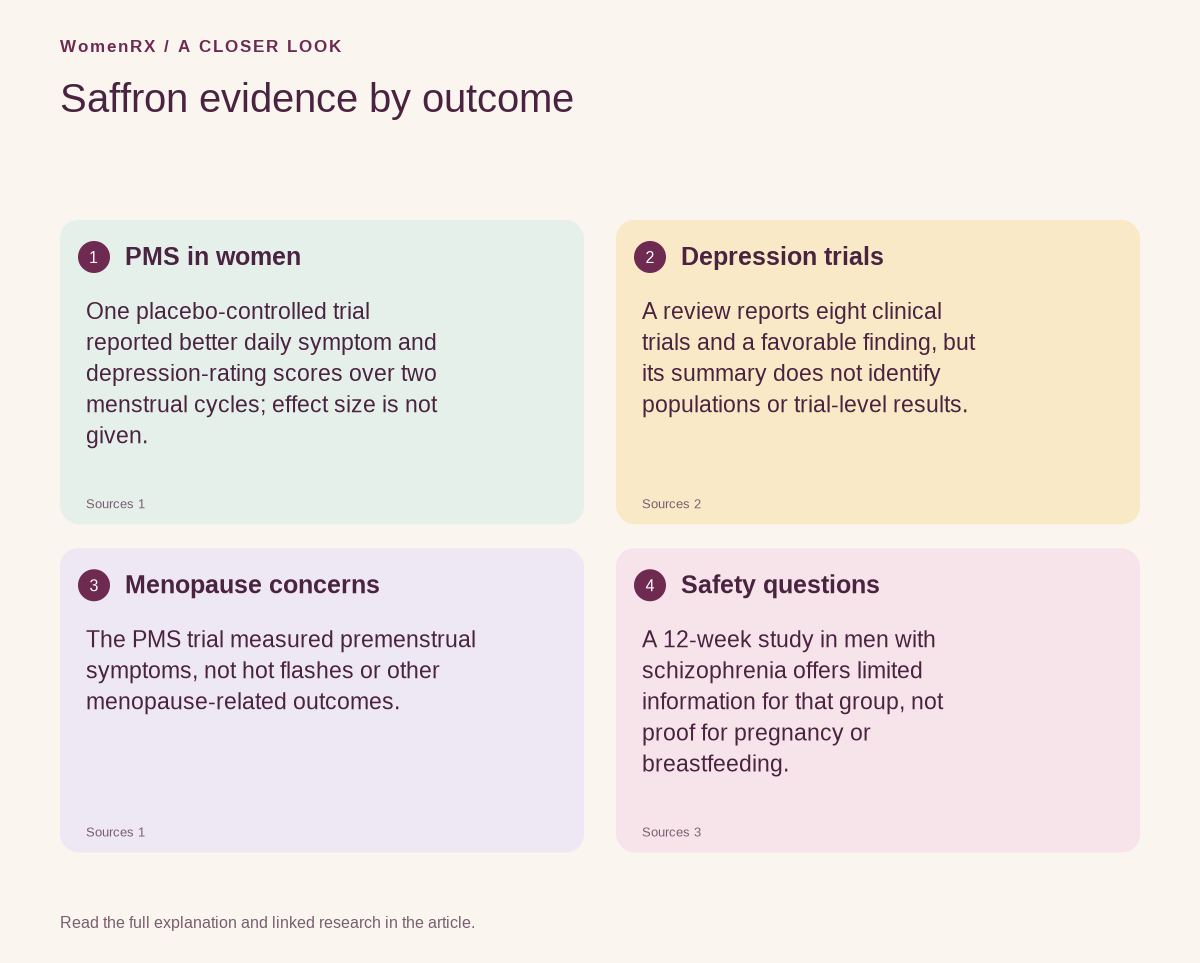
Saffron evidence by outcome
PMS in women: One placebo-controlled trial reported better daily symptom and depression-rating scores over two menstrual cycles; effect size is not given.1
Depression trials: A review reports eight clinical trials and a favorable finding, but its summary does not identify populations or trial-level results.2
Menopause concerns: The PMS trial measured premenstrual symptoms, not hot flashes or other menopause-related outcomes.1
Safety questions: A 12-week study in men with schizophrenia offers limited information for that group, not proof for pregnancy or breastfeeding.3
Read the figure as text
These findings differ by symptom and study population; a result in one setting cannot automatically be applied to another.- PMS in women: One placebo-controlled trial reported better daily symptom and depression-rating scores over two menstrual cycles; effect size is not given.1
- Depression trials: A review reports eight clinical trials and a favorable finding, but its summary does not identify populations or trial-level results.2
- Menopause concerns: The PMS trial measured premenstrual symptoms, not hot flashes or other menopause-related outcomes.1
- Safety questions: A 12-week study in men with schizophrenia offers limited information for that group, not proof for pregnancy or breastfeeding.3
More questions, answered
Does the PMS trial show saffron treats depression in general?
No. It found a difference in depression-rating scores among women in a PMS study. That does not establish saffron as a treatment for depression outside that setting. 1
Does the research establish a safe dose for a supplement?
No. The PMS trial reports the amount and preparation researchers used, but that is not a personal dosing recommendation or proof that a retail product is equivalent. 1
Sources you can check
- Crocus sativus L. (saffron) in the treatment of premenstrual syndrome: a double-blind, randomised and placebo-controlled trial.Agha-Hosseini M, Kashani L, Aleyaseen A, Ghoreishi A, Rahmanpour H, Zarrinara AR, Akhondzadeh S. · BJOG : an international journal of obstetrics and gynaecology · 2008Return to first citation
- Clinical Applications of Saffron (Crocus sativus) and its Constituents: A Review.Moshiri M, Vahabzadeh M, Hosseinzadeh H. · Drug research · 2015Return to first citation
- Safety evaluation of saffron stigma (Crocus sativus L.) aqueous extract and crocin in patients with schizophrenia.Mousavi B, Bathaie SZ, Fadai F, Ashtari Z, Ali Beigi N, Farhang S, Hashempour S, Shahhamzei N, Heidarzadeh H. · Avicenna journal of phytomedicine · 2015Return to first citation